SXF FIELD GUIDE / MODEL INTELLIGENCE · DECISION ENGINEERING
How to Choose the Best AI Model for Your Use Case:
Quality, Cost, Speed & Privacy
How to choose an AI model without guessing: a practical seven-step LLM model selection framework for coding, RAG, AI agents and business workflows. Compare real acceptance rates, latency, total cost, deployment requirements and privacy—and use the free interactive selection worksheet below.
How do you choose the right AI model?
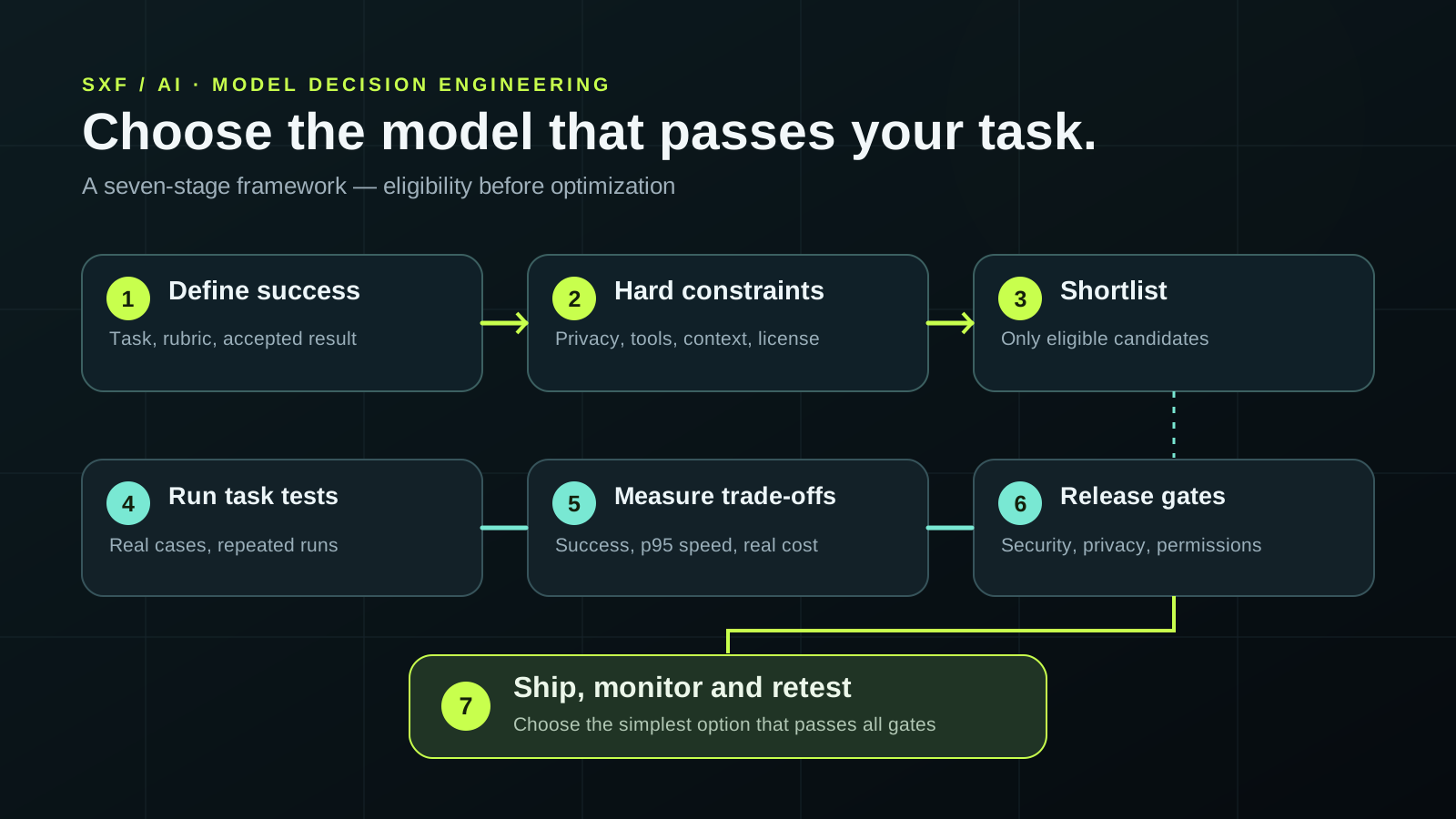
Start with the task, not the leaderboard. Specify what an accepted result looks like; eliminate models that violate context, privacy, modality or deployment requirements; evaluate 3–5 candidates on the same real tasks; measure verified accuracy, tail latency and cost per accepted outcome; then ship the simplest candidate that passes every non-negotiable requirement. This is more reliable than choosing the model with the highest generic benchmark score. Use the 7-step method, interactive selector, or cost calculator.
LLM MODEL SELECTION FRAMEWORK
The 7-step AI model selection framework
A model is only “best” relative to a workload, constraints and evaluation method. The decision has two distinct phases: eligibility (will it meet the requirement at all?) and optimization (which eligible option has the best verified trade-off?). Skipping phase one often produces an impressive demo that cannot be deployed.
Define the job and acceptance test
Write down representative inputs, expected outputs, failure consequences and the minimum acceptable completion rate. “Summarize contracts” is vague; “extract 12 fields with citations and no invented clauses” is testable.
Write the non-negotiable constraints
Check supported modalities, language, structured output, tool calling, region, licensing, maximum latency, context length, rate limits and data retention before evaluating quality.
Build a diverse shortlist
Include a frontier candidate, a balanced candidate and a lower-cost candidate. If local processing is mandatory, shortlist models you can actually host on your hardware.
Evaluate complete outcomes
Test the same tasks under consistent tool access, prompts, retries and reasoning settings. Record verified outputs and failure categories; do not trust a model grading itself without calibration.
Measure speed and economics
Track time to first token, p50/p95 end-to-end latency, input, output, cache and tool charges, retries and human review. Use cost per accepted task instead of cost per 1M input tokens.
Apply safety and privacy release gates
Validate the provider’s retention rules for the exact API/feature, access boundaries, logging, prompt-injection exposure and human approval for consequential actions.
Choose, monitor and retest
Pick the lowest-complexity model that passes. Pin versions when supported, create a fallback, record baseline metrics and rerun your evaluation when models or workloads change.
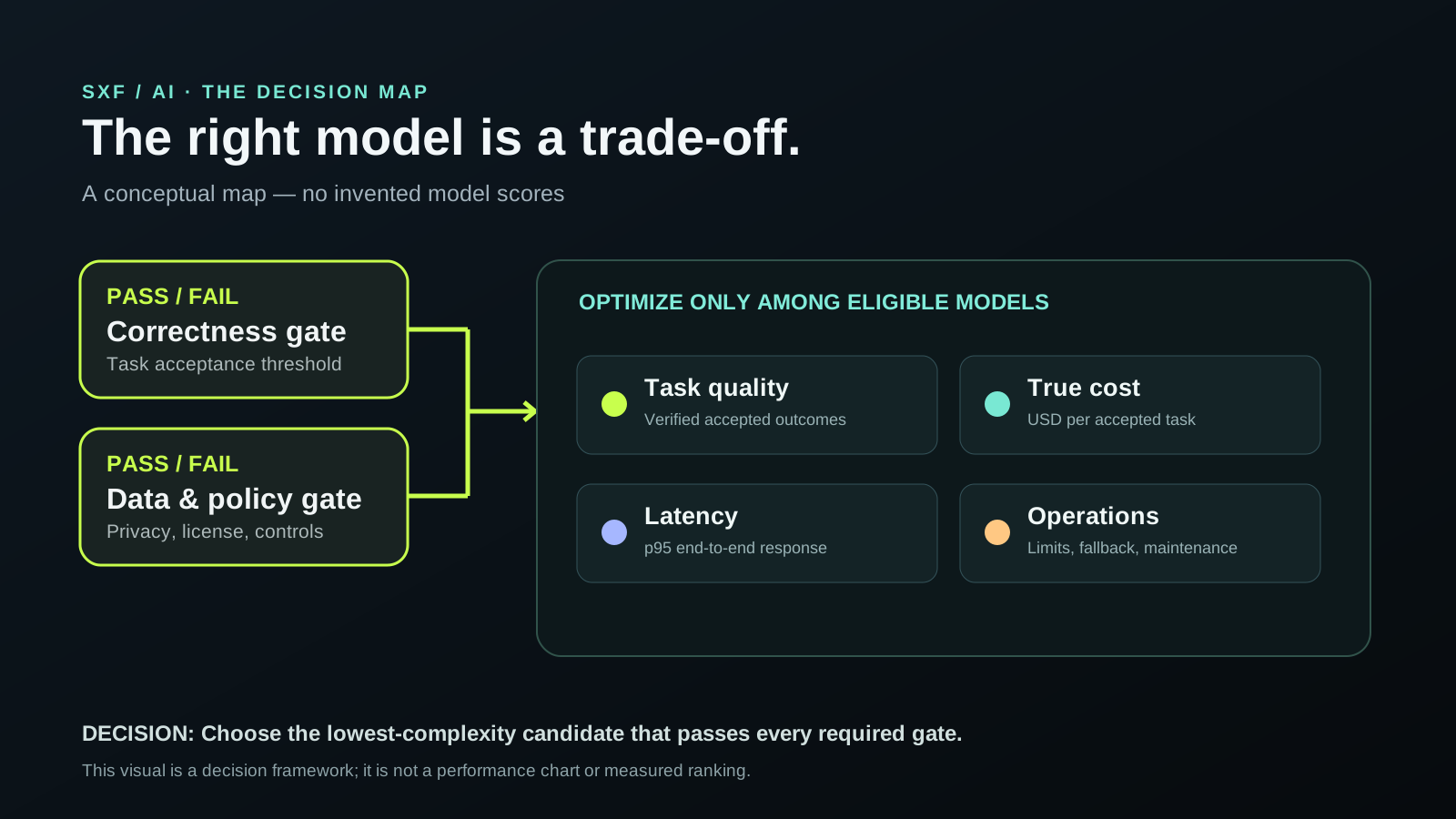
If a model fails privacy, license, policy or required correctness gates, its low token price cannot rescue it. Optimization happens only among eligible candidates.
MODEL CHOICE BY USE CASE
Choose an AI model by use case
“Best AI model for coding” and “best AI model for documents” are different search intents. Rather than recycle one universal leaderboard, test the metric that makes the application useful to its real user. These are starting points to test, not independent live rankings.
| Workload | Primary acceptance test | Essential capabilities | Operational bottleneck | Go deeper |
|---|---|---|---|---|
| Coding assistant | Tests pass; edits compile; no regressions | Repository context, tools, diffs, multi-file reasoning | Execution loops, debugging latency and tool cost | Coding tools |
| RAG / knowledge assistant | Grounded, cited answers; abstention when evidence is absent | Long-document reasoning, structured citations, retrieval integration | Retrieval quality and unsupported claims | RAG embeddings |
| Autonomous AI agent | Verified final state and authorized actions | Tool calling, recovery, instruction hierarchy, safety checks | Retries, tool failures, approval and leakage | Agent scorecard |
| Support / extraction | Correct fields or answers within SLA | Reliable JSON, multilingual response, efficient context | Volume, p95 latency, escalation rate | API pricing |
| Research and analysis | Traceable factual answers and clear uncertainty | Source use, reasoning, large documents and browsing where allowed | Verification and long-context charges | Benchmarks |
| Sensitive internal workflow | Outcome + verified data handling | Suitable regional deployment, local hosting or contractual controls | Governance, access and infrastructure cost | Local models |
Best AI model for coding: evaluate a real pull request
Use a small set of repository issues (bug fix, failing test, refactor, multi-file edit). Give candidates equal tool permissions, freeze dependencies, and require successful CI plus review. A solution that looks plausible but breaks the build fails. Track human fixes, iterations and total elapsed time. See the coding agent architecture field guide to separate model capability from orchestration quality.
Best model for RAG: evaluate evidence use, not memory size
Use a corpus with known answers, conflicting sources and absent information. Score retrieval recall, citation faithfulness, answer correctness and appropriate abstention separately. Test multilingual documents and how performance changes with long context. The embedding layer is a distinct decision: compare RAG embedding models here.
Best model for AI agents: test the task outcome
For agents, successful chat text is not proof of completed work. Capture tool traces and compare the final database, file or environment state to a ground truth. Retry the same scenario repeatedly, and include tool failures and revoked permissions. Our agent reliability research explains what a single benchmark run misses.
AI MODEL EVALUATION CRITERIA
What should you measure when comparing AI models?
A good scorecard separates measured results from published specifications and policy statements. Benchmarks are useful shortlisting signals, but they do not establish performance on your own data. The SXF benchmarks explainer covers Artificial Analysis Intelligence Index, AA-Briefcase, AA-LCR and GDPval-AA in depth; this guide translates that evidence into a buying and deployment decision.
| Metric | How to measure | What to avoid |
|---|---|---|
| Task quality | Verified accepted results / evaluated cases; stratify by scenario | One beautiful response, generic IQ-style rankings |
| Reliability | Repeat-run success, regression rate, valid outputs | Reporting only the best run |
| Speed | p50 and p95 full-task latency plus time to first token | Tokens/sec as a substitute for user response time |
| True cost | Input + output + cache + reasoning + tools + retries + review | Comparing only advertised input price |
| Context | Accuracy with realistic document lengths and noisy retrieval | Treating maximum window as guaranteed recall |
| Privacy | Endpoint-specific retention, region, contracts and logging audit | Assuming a generic “private” marketing label applies everywhere |
| Compatibility | Structured output validity, tool schemas, languages, modality tests | Inferring availability from model-family name |
| Operations | Rate limits, quotas, outages, version stability and fallback tests | Picking a preview model for a critical SLA without a contingency |
The NIST AI Risk Management Framework calls for appropriate metrics, ongoing evaluation and documented limits of generalizability. Your acceptance criteria should reflect the actual impact of errors, not just the convenience of a public leaderboard. [5] [9]
MODEL TRADE-OFFS
Quality vs cost vs speed vs privacy: what matters most?
These objectives compete, and the trade-off depends on your workload. Higher published quality does not guarantee lower end-to-end cost; a lower-cost model can become expensive if it fails more often or needs more review. For high-stakes deployments, privacy, policy and correctness are release gates—not weights to average away.
Research or high-impact decisions
Make factual correctness and reviewability dominant. Require citations, uncertainty handling and a review process; quality is a gate before cost optimization.
Live interfaces and voice
Use p95 response times with realistic concurrency. Short answers, smaller candidate models or routing can matter more than peak benchmark scores.
High-volume extraction
Test compact models and batch options, but use cost per valid record after retries and human rework rather than the cheapest input rate.
Regulated and sensitive data
Check allowed deployment, data residency, contracts and logging. Local/open-weight models add hosting and security obligations even when data never leaves your infrastructure.
OpenAI, Anthropic and Google each publish model-specific pricing and different caching, processing or retention terms. Compare the exact plan, endpoint and billing date rather than assuming an advertised “per million tokens” rate is complete. [1] [2] [3] [7] [8]
FREE INTERACTIVE WORKSHEET · ON-DEVICE
Interactive AI model selection worksheet
Choose your workload, deployment and dominant constraint. The worksheet gives a transparent shortlist to evaluate—not an invented real-time model ranking. It runs in your browser; input choices are not sent to a server by this widget.
COST PER VERIFIED OUTCOME
AI model cost calculator: what will your workflow really cost?
Calculate a transparent illustrative monthly estimate using your own token volumes, current vendor input/output rates and observed acceptance rate. The tool deliberately does not fetch live prices or silently invent cache discounts, tool fees or retry patterns.
For a deeper model-specific quote with cache, long context and published pricing periods, use the SXF AI Model Cost Calculator. For autonomous systems, read AI Agent Cost: TCO, Reliability & ROI—tokens alone are not an enterprise business case.
(input tokens × input rate / 1,000,000 + output tokens × output rate / 1,000,000 + extra cost per attempt) ÷ acceptance rateFor example, a lower model price that reduces acceptance from 95% to 65% may increase total unit cost despite cheaper tokens. Test the assumptions with your own data.
CURRENT MODELS · OCTOBER 2026
Which AI models belong on a 2026 shortlist?
Start with model families suited to the task, not a fabricated universal ranking. These are candidate categories visible in the SXF model catalog on October 17, 2026. New releases and deployments may change what is available; confirm up-to-date characteristics on linked model pages and vendor documentation.
| Decision hypothesis | Candidate examples to test | What would justify choosing one? |
|---|---|---|
| Demanding long-horizon tasks | GPT-6 Astra · Claude Opus 5.5 | Higher verified acceptance on hard tasks compensates for total cost and latency |
| Balanced production reasoning | GPT-6.1 Sol · Claude Sonnet 5.5 | Meets quality threshold with better observed operational economics |
| Low-latency / volume candidate | GPT-6 Luna · Claude Haiku 5.5 | Acceptable quality under the real response-time and throughput SLA |
| Self-hosted deployment | Mistral Small 4 · Gemma 4 31B | License, hardware, privacy, model quality and support all pass deployment requirements |
| Tool-heavy engineering | Claude Sonnet 5.5 · GPT-6.1 Sol | Tasks pass in your repository with permitted tools, valid outputs and acceptable cost |
The provider price and functionality picture changes rapidly. For latest catalog values, visit all AI model profiles, compare AI models side by side and the source-linked pricing database. For open models, compare open-weight licenses and hardware before making a hosting decision.
REPRODUCIBLE EVALUATION PROTOCOL
How to run a fair 50-task AI model evaluation
Below is an original evaluation plan, not a claim that SXF ran these 50 tasks against particular model APIs. Make a small, representative sample first, then scale the test set after you understand failure modes. Include difficult and adversarial examples; report your sampling limitations.
| Bucket | Cases | Evidence to collect | Gate |
|---|---|---|---|
| Routine successful tasks | 15 | Accepted output vs gold answer or verified state | Required quality |
| Long / ambiguous inputs | 10 | Correct interpretation, clarification or justified abstention | No unsafe guessing |
| Edge cases / format rules | 10 | Schema validation, rare language and difficult examples | Valid output |
| Failure / tool recovery | 10 | Error traces, retries, final system state and idempotency | Safe failure |
| Privacy / authority gates | 5 | Rejected forbidden actions, no disclosure of sensitive information | Zero critical violations |
- Freeze the test configuration. Record date, endpoint, model ID, model version, temperature, reasoning level, prompt, tools and input size.
- Use an independent grader. Verify code with tests, extracted data with golden labels and tool actions with actual backend state. Calibrate subjective graders against reviewers.
- Repeat meaningful trials. Measure run-to-run variability where stochastic behavior or tool dependence matters; keep failed calls in the denominator.
- Measure p95, not just average time. Include network overhead, tool calls and any review loop where they affect users.
- Report cost correctly. Track billable token categories, tool charges, retries and accepted outputs under the same traffic assumptions.
- Apply deployment gates. Model quality is irrelevant if it breaches data protection, permissions or required SLA.
- Ship with regression tests. Re-run the same test set after model updates and track real-world drift.
A model's own confidence score is not proof. A public benchmark is context. An accepted, independently verified workflow outcome under consistent conditions is decision evidence. Get the 25-test agent scorecard if your application takes actions.
AVOID FALSE WINNERS
Seven AI model selection mistakes to avoid
1. Picking the overall leaderboard winner. Aggregate benchmark scores can hide weak performance on your exact workload, language or tools.
2. Treating model names as stable specifications. Versions, context policies, model routing and deployment surfaces may change; capture exact IDs and dates.
3. Comparing input-token price only. Output tokens, reasoning, cache writes, tool calls, retries, manual review and failures can dominate cost.
4. Assuming long context equals reliable retrieval. Test where evidence appears and whether citations are faithful.
5. Using one successful demo as a reliability claim. Repeat trials and examine variation, tail latency and consequential failures.
6. Assuming an API’s privacy policy applies to every endpoint. Retention, application state and ZDR coverage may vary by provider and feature.
7. Publishing a universal top-ten ranking without data. If you have not measured real model outputs, present criteria and candidates instead of invented scores.
PEOPLE ALSO ASK
Frequently asked questions about AI model selection
How do I choose the best AI model for my use case?
Define the job and hard constraints, shortlist models that satisfy deployment and data rules, run the same representative tasks on each candidate, compare verified task success, p95 latency and cost per accepted result, and retest before deployment.
Which AI model is best for coding?
There is no universal winner for coding. Test real changes in your repository with a reproducible test suite, fixed tool permissions, the same token budget and independent acceptance checks. Evaluate coding-specific candidates rather than relying only on a general reasoning leaderboard.
What is the cheapest AI model?
The lowest input-token price does not necessarily mean the cheapest successful workflow. Calculate output, cache, reasoning, tools, retries and review, then divide by verified accepted tasks. Pricing changes by model, provider, region, tier and date.
How should I compare AI models fairly?
Freeze your test dataset and prompt, log the exact model version and reasoning settings, use the same tools and timeouts, run repeats, assess correct outcomes with a rubric or human review, and report uncertainty rather than a winner based on one prompt.
Should I choose a local open-source AI model for privacy?
Local deployment can reduce exposure to external inference providers, but it does not automatically ensure privacy. Check licensing, logging, network access, updates, access controls, stored embeddings, monitoring and the device or cloud host.
What matters more: model benchmarks or my own tests?
Public benchmarks are useful for discovery. Your own representative acceptance tests should make the final decision, because benchmarks may measure different abilities, versions, languages and operating conditions from your product.
Does a larger context window mean a better RAG model?
No. A larger advertised context window increases the amount of text a model can receive, but not necessarily retrieval precision, factual grounding or reliable use of information far from the start of a long document. Test retrieval and grounded answers separately.
When should I switch to a newer model?
Switch only when a challenger passes an agreed acceptance threshold, remains within latency and privacy limits, and delivers a meaningful improvement in cost or outcomes under production-like traffic. Keep a rollback path.
SOURCE LEDGER · VERIFIED OCTOBER 17, 2026
Research, official sources and editorial methodology
This guide combines primary vendor documentation, independent benchmark methodology and an original decision framework. The tables above are decision templates and candidate shortlists—not independently measured model performance results. We did not run vendor APIs or invent success rates for this page. Pricing, API availability and policy terms can change; recheck original documents before signing a production contract.
Editorial boundaries: interactive widgets run locally in the browser and use your inputs. They do not access a live model, benchmark server, vendor account or price feed. Examples were reviewed against public documents on October 17, 2026. No affiliate ranking or paid placement determines the shortlists.