SXF FIELD GUIDE / OPEN-WEIGHT AI · COMMERCIAL RIGHTS · ENTERPRISE PROCUREMENT
AI Model Licensing for Commercial Use:
Open Weights, Restrictions & Compliance
A practical, source-backed framework to assess commercial AI model rights. Compare MIT and Apache 2.0 with model-specific agreements, understand hosted SaaS vs redistributed weights and audit exact evidence—plus an executed SXF experiment and free due-diligence tool.
Can you use open-source or open-weight AI models commercially?
Often yes, but never decide from a license tag alone. Check which terms govern the exact weight release, whether the grant covers your commercial activity, what notices or attribution must accompany redistributed artifacts, and whether additional acceptable-use policies, trademarks, data rights or regulation apply. MIT and Apache 2.0 are permissive licenses, while custom model terms must be read individually.
A release being free to download does not mean the complete AI system satisfies the Open Source AI Definition or that your intended use has been legally cleared. Record provenance, obtain a human review and repeat it when changing models or business activity.
LEGAL & ENGINEERING GUIDE
What is AI model licensing—and can you use open-source AI commercially?
AI model licensing determines which rights a particular legal instrument grants over a specified model artifact, subject to its conditions. A company may be using an open-weight model for internal inference, offering a paid SaaS using that model, reselling access to a hosted inference API or distributing a modified checkpoint. These are not automatically the same contractual act.
Many permissive licenses allow commercial exploitation—but downloadable weights, a model-card license tag or an “open source” label do not independently prove permission for every activity. You must identify the exact released weights, version, governing license text and any incorporated acceptable-use terms, then evaluate the actual commercial deployment. See the SXF Open-Source and Open-Weight Model Guide for current model choices; this guide instead focuses on operational evidence and obligations.
For a commercial AI product: pin the weight artifact and license version; verify commercial, hosted-service, modification and distribution grants; preserve notices; review custom policies and independent laws; record legal review before deployment. This page supplies an audit framework, not a legal clearance.
FOUNDATIONAL DEFINITIONS
Open-source AI vs open weights vs source available: why the terms matter
| Term | What it normally indicates | What it does not automatically establish |
|---|---|---|
| Open-source software | A software license satisfying the Open Source Definition's freedoms | That model weights and training information are equally available |
| Open-source AI system (OSI definition) | Use, study, modify and share freedoms plus the preferred form for modification across system components | That every vendor calling a release “open source” satisfies the definition |
| Open-weight model | Numerical model parameters available under stated release terms | Access to training code/data details or unrestricted commercial redistribution |
| Source available | Some source or artifacts may be viewable | Freedom to sell, modify, redistribute or host commercially |
| Public or gated download | Files can be downloaded, possibly after accepting terms | That the model is public domain or has no license restrictions |
The Open Source Initiative's Open Source AI Definition 1.0 addresses the system-level freedoms and preferred form for modifications, including adequate training-data information, code and parameters. That is a broader test than “I can download model weights.” The licensing analysis remains artifact- and version-specific. OSI primary definition ↗.
LEGAL & ENGINEERING GUIDE
AI model licensing comparison: rights, restrictions and evidence
| Issue | MIT | Apache 2.0 | Model-specific custom terms |
|---|---|---|---|
| Commercial use | Broadly allowed under granted scope | Broadly allowed under granted scope | Must inspect exact model license and use policy |
| Modification / fine-tuning | Generally permitted for covered material | Generally permitted for covered material | Permissions and restrictions vary by model release |
| Redistribution of weights | Generally permitted if covered and required notices retained | Generally permitted subject to section 4 and notice conditions | May require naming, additional terms, size thresholds or restrictions |
| Attribution / license notices | Include copyright and permission notices | Keep license, required notices, modified-file notices and relevant NOTICE contents | Exact attribution/branding terms can differ |
| Patent treatment | No express patent license text comparable to Apache-2.0 section 3 | Contains express patent grant and termination provisions | Must read full text; do not assume a patent grant |
| Trademark / brand rights | Not a blanket trademark grant | Section 6 excludes trademark use other than limited descriptive purposes | May require special model naming or branding |
| Acceptable-use policy | Not inherently included in bare MIT grant | Not inherent in bare Apache-2.0 license | Can be incorporated into the custom agreement |
| Output and training-use restrictions | Check applicable scope and separate law | Check applicable scope and separate law | May include explicit model-specific conditions |
Neither MIT nor Apache-2.0 automatically gives rights to third-party datasets, personal data, unrelated trademarks or all model artifacts. A repository may contain differently licensed weights, source code, tokenizers or examples. For the actual texts see MIT and Apache 2.0.
A license-comparison table cannot establish whether a named model artifact is actually governed by that license. Confirm the complete license document, any model-specific addendum and the released revision before concluding anything about commercial use.
APACHE-2.0 COMPLIANCE
Apache 2.0 AI models: commercial use, NOTICE and patent clauses
Apache License 2.0 provides a permissive copyright grant and express patent terms, while imposing distribution conditions. Section 4 addresses reproducing the license, marking modified files, retaining required attribution notices and carrying applicable NOTICE contents when the original work includes a NOTICE file. Section 6 does not grant general rights to use licensors' trade names or trademarks.
For a downloadable model checkpoint, the reviewer must ask whether Apache-2.0 covers the weights themselves, the repository's code, or both. If you redistribute a modified model, record what was changed and package the license/required notices correctly. This is separate from the technical question of which inference server or quantization format you use.
Weight artifact: model-weights-v1.safetensors
Canonical publisher: https://example.org/REPLACE
Immutable revision / SHA256: [capture and verify]
Governing license text: Apache-2.0 [verify scope]
Use case: modified weights redistributed to paying customers
Evidence: license copy; NOTICE if present; modified-file notices;
         attribution and third-party component inventory
Reviewer: assigned person, date and documented conclusion
LEGAL & ENGINEERING GUIDE
MIT licensed AI models: what actually travels with a commercial product
The MIT License grants broad rights over covered material, including use, copy, modification, distribution, sublicensing and sale, subject to inclusion of the copyright and permission notice in copies or substantial portions. It is not a warranty or guarantee of ownership over every artifact a project bundles.
For commercial AI deployment, retain the actual licensor notice and record which materials are covered. Hosted inference may not involve giving users weights, while distributing an on-device model package does. Separate rights in training datasets, third-party components, branding and product claims remain separate.
LEGAL & ENGINEERING GUIDE
Custom LLM licenses: Llama, Gemma and version-specific usage conditions
Model-specific agreements can be designed for broad commercial adoption while imposing conditions absent from plain MIT or Apache 2.0. A contract may distinguish distributing the model itself from making model functionality available as a service, or incorporate an acceptable-use policy. The text and release version control.
| Example | Primary documents to inspect | What must not be assumed |
|---|---|---|
| Meta Llama 4 | Llama 4 Community License Agreement and associated Acceptable Use Policy | That a historical Llama license, general “commercial use allowed” claim or an older threshold applies unchanged |
| Google Gemma | The exact release's Gemma Terms of Use and referenced prohibited-use terms | That the word “open” or a repository badge removes custom conditions |
| Other custom model | Model release agreement, incorporated policies, license notice and version history | That a license tag in a model registry captures the complete contract |
| Permissively licensed alternative | Exact weight license, NOTICE and model/source card | That the training set and system as a whole meet the OSI Open Source AI Definition |
Llama 4 example: Meta's published Llama 4 agreement describes a monthly-active-user scale provision for organizations above a defined threshold and imposes naming/attribution conditions; those details need checking against the original text and your legal entities. Avoid generalizing the threshold to all Llama releases or to unrelated Meta systems. Read the Llama 4 agreement and its use policy before forming a deployment conclusion.
A model family name is not a governing contract. Capture the exact model and license release, effective agreement, terms accepted and authorized commercial activity, then have a qualified reviewer check the relevant provisions.
LEGAL & ENGINEERING GUIDE
Three real commercial deployment scenarios: SaaS, hosted API and redistributed weights
| Scenario | Engineering activity | Contract questions and evidence |
|---|---|---|
| A. Internal company SaaS | A private application calls open-weight models without sharing weights with end users | Is commercial internal use permitted? What terms govern provider hosting, sensitive data and output use? |
| B. Paid hosted inference API | Customers send prompts and receive responses; provider keeps weights | Does the custom agreement regulate offering hosted API/model services? Are there branding, scale or territory rules? |
| C. Modified checkpoint distribution | Fine-tune or quantize a model, then deliver weights to customers | Are modifications and distribution permitted? Which notices, copies, named restrictions and downstream terms must accompany the files? |
| D. Model embedded in client software | Ship on-device weights in an application or edge product | What redistributed artifacts and licenses accompany the install? What updates and customer rights apply? |
| E. Dataset/model training | Use outputs or weights in a new model or a training pipeline | Check output restrictions, training-use restrictions, dataset provenance and independent data rights |
Do not assume that access to a paid API means the customer has received model weights, or conversely that an API is outside all custom-license obligations. The definition of “distribution,” “service,” “derivative work,” “model materials” and “affiliate” varies by contract and legal setting.
LEGAL & ENGINEERING GUIDE
Fine-tuning, LoRA, quantization and model redistribution: what changes?
- Track the original weight artifact: canonical source, revision, hash and governing license.
- Track transformation provenance: fine-tuning dataset rights, adapters, merged weights, quantization process and changed files.
- Record new package contents: converted tensors, tokenizer, config, runtime code and accompanying model cards; licenses can differ.
- Review redistribution grants: where the modified weights go, which legal entities receive them, and whether extra obligations arise.
- Preserve obligations: license copies, notices, copyright statements, relevant NOTICE contents and change indicators.
- Version the final decision: a new upstream checkpoint or model-card change requires renewed inspection.
The engineering details of memory reduction are in LLM Quantization Explained; deployment mechanics are in How to Run AI Models Locally. Here the issue is licensing the original and redistributed artifacts, not benchmarking their speed.
SXF ORIGINAL FRAMEWORK
The SXF AI license evidence chain: from model card to sign-off
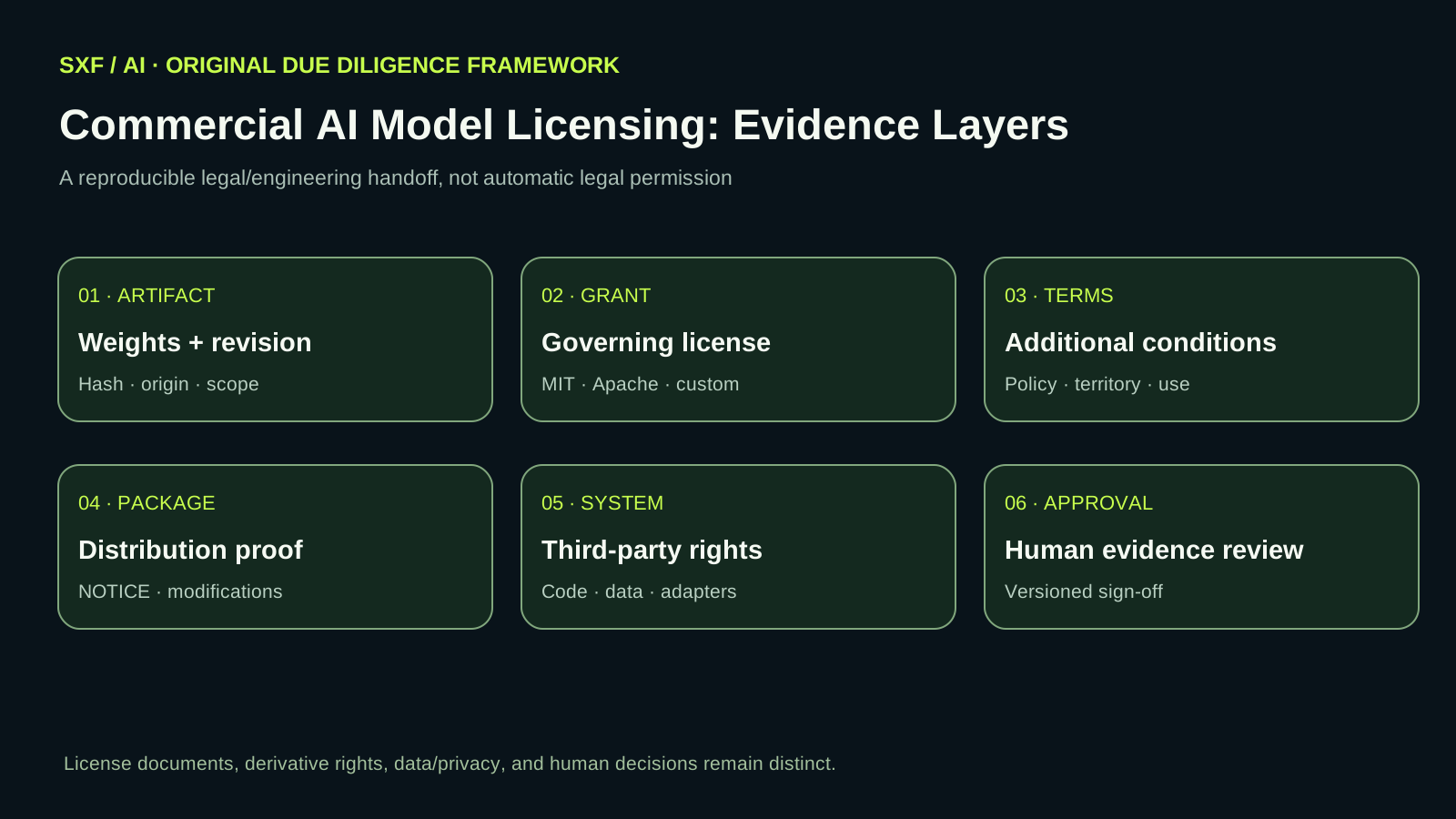
A compliant review starts with a reproducible evidence record. Merely keeping an SPDX-style string such as Apache-2.0 cannot establish which weights it covers, what a customer is allowed to receive or whether referenced policies affect the deployment.
| Evidence layer | Record or artifact | Who verifies |
|---|---|---|
| Origin and hash | Publisher URL, immutable weight revision, file digest | ML engineering / supply chain |
| Governing text | Complete license and release-specific terms | Legal and engineering |
| Incorporated terms | Acceptable-use policy, territory, scale limits and effective versions | Legal / procurement |
| Shipping proof | LICENSE, attribution, NOTICE, change statements, SBOM/model inventory | Release engineering |
| Independent rights | Dataset and adapter permissions, trademark and privacy analysis | Legal / privacy specialists |
| Approval trail | Reviewed use case, owner, exceptions, next renewal trigger | Accountable business owner |
EXECUTED ORIGINAL SXF LAB
SXF original experiment: why an AI model license tag is not an evidence packet
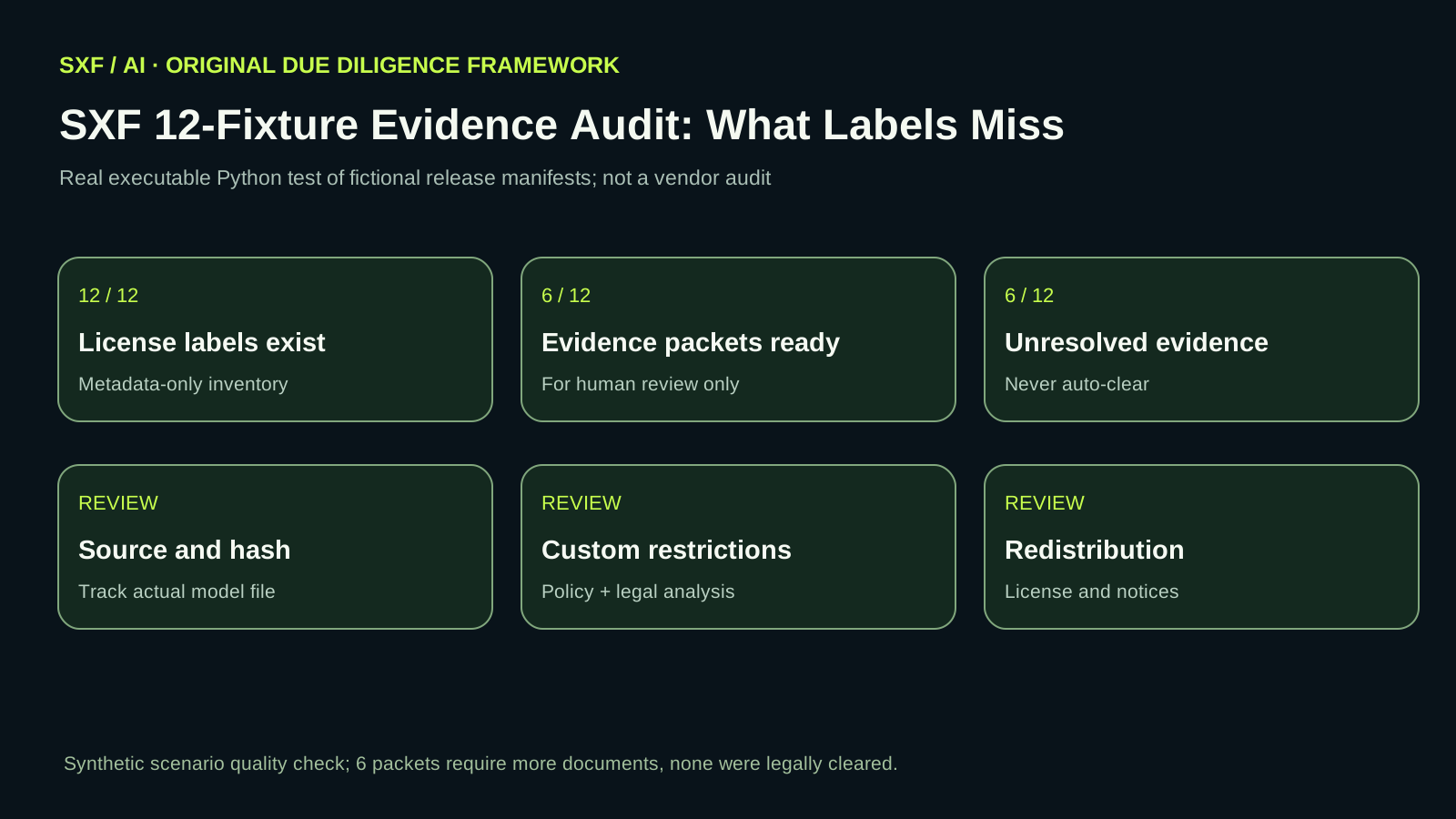
We designed and executed a deterministic Python experiment comprising 12 synthetic model release manifests. Each record carried a license label (MIT, Apache-2.0 or a fictional custom license), a deployment type and several evidence flags. We compared a naive rule—“license label present”—with a minimal auditable packet that also requires an origin, pinned revision, full license, model card and use-specific supporting documents.
| Test finding | Observed result | Scope |
|---|---|---|
| Synthetic manifests containing license labels | 12 of 12 | All fixtures have a metadata label |
| Packets meeting the simplified evidence criteria | 6 of 12 | Documentation ready for human review |
| Packets requiring further documentation | 6 of 12 | Unresolved, not automatically rejected as illegal |
| Commercial rights automatically cleared | 0 | The code does not issue legal permissions or legal verdicts |
The experiment flags missing source revision, missing full license, unreviewed custom-use policies or missing redistribution copies and notices. It does not inspect real commercial model licenses, determine copyright ownership, decide whether permissions exist or provide statistical prevalence estimates. The design demonstrates an engineering improvement: converting an unverified marketing label into a versioned human-review evidence package.
These are 12 deliberately fictional cases, not a representative survey of actual publishers. “Ready for review” means required files were present under our simplified rules; it is not a release approval, a compliance certificate or legal advice.
Reproduction: run python sxf-license-evidence-lab.py. The script uses only the Python standard library, makes no network requests and contains assertions checking the results.
SXF INTERACTIVE TOOL
Interactive SXF AI Model License Due Diligence Checklist
Use the tool below to generate an evidence-gathering plan for a commercial model use case. It does not analyze private contracts, approve any vendor or make legal conclusions. Inputs stay on your device.
The output is a documentation checklist, not a permission engine. A green evidence record cannot replace reviewing contractual wording, jurisdiction, third-party rights or current regulation.
LEGAL & ENGINEERING GUIDE
AI model governance: data rights, trademarks, privacy and copyright remain separate
| Layer | What can go wrong | Required due diligence |
|---|---|---|
| Weights license | The publisher grants less than assumed or custom conditions apply | Verify source/revision, grant scope and restriction text |
| Training data | Personal/third-party content has independent rights or transparency requirements | Data provenance, copyright/privacy counsel assessment |
| Fine-tuning data | Contracts do not authorize reuse to improve models | Collection rights, retention and consent/legal basis |
| Model outputs | Rights, privacy, branding or prohibited use can affect deployment | Output policies, provenance and use-case review |
| Trademark / product claims | Model name usage implies endorsement | Brand rules and no misrepresentation |
| Dependencies | Tokenizers, adapters, training and inference code carry different licenses | Component-by-component inventory / SBOM |
| Geography / industry | National law, export controls or sector rules apply | Jurisdiction and role-based compliance review |
The risk is not limited to a particular open model. A permissive weight license is one legal instrument; it does not pre-approve healthcare uses, copyrighted training inputs, personal data processing or trademark advertising.
LEGAL & ENGINEERING GUIDE
EU AI Act and open-source model exemptions: what companies must distinguish
Do not assume “open source” means “EU AI Act exempt.” The EU AI Act distinguishes actors and obligations—including providers of general-purpose AI models, deployers and systems with particular risk profiles. Open-source-related exceptions are conditional and do not remove every obligation; special rules can continue to apply to general-purpose AI models with systemic risk. The applicable dates, guidance and any later amendments should be checked for the precise model and business role.
For a real EU-facing launch, begin with the actual EU AI Act regulation and the European Commission's guidance; document whether your organization is merely deploying an already-provided model or creates a legally relevant new system or model provider role. Assess obligations separately from license permissions.
This guide is not a substitute for EU regulatory advice. The relevant risk category, provider/deployer role, open-source conditions, systemic-risk designation and compliance dates must be established on the date of the actual release.
LEGAL & ENGINEERING GUIDE
Enterprise procurement checklist: what evidence should vendors actually provide?
| Question for model host / vendor | Evidence needed |
|---|---|
| Which weights and release are you serving? | Model ID, provenance, checkpoint digest, version history |
| Who owns the commercial grant? | Full license text and chain to published model artifacts |
| Can we host or resell an API? | Specific contractual rights and hosted-service definitions |
| Can we ship fine-tuned or quantized weights? | Modification/distribution terms and required notices |
| Are there usage, territory or scale restrictions? | Complete use policy and current commercial thresholds |
| Are output and training rights constrained? | Separate terms covering outputs and model training |
| What happens after a terms update? | Versioning, grandfathering or migration clauses if documented |
| What about datasets and third-party components? | Model card, component inventory and known limits |
| Who signs off internally? | Named legal owner, procurement reviewer and versioned decision |
LEGAL & ENGINEERING GUIDE
Step-by-step AI model licensing audit for real deployments
- Define use: identify the operating company, customers, product, territory and whether weights leave your systems.
- Pin artifact: exact canonical release, revision, SHA256 and all components in the deployment bundle.
- Read the full grants: MIT, Apache-2.0 or custom text as applied to each relevant component—not repository metadata alone.
- Collect incorporated policies: restricted uses, versioned acceptable-use terms, thresholds, branding and third-party conditions.
- Prepare notices: copyright, LICENSE, NOTICE when applicable, modification labels and downstream files.
- Separate legal layers: data rights, privacy, industry regulation, export, trademarks and the EU AI Act where relevant.
- Get human sign-off: record reviewer, decision scope, unresolved questions and evidence references; never “auto-approve” from tags.
- Gate deployment: block or escalate launch for missing mandatory evidence or unapproved high-risk conditions.
- Recheck on change: new model or checkpoint, weights redistribution, country expansion, modified policy or new customers.
LEGAL & ENGINEERING GUIDE
Ten AI model license mistakes that create hidden commercial risk
- Treating a public weights download as a blanket commercial license.
- Conflating a permissive repository code license with the released checkpoint's license.
- Assuming the “open-source AI” label satisfies the system-level OSI definition.
- Assuming a Llama license applies identically across all Llama versions.
- Distributing quantized weights without checking original terms and notices.
- Copying “MIT” or “Apache” into a spreadsheet without the actual source and license text.
- Ignoring model-specific acceptable-use terms incorporated by reference.
- Using a model brand in marketing without checking trademark constraints.
- Confusing weight license permissions with AI Act, privacy or training-data obligations.
- Publishing automated “legally approved” badges without qualified human review.
LEGAL & ENGINEERING GUIDE
Frequently asked questions about commercial AI model licenses
Can I use an open-source AI model commercially?
Often, but you must inspect the exact weight artifact and governing terms. Permissive licenses such as MIT and Apache-2.0 can grant commercial permissions subject to conditions. A public download or 'open' marketing label is not sufficient evidence.
Are open weights the same as open-source AI?
No. Publicly available weights alone do not establish the Open Source AI Definition's freedoms and preferred form for modification; related code and training-data information also matter.
Does an Apache 2.0 AI model allow commercial use?
Apache-2.0 is a permissive license generally allowing commercial use and redistribution subject to its terms. Confirm it actually governs the weights and check notices, modification obligations, patents and third-party rights.
Can I commercially use a model under the MIT License?
MIT is permissive and generally permits commercial use of the licensed material while requiring the copyright and permission notices to be included in copies or substantial portions. Scope and other rights require verification.
Can I sell an API powered by Llama?
You must review the exact Llama release's custom license and acceptable-use policy for the hosted service, threshold rules, branding and any restrictions. Do not infer rights from the name 'Llama' alone.
Is hosting model weights behind an API the same as redistributing them?
Not necessarily. Hosted inference, delivering weights to customers and distributing a modified checkpoint can be distinct activities; contract definitions and applicable law determine relevant conditions.
What changes when I fine-tune or quantize open weights?
You need to check permissions and obligations covering modifications, new artifacts, attribution, redistributed checkpoint packaging, third-party dependencies and any derivative use restrictions.
Is a Hugging Face license tag enough for legal compliance?
No. A license field is useful metadata, but the actual version-specific legal text, model card, referenced policies, provenance and artifact scope must be reviewed.
Does open-source licensing exempt an AI provider from the EU AI Act?
Do not assume a blanket exemption. Certain open-source-related exemptions are role- and condition-specific, and some obligations can remain, particularly for systemic-risk models. Consult the EU AI Act and current Commission guidance for your role and release.
Does an AI model license cover training data, trademark and privacy?
Not automatically. Training-data rights, third-party material, trademark/branding, privacy, consumer law and sector obligations can arise independently.
How do I audit an AI model license before production?
Pin the weights' revision and source, collect governing licenses and incorporated terms, map the intended commercial activity, prepare notices and third-party inventories, resolve jurisdictional requirements, and obtain human sign-off.
Can an AI license checker automatically approve a model?
No general automated checker can reliably replace contractual and legal analysis. Automated evidence checks can flag missing documents but cannot prove permission, resolve ambiguous restrictions or replace a qualified review.
PRIMARY LEGAL MATERIAL
Primary documents, research methodology and legal limitations
Primary-document-first policy: this guide uses the official license texts, OSI definitions, publisher model agreements and EU primary regulatory text. All model-level claims are version-dependent. For publication and procurement, confirm that links resolve to the current relevant release and keep an archived, timestamped evidence package for each deployment.
The original twelve-fixture evidence audit contains invented releases and real executable Python checks. No named vendor model's license was automatically scanned or certified. The rules test missing records, not legal rights. This is technical educational material, not legal advice or a representation by a licensed attorney.