SXF RESEARCH / AGENT EVALUATION
Are AI Agents Reliable in 2026?
12 Metrics Benchmarks Miss
AI agents can write code, browse websites, operate software and execute multi-step workflows. But “it passed the benchmark” is not the same as “you can depend on it.” This research-backed field guide separates capability from reliability and shows how to measure whether an agent succeeds repeatedly, survives changed conditions, recognizes its limits and fails without creating unacceptable damage.
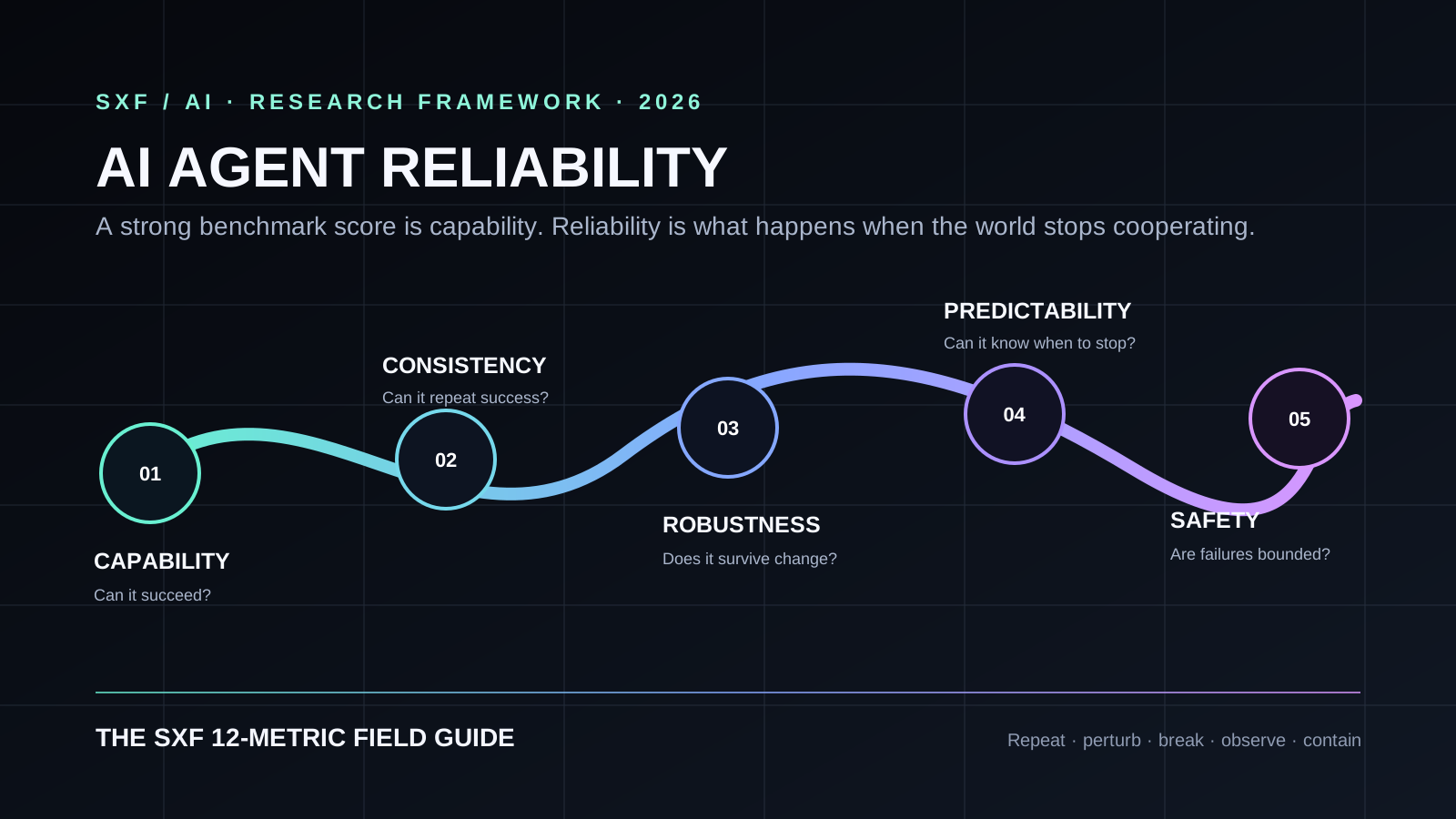
AI agents are not simply “reliable” or “unreliable.” Reliability is conditional — and it has to be measured across repeated runs, changed conditions and failure states.
The strongest evidence in 2026 points to the same conclusion from several directions: benchmark accuracy can improve faster than operational reliability. An ICML 2026 study evaluated frontier agents using a multidimensional reliability profile and found that capability gains produced only small improvements in reliability. METR measures how task success changes as software tasks become longer. NIST now treats real-world AI evaluation as a broader test, evaluation, verification and validation problem. For deployment, the practical question is therefore not “what score did the model get?” but “under the exact conditions that matter to us, how often does the full agent system succeed, how does it fail, and what happens after the first failure?”
DEFINITION
What does “AI agent reliability” actually mean?
AI agent reliability is the degree to which an agent performs its intended function dependably under stated operating conditions — including repeated executions, reasonable variations in input and environment, tool or API failures, uncertainty, and unexpected intermediate states.
That definition is intentionally stricter than “the agent got the answer right.” An agent is a system that can observe, decide, call tools, modify state and continue acting. Reliability therefore belongs to the whole loop: model, prompts, tools, memory, permissions, environment, orchestration, retries, graders, human approvals and recovery logic.
This is why a strong language model can sit inside an unreliable agent, and why a weaker model can sometimes participate in a reliable workflow when the system constrains the task, validates actions and handles failure well. The underlying model matters, but it is not the whole product.
Can it do the task?
Measures whether the system can reach a correct end state under the evaluation conditions.
Can you depend on how it behaves?
Measures repeatability, graceful degradation, failure awareness, cost stability and bounded consequences.
For a primer on the agent loop itself, see What Is Agentic AI?. For the security side of the same execution loop, see AI Agent Security in 2026.
THE CENTRAL DISTINCTION
A benchmark can prove capability without proving reliability
Suppose an agent completes 90 of 100 tasks in a benchmark. That is useful information: under that setup, its average task success rate was 90%. It does not tell you whether the same task would succeed five times in a row, whether a harmless rewording would change the result, whether a rate-limited API would cause a cascade, whether the agent knows when it is stuck, or whether the 10 failures are minor mistakes or catastrophic actions.
That distinction matters because production systems are exposed to distributions, not screenshots. Users phrase the same intention differently. Websites change. API schemas drift. Files are missing. Network calls time out. Memory can contain stale state. An agent may receive the correct data in an unfamiliar order. Reliability asks what happens across that operational envelope.
If a task has a 90% independent success probability on one run, the probability of five successful runs in a row is only 0.90⁵ ≈ 59%. Real agent runs are not perfectly independent, but the example shows why a high single-run number can still feel unreliable in repeated use.
The reverse can also happen: an agent may fail consistently on a difficult task. That system is low-capability for the task but highly predictable. Production engineering needs both pieces of information because consistent failure can be routed, blocked or escalated; intermittent failure is often harder to diagnose and govern.
2026 EVIDENCE
What current research says about AI agent reliability
The most direct 2026 evidence comes from Rabanser et al., “Towards a Science of AI Agent Reliability”, published at ICML 2026. The authors argue that one accuracy score hides operational properties that matter in deployment and propose a reliability profile across four dimensions: consistency, robustness, predictability and safety. Across the agents and benchmarks they studied, capability gains translated into much smaller improvements in reliability.
METR's time-horizon evaluations make a different but complementary point. They estimate the human task duration at which an AI agent reaches a specified success probability. The measure is not “how long an agent can stay awake”; it links task difficulty, approximated by expert human completion time, to a probability of agent success. METR reports both 50% and 80% time horizons, which is a useful reminder that the reliability target changes the answer.
ReliabilityBench, a 2026 preprint, explicitly stress-tests repeated execution, semantically equivalent prompt changes and injected tool/API faults such as timeouts, rate limits, partial responses and schema drift. Its value is methodological: a production agent should be tested not only on clean tasks but also on realistic failure conditions.
The evaluation ecosystem is moving in the same direction. NIST's TEVV-Athlon framework is designed to support real-world evaluation across many kinds of AI systems, including agentic systems. NIST's 2026 ARIA evaluation planning manual combines model testing, red teaming and user testing. Anthropic's agent-eval guidance emphasizes multiple trials and transcript inspection. OpenAI's current agent-evaluation documentation emphasizes traces, tool calls, handoffs and structured graders rather than judging only the final text.
SXF FIELD GUIDE
The 12 metrics that reveal whether an AI agent is actually reliable
Do not collapse reliability into one vanity number. Start with a capability baseline, then build a profile. The following 12 measurements are designed to expose different ways an agent can look strong in a leaderboard and still fail in real use.
Repeated-run success
Run the identical task multiple times. Report both per-run success and the fraction of tasks that succeed on every repetition. This is the clearest test of whether a success is reproducible rather than lucky.
Outcome variance
Measure how often identical starting conditions produce materially different end states. An agent that alternates between approve and deny, deploy and abort, or correct and incorrect is operationally unstable even when average accuracy looks acceptable.
Trajectory stability
Compare the tools and action sequences used across repeated successful runs. Different paths are not automatically wrong, but large unexplained path variation makes auditing, debugging and interruption recovery harder.
Resource stability
Track variance in tokens, tool calls, wall-clock time and monetary cost. A task that costs $0.20 on one run and $6 on another may be functionally correct but operationally unreliable.
Prompt-paraphrase robustness
Rephrase the same intent without changing requirements. Measure how much success changes. The user should not need to discover a fragile magic wording for a normal task.
Tool-fault tolerance
Inject timeouts, rate limits, empty payloads, partial responses, stale results and recoverable errors. Measure whether the agent retries safely, switches strategy, asks for help or silently corrupts the workflow.
Environment & state robustness
Vary harmless details of the environment: file order, page layout, record ordering, session state or irrelevant distractors. Reliability requires stable task intent even when the surface changes.
Confidence calibration
Compare the agent's stated confidence or verifier score with actual success. A useful confidence signal should separate likely successes from likely failures rather than sounding certain all the time.
Failure detection & escalation
Measure whether the agent recognizes conditions it cannot safely complete and escalates before taking a damaging action. “I need approval” can be a reliability success, not a capability failure.
Recovery predictability
When a step fails, classify the recovery path: retry, alternate tool, rollback, ask user, stop or continue. The agent should not improvise a different high-risk recovery strategy each time.
Severity-weighted failure
Count failures by consequence, not only frequency. One irreversible data deletion can matter more than 100 formatting mistakes. Reliability engineering cares about the tail of the loss distribution.
Failure containment
Measure how far an error propagates before controls stop it. In long or multi-agent workflows, a local mistake should not automatically become a customer message, production deploy, payment or permission change.
CONSISTENCY
The first reliability test: can the agent succeed more than once?
Repeated trials are the simplest reliability upgrade most teams can make. The same task should be run several times from the same initial state. Five repetitions are enough to reveal obvious instability; higher-consequence workflows need more evidence and a statistically justified test plan.
A useful distinction is pass@k versus pass^k. In coding research, pass@k usually asks whether at least one of k attempts succeeds — a best-of-many capability question. Reliability needs the opposite pressure: does the system keep succeeding? ReliabilityBench uses pass^k to represent strict repeated success. The ICML reliability work makes a similar conceptual distinction between best-case capability and repeated-run consistency.
| Measure | Question answered | Why it matters |
|---|---|---|
| Pass@1 | Did one ordinary run succeed? | Basic capability baseline. |
| Pass@k | Did at least one of several attempts succeed? | Useful when retries are cheap and you can select the correct result. |
| Pass^k | Did all repeated attempts succeed? | Captures strict consistency for workflows that must work repeatedly. |
| Cost / latency variance | Did repeated successes consume similar resources? | Exposes loops, wandering and unpredictable operating cost. |
Do not hide retry policy. An “agent success rate” measured with ten invisible retries is a different product from one measured on the first attempt. Report the retry budget, selection logic and total cost alongside the result.
ROBUSTNESS
A reliable agent should survive normal change — and fail gracefully when dependencies break
Real users do not reproduce benchmark prompts character for character. Real APIs do not return ideal responses forever. Robustness testing deliberately changes conditions while preserving the underlying goal.
Test semantic equivalence, not prompt memorization
Create several versions of each task that preserve the same constraints but change wording, order, irrelevant details or presentation. If performance collapses, the benchmark may be measuring prompt fit rather than operational understanding.
Inject failures before production injects them for you
Tool-using agents need chaos testing. Introduce controlled timeouts, 429 rate limits, 500 errors, missing fields, partial tool responses, stale pages and changed schemas. Record not only whether the final task succeeds but also whether the recovery behavior is safe.
Stop + explain
The agent cannot verify a required fact, so it stops and asks for the missing input.
Retry + bound
The agent retries a transient tool error within a defined budget and then escalates.
Guess + act
The agent fills a missing value with an assumption and executes a consequential action.
This connects directly to prompt injection and agent security: robustness is not only about benign errors. External content can be adversarial, and a reliable agent must keep untrusted context from silently becoming authority.
PREDICTABILITY
The best agent is not the one that never fails. It is the one whose limits you can detect before failure becomes expensive.
Many production workflows can tolerate imperfect capability if uncertainty is visible. A support agent that knows when to hand off can be safer than a more capable agent that confidently improvises outside policy. A coding agent that flags an unverified migration can be more dependable than one that always declares completion.
Predictability therefore needs more than “confidence” text generated by the same model. Build external signals from tool errors, verifier results, constraint checks, test suites, missing evidence, repeated disagreement and trace patterns. Then measure whether those signals actually predict failure.
Three questions to ask
Calibration: when the system says a task is high-confidence, is it actually more likely to be correct? Selective accuracy: if the agent is allowed to abstain on its least certain cases, does accuracy on the remaining cases improve? Escalation quality: does it ask for human help before the irreversible step rather than after it?
Trace-level evaluation is especially useful here. Current agent-evaluation guidance from both Anthropic and OpenAI emphasizes inspecting the sequence of tool calls and intermediate decisions, because the final answer alone often hides where a workflow started to go wrong.
SAFETY
Reliability includes what happens on the worst run, not only the average run
An agent that succeeds 99 times and deletes production data on the 100th run is not “99% reliable” in any useful operational sense. Safety changes the metric from frequency to consequence.
For every failure class, assign a severity level based on reversibility, affected data, external visibility, financial impact, security impact and human recovery effort. Then test whether architectural controls prevent a model error from becoming a high-severity system action.
The model can be wrong without the system being dangerous. A reliable agent architecture assumes reasoning errors will occur and places authorization, validation, approval, sandboxing, transaction limits and rollback around the model.
High-impact actions should be gated independently of model confidence. The agent should not decide for itself that it is “certain enough” to bypass an authorization boundary. See the production controls in AI Agent Security and the orchestration patterns in How to Build an AI Super Agent.
BENCHMARK MAP
Which AI agent benchmarks are useful — and what do they not prove?
No single leaderboard answers “is this agent reliable?” because different benchmarks measure different environments, task families and success criteria. Use benchmarks as instruments, not verdicts.
| Benchmark / framework | What it helps measure | Reliability caveat |
|---|---|---|
| GAIA | General assistant tasks requiring reasoning, tools and information gathering. | A benchmark score does not automatically reveal repeated-run variance or your production tool stack. |
| OSWorld / OSWorld 2.0 | Open-ended computer-use tasks across real desktop and web applications. | Excellent for environment interaction, but your apps, permissions and failure costs may differ. |
| SWE-bench Verified | Software-engineering tasks grounded in real repositories and human-validated issues. | Coding success does not transfer automatically to browser, business or safety-critical workflows. |
| METR time horizon | How success probability changes with software-task difficulty measured using human task duration. | Primarily software tasks; time horizon is not literal autonomous runtime. |
| ReliabilityBench | Repeated execution, paraphrase robustness and controlled tool/API faults. | Useful methodology, but it is a 2026 preprint with a limited model/architecture sample. |
| NIST TEVV / ARIA | Structured evaluation planning across model testing, red teaming, user testing and real-world outcomes. | A framework for rigorous evaluation, not a single agent leaderboard. |
Benchmark contamination is another reason to avoid treating leaderboards as production guarantees. NIST and Google DeepMind have both highlighted methods for reducing contamination or evaluation gaming. A benchmark can be technically valid and still be insufficient for your use case; it can also become less informative as systems optimize against it.
PRACTICAL PROTOCOL
How to test an AI agent before you trust it in production
A useful reliability evaluation starts with your actual workflow, not a famous benchmark. Build the test around the consequences the agent will face.
List the tasks, tools, data sources, permissions, expected environments, retry budgets and actions the agent is allowed to take.
Use real anonymized workflows, edge cases and known historical failures. Separate easy, normal and difficult tasks instead of averaging them into one opaque bucket.
Repeat each task from a reset state. Record outcome, trace, time, tokens, tool calls and cost. Do not keep only the best run.
Paraphrase instructions, reorder nonessential information, change harmless layout details and vary realistic initial states.
Test timeouts, rate limits, partial data, missing fields and stale responses. Verify retry limits, escalation and rollback.
Test exactly where the agent must ask for approval, refuse, defer or stop. Verify downstream authorization independently.
Read failed and borderline trajectories, validate graders, then monitor live drift. Pre-deployment evals become stale as models, tools, prompts and user behavior change.
NIST's 2026 work on monitoring deployed AI systems emphasizes this last point: controlled pre-deployment evaluation is necessary, but real-world monitoring is needed because nondeterminism and changing inputs can reveal behavior that a lab setup did not capture.
FAILURE TAXONOMY
The failure modes you should label instead of writing “agent failed”
A single failure bucket hides the engineering signal. Label failures by where they enter the loop and what the system does afterward.
Wrong decomposition
The agent chooses an invalid plan, misses a constraint or executes steps in a harmful order.
Right goal, wrong capability
The agent calls the wrong tool or uses a broader tool than the task requires.
Correct tool, wrong arguments
IDs, dates, recipients, paths, quantities or scopes are extracted incorrectly.
Stale or lost context
The workflow acts on an outdated page, memory entry, file version or partial result.
False completion
The agent reports success without checking that the external state actually changed as intended.
Error becomes loop
Retries repeat the same failed strategy, consume budget or multiply side effects.
Untrusted context gains authority
External content or another agent changes behavior beyond intended policy.
Local failure becomes system failure
An unchecked mistake propagates into messages, commits, deployments, payments or permissions.
DEPLOYMENT DECISION
So when should you trust an AI agent?
Do not ask whether the agent is trustworthy in the abstract. Ask whether the system is reliable enough for a defined task with defined consequences.
A low-impact research agent may be useful with modest success because a human reads the output before acting. A coding agent that opens a draft pull request can tolerate more uncertainty than one that deploys directly to production. An agent that changes financial records, permissions, customer commitments or safety-critical state needs stronger evidence, independent authorization and tighter containment.
Assist + verify
Use the agent to draft, summarize or research where human review is naturally part of the workflow.
Act + observe
Allow bounded actions with logging, easy rollback, limited permissions and tested recovery paths.
Gate + constrain
Require independent validation, explicit authorization, human approval and hard limits on what the agent can change.
The goal is not to wait for a mythical perfectly reliable agent. The goal is to engineer a system in which the measured failure profile matches the consequence profile of the job.
Execution environment, autonomy and governance matter as much as the underlying model.
Context windows are not long-term memory. See how agents select, store, retrieve, apply and deliberately forget persistent state.
FAQ
Frequently asked questions about AI agent reliability
Are AI agents reliable in 2026?
They can be reliable for bounded, tested workflows, but there is no universal reliability score for an agent. Reliability changes with the task, tools, permissions, environment, task length and required success probability. Current research shows that capability can improve faster than reliability.
How do you measure AI agent reliability?
Measure repeated-run consistency, outcome and resource variance, robustness to paraphrases and environment changes, fault tolerance under tool failures, calibration and escalation quality, recovery behavior, severity-weighted failures and containment.
What is the difference between AI capability and AI reliability?
Capability asks whether an agent can complete a task. Reliability asks whether it does so repeatedly, under variation and stress, with predictable and acceptably bounded failure modes.
Why is benchmark accuracy not enough?
Average accuracy can hide intermittent behavior, fragile prompt dependence, tool-failure sensitivity, cost spikes, unsafe rare failures and the inability to recognize when the system should stop or escalate.
What is pass^k?
Pass^k is a strict consistency measure in which a task counts only if all k repeated runs succeed. It contrasts with pass@k, which asks whether at least one of k attempts succeeds.
How many times should an AI agent task be repeated in an evaluation?
There is no universal number. Multiple trials are essential; five runs can reveal obvious instability, while higher-consequence deployments need larger samples chosen from the expected failure rate, desired confidence and cost of a miss.
Can a more capable model be less reliable?
Yes. Capability and reliability are related but distinct. A model can improve average task accuracy while still showing unstable trajectories, poor calibration or dangerous tail failures. Evaluate the full system under the target conditions.
What is the best benchmark for AI agents?
There is no single best benchmark for every agent. GAIA, OSWorld, SWE-bench Verified and METR time-horizon evaluations measure different capabilities. Production reliability requires a task set and stress conditions matched to the actual deployment.
How should tool failures be tested?
Inject realistic faults such as timeouts, rate limits, partial responses, missing fields, stale data and schema changes. Measure whether the agent retries within bounds, switches safely, escalates or creates incorrect side effects.
Can human approval make an unreliable agent safe?
Approval can reduce the consequence of some failures, but only if it is placed at the right action boundary and gives the reviewer enough context. It does not fix poor planning, hidden errors or weak evaluation by itself.
PRIMARY & RESEARCH SOURCES
Sources for this AI agent reliability field guide
SXF prioritizes peer-reviewed research, official benchmark documentation, standards bodies and first-party evaluation guidance. Benchmark results are treated as evidence within their stated setup — not as universal claims about every production deployment.