SXF / EVERYDAY AI EXPLAINED / EVIDENCE FIRST
Why Does AI Use Water?
How much water and electricity does ChatGPT really use? Where does the water go? And why do credible estimates disagree by more than a hundred times?
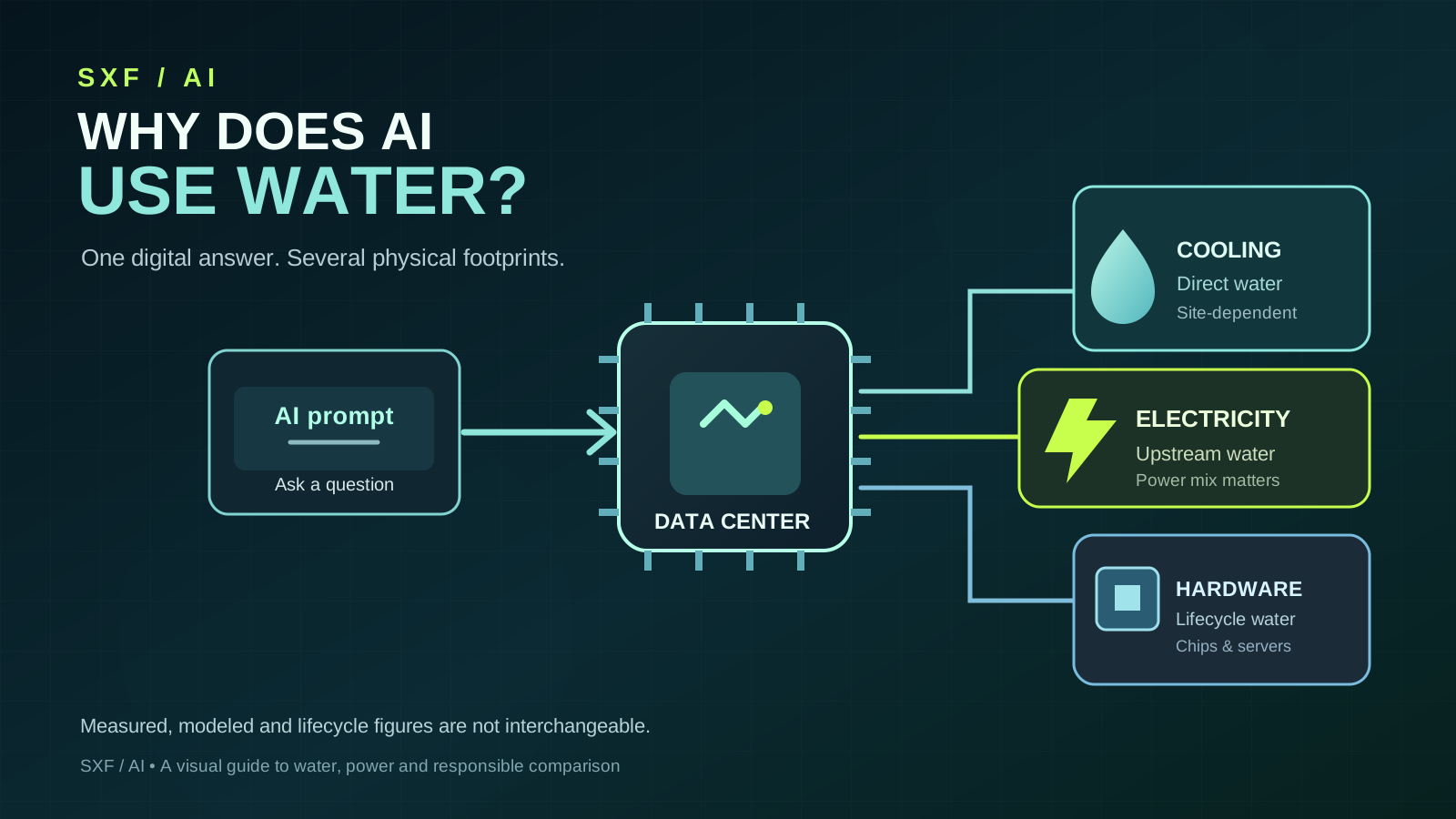
AI uses water because its servers get hot—and generating the electricity that runs them can use water too.
Data centers do not “feed water” to a chatbot. Chips consume electricity and generate heat; some facilities use evaporative cooling to carry that heat away. Water may also be consumed by power plants and during chip manufacturing. How much is attributable to one request depends on the model, workload, location and accounting boundary.
There is no single universal “liters per ChatGPT question” number. A widely shared “one bottle per prompt” interpretation is not what the original research concluded. See the bottle fact check.
Median text prompt; reported on-site water estimate. See what counts ↗
Average query, publicly stated; accounting details not published. Understand the limit ↗
A 400-token response with a wider lifecycle approach. Compare boundaries ↗
01 / The physical explanation
Why does artificial intelligence use water?
When you submit a question to ChatGPT or another AI service, specialized computer chips perform calculations in data centers. Their electrical energy ends up primarily as heat. Every cooling system must move that heat away. A facility may use air cooling, a closed liquid loop, evaporative cooling, or a combination; liquid cooling is not the same as consuming fresh water.
In an evaporative cooling tower, warm water circulates, some evaporates and carries heat into the air, and fresh make-up water replaces that loss. A portion is also drained to manage mineral build-up. Other facilities use dry coolers with little on-site water consumption, sometimes at the cost of greater electricity needs. The trade-off changes with climate and engineering design. The U.S. Department of Energy explains the mechanisms and WUE metric.
You send a question
A prompt travels to a hosted AI service.
Servers compute
Accelerators use electricity and release heat.
Cooling removes heat
Some sites evaporate water; others do not.
Electricity has a footprint
Power production may have its own water use.
Four different water footprints people often mix together
Water consumed at the data center during operations. Direct cooling numbers typically focus here.
Water consumed upstream when generating electricity. Its intensity depends on generation technology and location.
Water associated with making chips, servers and facilities. Allocating it per query requires lifetime and utilization assumptions.
Large one-time training runs plus future tuning. Whether and how to amortize this across queries is an additional choice.
The important distinction: water withdrawal is not water consumption. Water returned to the watershed after use is different from water evaporated or moved elsewhere. A high withdrawal number must not be relabeled “water used up.” See the 2026 water-accounting research.
02 / Numbers with context
How much water does one ChatGPT question actually use?
A June 2025 statement by Sam Altman put an average ChatGPT query at approximately 0.000085 US gallons, or 0.32 mL of water, and 0.34 Wh of electricity. It was a public estimate, not a full reproducible, model-by-model measurement with all lifecycle boundaries reported. Read the original statement.
Google’s more explicit May 2025 median Gemini Apps text prompt figure was 0.26 mL and 0.24 Wh. Google disclosed a methodology including serving hardware and overhead, but its cited water metric uses data-center cooling water rather than a full lifecycle total. Google explicitly warned that its prompt-level numbers are point-in-time and not independently verified. Read Google's method.
Meanwhile, Mistral reported 45 mL for a 400-token Le Chat response using a lifecycle-oriented assessment that includes broader upstream impacts and excludes the user device. That does not mean one model is automatically over 100 times thirstier than another. The measurements are not the same experiment. See Mistral’s disclosure.
Published figures: the comparison most headlines skip
| Source / workload | Water | Electricity | What is included? |
|---|---|---|---|
| Google, median Gemini text prompt (May 2025) | 0.26 mL | 0.24 Wh | Reported fleet-average on-site cooling water; not full lifecycle. |
| Sam Altman, average ChatGPT query (June 2025) | ≈0.32 mL | 0.34 Wh | Public statement; exact water accounting boundary not described. |
| Mistral, Le Chat 400-token response (2025) | 45 mL | Not directly stated | Broader lifecycle impact; user terminal excluded. |
| Li et al., modeled GPT-3 medium response (2023 research; 2025 journal) | ~10–50 mL | Workload-specific model | Derived from 500 mL / ~10–50 responses, including on-site and electricity water. |
The GPT-3 row is a range inferred from an estimate for a group of responses, not a measured ChatGPT query. The figures come from different dates, systems and scopes and should never be ranked as equivalent apples-to-apples measurements.
Why the numbers disagree
- Different requests: a short text reply, a long reasoning trace and a video are not comparable workloads.
- Different statistics: median is not the same as arithmetic average.
- Different facilities: water cooling, dry cooling, temperature, grid and utilization vary.
- Different boundaries: on-site cooling, electricity, manufacturing and training are different totals.
- Different years: faster hardware and improved batching can lower per-query energy while total use rises.
- Different confidence: a source-backed measured sample and a public estimate have different evidentiary weight.
03 / Viral claim fact-check
Does asking ChatGPT one question use an entire bottle of water?
A frequently cited study estimated that generating approximately 10–50 medium-length GPT-3 responses could be associated with 500 mL of water under specified assumptions. The claim was about a range of responses and included on-site plus electricity-related water. It was not a direct measurement of every present-day ChatGPT message.
Turning that finding into “one AI question uses a bottle of drinking water” changes both the denominator and often the accounting scope. The original authors specifically highlighted that location and time change the result. Read the published paper.
A rough model-dependent range, not a current live ChatGPT meter. The range endpoints reverse when dividing: 500/50 = 10; 500/10 = 50.
04 / Original SXF explainer
SXF Claim Decoder: what does a water-per-prompt headline leave out?
Choose a published claim and examine its measurement boundary. This decoder does not rank models: it checks what the source actually supports and what remains unknown.
Google’s Gemini text prompt
0.26 mL per median text prompt.
05 / SXF original interactive model
SXF Water Footprint Lab: build a transparent scenario
This is not a ChatGPT meter. Instead of assigning every prompt a fabricated universal footprint, change the assumptions and watch the calculation. The lab separates on-site cooling water from water consumed to generate electricity. It deliberately excludes manufacturing and training because estimating those needs more information.
ILLUSTRATIVE WATER CONSUMPTION
88.5 mLfor 100 modeled requests under your selected assumptions
Scenario assumptions, not measured usage. Neither provider, model, region nor actual power mix is inferred.
See the exact formulas and what the lab excludes
On-site (mL) = requests × IT energy (Wh) × on-site WUE (L/kWh).
Electricity-related water (mL) = requests × IT energy (Wh) × PUE × electricity-water intensity (L/kWh).
Facility energy (Wh) = requests × IT energy (Wh) × PUE.
Wh-to-kWh and L-to-mL conversions cancel numerically in the water formulas. WUE here uses IT energy as its denominator, so the lab does not multiply the on-site term by PUE again. The electricity term uses facility energy. Electricity-related intensity is a variable scenario input, not a verified universal constant. This simplified model does not allocate cooling versus grid-water overlap by region and does not include manufacturing, training, building materials or user devices.
The default inputs are round, hypothetical teaching values chosen to make the math inspectable. They are not Google’s, OpenAI’s or Mistral’s actual provider settings. Read about WUE and the original research.
06 / Energy explained
How much electricity does ChatGPT or AI use?
Electricity use is commonly expressed as watt-hours (Wh). One watt-hour is the electricity used by a one-watt load over an hour. A kilowatt-hour (kWh) is 1,000 Wh. A June 2025 public estimate put an average ChatGPT query at approximately 0.34 Wh. Google reported 0.24 Wh for its median Gemini Apps text prompt in May 2025. Both figures are snapshots, not rates that apply to every feature or model.
Microsoft’s 2026 production-aware research found a median estimate of 0.31 Wh per typical query across the systems and assumptions it modeled. It also found long reasoning and agentic tasks can use much more energy. Estimates for one short text answer should not be multiplied uncritically across image generation, video, web research and multi-step agents. Read Microsoft Research.
How much electricity do data centers use worldwide?
The International Energy Agency’s updated 2026 outlook estimated 485 TWh in 2025 and around 950 TWh in 2030 for all data centers worldwide in its central projection. These are sector-wide data-center figures, not an electricity meter for ChatGPT alone. IEA expects AI-focused capacity to grow faster than the overall total, but the infrastructure also supports storage, business software and other digital services. IEA’s updated assessment.
More efficient chips, batching, software and cooling can lower energy for a given task.
More users, more data centers and more demanding tasks can raise total electricity use.
07 / The wider picture
Is AI bad for the environment?
AI has environmental costs; a single water-per-query figure cannot determine its net impact. Important outcomes include electricity demand, grid carbon intensity, land use, manufacturing, water withdrawal, local water stress and the possible environmental benefits of the task AI enables. Claims that AI is harmless or uniquely catastrophic from one number both miss this context.
Local water stress matters more than a global average
One liter consumed in a region experiencing drought can have different consequences from one liter consumed in a water-abundant location. Operators also differ in whether they withdraw potable freshwater or treat and reuse reclaimed water. Comparing only global “drops per prompt” can hide impacts on nearby communities and water systems.
Does dry cooling solve AI water consumption?
It can greatly reduce on-site water consumption, but may increase the electricity required for heat rejection under some conditions. The water and emissions effects depend on the local grid, outdoor temperature and engineering design. “Zero water for cooling” is not the same as “zero total water footprint.”
Training versus using a model
Training can consume energy and water over a concentrated period, while model inference consumes resources every time it is used. The balance depends on the model’s size, the duration of its deployment, the number of requests and whether a wider lifecycle is counted. Hardware manufacturing should also be examined, rather than automatically divided by a guessed number of queries.
What would responsible reporting look like?
- Name the specific model and workload, rather than saying “AI” without qualification.
- Give the date, region, sample size and median or average.
- Separate water consumption from withdrawal and discharge.
- Separate on-site cooling from water associated with electricity production.
- Show whether training, hardware and end-user devices were included.
- Publish energy, PUE, WUE, uncertainties and methods where possible.
- Discuss local water stress, not only global totals.
08 / Practical actions
What can AI providers and users actually do?
Providers can publish reproducible workload data; improve model and serving efficiency; use climate-appropriate cooling; consider reclaimed water where safe; select grid and cooling configurations jointly; and evaluate impacts on local watersheds. Reducing an isolated per-query number is not enough if total demand and local stress are ignored.
Users can choose the right tool for the task, avoid repeated unnecessary high-compute runs, and seek verifiable environmental reporting. Do not assume that a short question produces a particular amount of water or that every use of AI displaces zero-emission work. A better decision asks what actual benefit was obtained per unit of resource use.
For more technical decisions on hosted versus local systems, see SXF’s guide to running AI models locally, AI model selection guide and AI agent cost and total-ownership analysis. For an accessible explanation of why model answers can be unreliable, read why ChatGPT makes things up.
09 / Common questions
AI water and electricity: frequently asked questions
Why does AI use water?
AI runs on servers that produce heat. Some data centers evaporate water to remove that heat, and generating their electricity can consume water too. Manufacturing the chips and buildings adds an additional lifecycle footprint.
Does ChatGPT use water every time I ask a question?
Using ChatGPT entails computing resources with an environmental footprint, but the water associated with one request varies by facility, cooling system, electricity source and request type. It is not a fixed measured dose per question.
How much water does one ChatGPT question use?
A June 2025 public statement estimated about 0.000085 US gallons, approximately 0.32 milliliters, per average ChatGPT query. The statement did not publish enough methodology to compare it directly with wider lifecycle studies or independently verify each workload.
Does one AI question use a whole bottle of water?
No universal one-question, one-bottle rule is supported. The widely shared half-liter estimate in the GPT-3 research referred to roughly 10–50 medium-length responses under a specific modeled accounting scope—not one prompt.
How much electricity does one ChatGPT query use?
A 2025 public estimate said an average ChatGPT query uses about 0.34 watt-hours. This is not a guaranteed value for every model, image task, deep-research session or long reasoning request.
Does Gemini use less water than ChatGPT?
Google reported 0.26 mL for a May 2025 median Gemini text prompt, while a public statement gave about 0.32 mL for an average ChatGPT query. Different prompt populations and undisclosed accounting boundaries make a direct winner claim unjustified.
What is the difference between water withdrawal and consumption?
Withdrawal is water taken from a source. Consumption is water not returned to the same watershed, such as water evaporated during cooling. Confusing the two can produce misleading comparisons.
Is AI bad for the environment?
AI has real resource costs, but overall effects depend on hardware efficiency, electricity generation, regional water stress and what task AI replaces or makes possible. A single per-prompt number cannot settle the question.
How can AI companies reduce water consumption?
Operators can choose site-appropriate cooling, use reclaimed water where suitable, improve compute efficiency, publish consistent water and energy metrics, and consider the local water basin rather than only global averages.
Do AI images and videos use more electricity than text?
Image and video generation can require different and often more compute than a short text response, but actual energy depends on the model, quality, duration, batching and hardware. Use measured workload-specific data rather than multiplying a text-prompt estimate.
Does training AI use more water than running it?
Training can have a large one-time footprint, while serving models incurs recurring usage costs. Their relative contribution depends on model lifetime and total inference volume; neither dominates in every case.
Can the SXF Water Footprint Lab measure my actual ChatGPT water use?
No. It is a transparent scenario model using user-selected assumptions, not a meter or a provider measurement. It deliberately keeps on-site cooling and electricity-related water separate.
10 / Evidence record
Sources, evidence levels and how SXF keeps this guide current
This is an editorial synthesis, not a laboratory measurement of private provider systems. Company measurements and statements are attributed; modeled academic estimates are identified as estimates; the original interactive lab is explicitly hypothetical. Published figures are included with their dates so future changes do not silently rewrite history.
Google’s Gemini inference measurement ↗
0.24 Wh of electricity and 0.26 mL of water for a median Gemini Apps text prompt in May 2025. This is not a measurement of ChatGPT or a full upstream-water lifecycle.
ChatGPT average-use statement ↗
0.34 Wh of electricity and 0.000085 US gallons (~0.32 mL) of water per average query were stated publicly; a reproducible accounting boundary was not supplied.
Le Chat lifecycle disclosure ↗
45 mL of water for a 400-token Le Chat response under Mistral’s lifecycle-based reporting method, excluding the user device.
Making AI Less ‘Thirsty’ ↗
Estimated 500 mL for roughly 10–50 medium-length GPT-3 responses, depending on place and time, including both on-site and power-generation water.
Energy use of AI inference ↗
Production-aware modelling found a median 0.31 Wh per typical query; longer reasoning and agentic tasks can have much greater energy demand.
Key Questions on Energy and AI ↗
IEA updated its central estimate of data-centre electricity demand from 485 TWh in 2025 to around 950 TWh in 2030. This covers all data centres, not only generative AI.
Cooling water efficiency opportunities ↗
Explains evaporative cooling, blowdown and the water usage effectiveness (WUE) metric in litres per kWh of IT energy.
Balancing Bits and Drops ↗
Distinguishes withdrawal, discharge and consumption; water removed from a local watershed is not the same as water withdrawn and subsequently returned.
Why AI requires water and energy ↗
Accessible journalistic context on the physical infrastructure behind AI.
Why AI water-per-query claims need context ↗
Explains why individual-facility design, electricity and water trade-offs change headline calculations.
Methods & update policy
Last reviewed: October 27, 2026. We prefer first-party disclosures, peer-reviewed research, government or intergovernmental data and directly attributed reporting. We do not mix median and average prompts or compare direct cooling with full lifecycle totals without labeling the boundary. New provider results should be added as dated rows with workload, geographic scope, evidence class and method. Interactive lab default inputs are teaching assumptions rather than provider claims.
Limitations: No live access to a data center’s meter, prompt logs, water source, regional power mix or provider-specific full lifecycle model. Environmental values change with time, system configuration and task difficulty. Changes to a source's methodology can invalidate an apparent trend.
Keep learning with SXF