SXF FIELD GUIDE / RETRIEVAL · CUSTOMIZATION · MODEL CONTEXT
RAG vs Fine-Tuning vs Long Context:
Which AI Architecture Should You Use?
A definitive decision guide for retrieval-augmented generation, model fine-tuning and long-context prompting. Compare knowledge freshness, accuracy, hallucination risks, privacy and full cost; test all three on the same questions, then build the smallest architecture that meets your requirements.
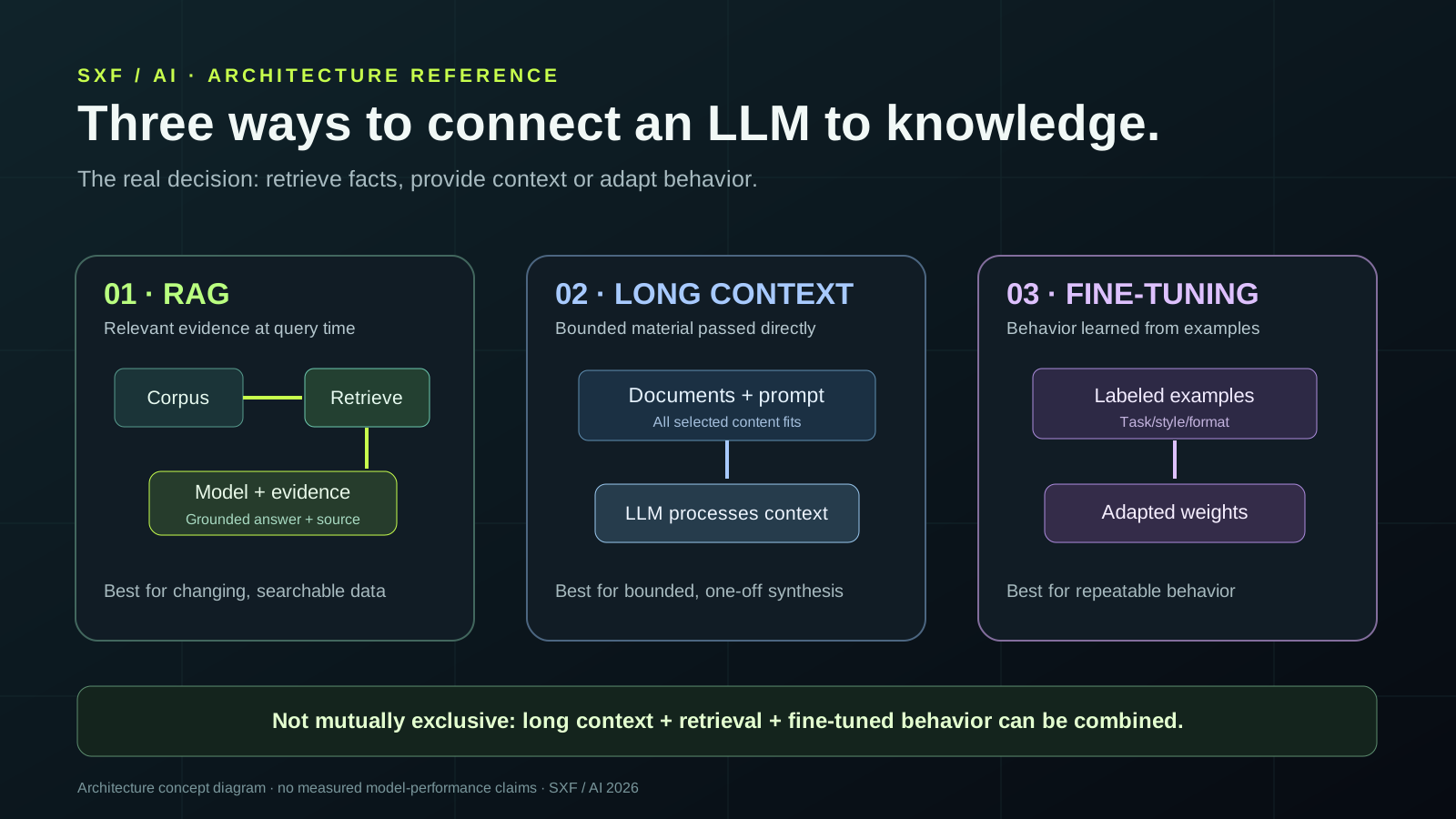
RAG, fine-tuning or long context: which one should you pick?
Choose RAG for current facts, large corpora, source-backed answers or per-user permissions. Test long context first for a manageable, bounded collection of documents when simplicity and complete source access matter. Consider fine-tuning for recurring behavior, output consistency or specialized tasks that prompting does not solve—and only where a supported training path and suitable labeled examples exist. None prevents hallucinations by itself; evaluate on your own documents and questions.
RAG VS FINE TUNING · QUICK COMPARISON
RAG vs fine-tuning vs long context: what is the difference?
RAG (retrieval-augmented generation) retrieves relevant documents or records and gives them to a model when answering a query. Fine-tuning trains model parameters on task examples to influence how a model behaves; it is not a reliable mechanism for continuously updating a knowledge base. Long context places a larger set of source materials directly in a single request, without requiring a separate retrieval stage. These approaches solve different problems and can be combined.
| Criterion | RAG | Fine-tuning | Long context |
|---|---|---|---|
| Best for | Changing facts, source attribution and large corpora | Consistent task behavior, style, formats and specialized transformations | One-off or bounded-document synthesis |
| Where knowledge sits | External index / database at request time | Weights influenced by labeled training examples | Provided prompt/context at request time |
| Freshness | Reindex on updates; can be near-real-time | Requires new training and validation for changed learned behavior | Fresh when current source material is supplied |
| Traceable citation | Natural fit if retrieval and citation verification are designed | Not provided by training alone | Possible if original source and citation instructions are provided |
| Scaling corpus size | Index and retrieve subsets of large collections | Not a searchable evidence database | Bounded by practical context, latency and cost |
| Cost drivers | Embedding, ingest, search, rerank, inference, maintenance | Data labeling, training jobs, deployment and inference | Repeated large input tokens, caching, latency |
| Key failure mode | Missing/irrelevant retrieval or untrusted snippets | Overfitting, stale behavior, unsupported facts | Missed evidence in long/noisy material |
| Privacy control | Per-document ACL and index tenancy required | Training-data governance and model access required | Request/retention/security policy for supplied data required |
| Default first test | Many documents, changing facts | Repeated task errors after simpler baselines | Small bounded corpus or a few files |
There is no generic winner on correctness or price. Evaluate with the same questions and source of truth before committing. See the shared question set and interactive cost worksheet.
ARCHITECTURE EXPLAINED
How RAG, fine-tuning and long-context prompting work
RAG: retrieve, rank, generate and verify
Documents are processed into searchable units, often embeddings and text indexes. At request time, a query retrieves candidate passages, optional reranking chooses the most relevant, and a language model answers with evidence. A production RAG pipeline also handles versions, deletions, user authorization, source attribution, monitoring and reindexing. Embedding choice is a separate topic covered in Best Embedding Models for RAG.
Fine-tuning: specialize the model’s behavior
Supervised examples teach a model to produce desired outputs for recurring tasks. A training set can capture document classification labels, an extraction schema or response conventions. It should not be sold as a database replacement. Provider support differs dramatically: verify actual fine-tuning eligibility on the precise model and account rather than treating it as a universally available API. Fine-tuning requires holdout tests and a data-governance review.
Long context: give the model the source material directly
With a bounded packet of contracts, annual reports or support documents, putting the original text into the prompt may be simpler than maintaining an index. Still, input context has limits, model utilization varies by evidence position, and large prompts create latency and token charges. Research on the lost-in-the-middle effect warns against equating maximum context length with reliable document understanding. [10]
RAG changes what evidence the model can see; fine-tuning changes how the model tends to respond; long context changes how much material can be supplied in one request.
LLM ARCHITECTURE DECISION TREE
When should you use RAG, fine-tuning or long context?
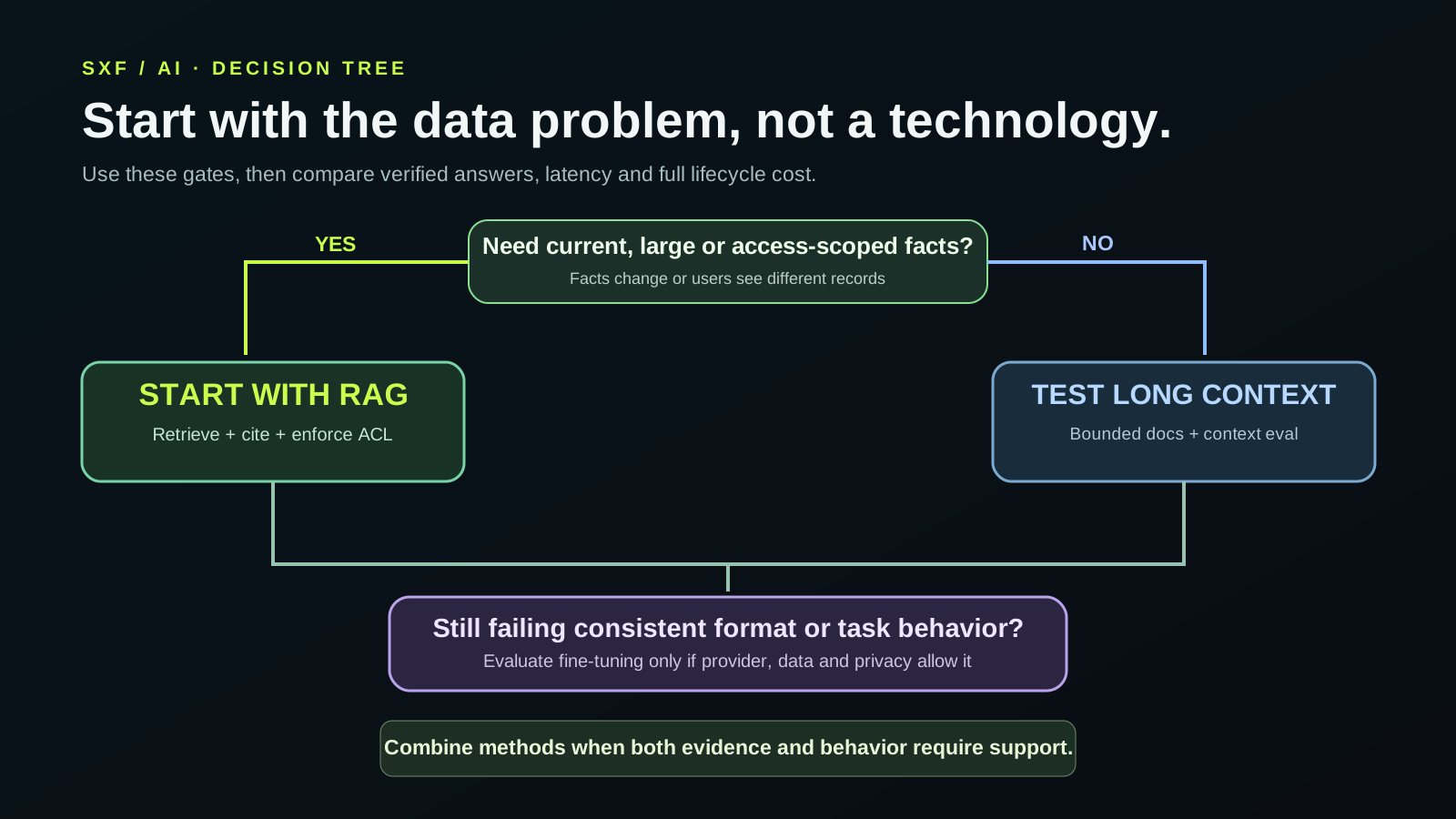
- Are answers based on changing or regulated knowledge? Start with retrieval and document-level access checks.
- Is the relevant source material small enough to fit safely in the prompt? Run a long-context baseline; compare full-text answers with retrieval-based answers.
- Is the major problem output format, style or a repeatable task? Test better prompts and validation first; if these fail and training is supported, evaluate fine-tuning.
- Do you need both fresh knowledge and specialized behavior? Consider RAG plus a tuned model, or retrieval plus long context, but measure the extra complexity.
- Are all answers predetermined? Prefer a database query, rules engine or search UI over a generative architecture.
USE CASE CHOICE MATRIX
Best approach by use case: examples that stay relevant
| Use case | Start with | What decides the winner |
|---|---|---|
| Internal policy assistant | RAG with ACL filtering | Policy freshness, citation faithfulness, user access boundaries |
| One long legal contract | Long-context baseline | Clause-level evidence recovery and cost per review |
| Customer classification / tagging | Prompt baseline, then fine-tuning candidate | Held-out precision/recall, schema validity and labeling cost |
| Product catalog or inventory Q&A | Database lookup / RAG | Current SKU state and zero fabricated availability |
| Fixed 20-page manual | Long context or small RAG | Accuracy vs prompt length and usage volume |
| Support assistant with brand tone | RAG + prompt conventions; tune if justified | Current knowledge + style consistency measured separately |
| Large technical documentation site | RAG + reranking | Retrieval recall, passage permissions and source version |
| Multi-file financial comparison | Long context and/or retrieval | Cross-document citations and arithmetic verification |
A request for “RAG vs fine-tuning for customer support” typically mixes two problems: source freshness and a predictable reply format. Split the requirements. Use a retrieval or database layer for policy facts; use prompt templates, output validation or justified fine-tuning for response conventions.
QUALITY, FACTUALITY AND RETRIEVAL
Which approach reduces hallucinations and improves accuracy?
None guarantees truth. RAG can ground an answer but may retrieve the wrong passage, omit key clauses or allow source text to inject instructions. Fine-tuning can improve repeated task performance but does not confer a verified source trail. Long context can contain the correct text while the model still overlooks an exception. Measure answer correctness, citation precision, abstention and evidence coverage separately.
Retrieval before generation
Measure recall@k on known relevant passages, reranker accuracy, grounding to actually authorized passages, and whether the model abstains when retrieval finds nothing.
Position sensitivity
Place answer-bearing text early, in the middle and late in documents. Add irrelevant distractors and test whether citations remain faithful.
Hold out unseen cases
Measure performance on a separate test set, robustness to changed wording, schema validity and catastrophic regressions. Exclude training examples from evaluation.
Verify outside the model
Use exact labels, deterministic checks, source spans and reviewers for high-impact decisions. Log errors and review trends after launch.
ILLUSTRATIVE WORKLOAD ECONOMICS
RAG vs long context vs fine-tuning: which costs less?
Price depends on model rates, prompt size, cache eligibility, retrieval operations, training availability, data ingestion, storage, usage and retries. The calculator below compares two simplified variable-cost scenarios using rates you enter. It does not claim current prices, predict training quality or silently add unverified discounts.
At high query volume, sending an entire large document repeatedly can become expensive; prompt caching may materially change this. RAG adds its own embedding, index, authorization, retrieval and maintenance charges. Fine-tuning adds training data, job cost, validation and versioning. For dynamic vendor rates, use SXF's source-linked model pricing and the model API cost calculator.
ORIGINAL COMPARISON METHOD
Same questions, three architectures: a reproducible experiment
Use the same synthetic policy corpus and the same 30 evaluation questions for each system. A fictional refund policy says standard purchases can be eligible within 30 days; subscription purchases are excluded; urgent cases require human review; only a verified support role may view customer-specific records. The policy is synthetic—never apply it to real customers.
| Test group | 10-case examples | Expected proof |
|---|---|---|
| Evidence present (10) | Return window; exclusion; conflicting revision; precise exception | Correct decision with traceable source passage |
| Evidence absent / access (10) | No relevant passage; tenant mismatch; revoked role; outdated document | Safe abstention / denied access, no private exposure |
| Long-context and behavior (10) | Answer fact placed early/middle/late; JSON schema; ambiguous wording | Citation fidelity, output validation and correct escalation |
RAG variant: retrieve from a versioned, access-filtered corpus and provide top passages. Long-context variant: supply the full authorized corpus that fits the input budget, preserving version labels. Fine-tuned variant: train only on separate labeled historical examples if a supported route exists; supply current rules at inference time if facts can change. Use the same base family where feasible and disclose incompatibilities.
The downloadable fixture specification includes cases and expectations. No API benchmark was executed for this publication. Results are deliberately blank until independently measured. A useful report records accuracy, citation support, wrong-answer rate, p50/p95 latency, output validation, total tokens, index cost, training cost and human-review time.
DATA FRESHNESS · PRIVACY
Fresh knowledge, secure retrieval and private data handling
For RAG, documents need versioning, deletion propagation, index permission synchronization, per-document access checks, prompt-injection defense, and citation verification. A “private vector database” does not ensure that users receive only documents they can access. For long context, sending complete documents to an API may enlarge data exposure; verify provider retention and regional controls. For fine-tuning, training datasets and derivative checkpoints demand separate governance and deletion planning.
Never let retrieval results grant themselves authority, and never treat embedded instructions inside a document as instructions from the user or system. Test revoked permissions, stale policies, poisoned documents and cross-tenant content explicitly. See AI Agent Security and Prompt Injection.
HYBRID ARCHITECTURES
Should you combine RAG, fine-tuning and long context?
Yes, but only when the combination fixes measured failures. RAG + long context uses retrieval to select evidence and then provides a larger verified packet to the model. RAG + fine-tuning combines fresh source documents with a model tuned for consistent extraction or response conventions. All three may be warranted for complex products, but also introduce more testing, operations and failure surfaces.
Keep an explicit control plane: question → permissions → evidence selection → context assembly → model execution → independent validation. If the retrieval stage returns no authorized evidence, the model should refuse or escalate rather than guess. The AI Agent Memory research covers how persistent state differs from retrieval and a context window.
REFERENCE IMPLEMENTATION PATTERNS
Python patterns: retrieval, long context and fine-tuning data
These snippets demonstrate the data flow; they are not claims of a complete secure production system. Substitute your permitted storage, provider SDK, model and authorization layer. Production retrieval must filter sources before content is returned.
documents = [
    {"id": "p1", "tenant": "A", "text": "Refund requests after 30 days require review."},
    {"id": "p2", "tenant": "B", "text": "Private customer details for tenant B."},
]
query = "What happens after 30 days?"
allowed = [d for d in documents if d["tenant"] == "A"]
hits = [d for d in allowed if "30 days" in d["text"]]
context = "\n".join(f"[{d['id']}] {d['text']}" for d in hits)
prompt = f"Answer using only these sources; cite IDs.\n{context}\nQ: {query}"
print(prompt)
# This toy keyword search is NOT vector retrieval or a security audit.def build_context_prompt(authorized_documents, question, token_counter, limit):
payload = "\n\n".join(
f"<source id='{d['id']}'>{d['text']}</source>"
for d in authorized_documents
)
prompt = f"Use only the cited sources.\n{payload}\nQuestion: {question}"
if token_counter(prompt) > limit:
raise ValueError("Context too large: use retrieval or split tasks")
return prompt
# token_counter is your model-specific token counter.{"messages":[{"role":"system","content":"Return classification JSON only."},{"role":"user","content":"Ticket: Customer requests a change of address."},{"role":"assistant","content":"{\"category\":\"account_update\"}"}]}
# Validate schema, separate train/test sets, redact private data.
# Check whether your chosen vendor/model permits fine-tuning.RELEASE-READY EVALUATION CHECKLIST
How to evaluate LLM architectures before deployment
For a broader decision framework, read How to Choose an AI Model and AI Model Benchmarks Explained. A high leaderboard result does not substitute for source-grounded evaluation on your actual task.
COMMON ARCHITECTURE ERRORS
Seven mistakes that make the comparison misleading
- Fine-tuning to memorize a moving database. Update evidence via retrieval or direct queries instead.
- Assuming one million tokens means perfect recall. Test information position, distractors and factual grounding.
- Adding RAG without evaluation. Retrieval quality and permission filtering are first-order correctness issues.
- Comparing costs without volume. Training and indexing have upfront and recurring components.
- Using generated citations without verifying sources. Match every cited claim to text the authorized user can read.
- Assuming retrieval is inherently private. The wrong index ACL can expose entire tenant records.
- Publishing winner claims without running a shared test. Define the protocol first and report missing results honestly.
DIRECT SEARCH QUESTIONS
Frequently asked questions about RAG vs fine-tuning vs long context
RAG vs fine-tuning: what is the difference?
RAG retrieves relevant external evidence at query time. Fine-tuning updates a model’s learned behavior using training examples. RAG usually suits changing or source-backed knowledge; fine-tuning can help repeated formats, domain tasks or behavior when quality data and a supported training route exist.
Is long context better than RAG?
Not universally. Long context can be simpler for bounded documents that fit within a request, while RAG can scale to larger, frequently updated and access-controlled collections. Evaluate accuracy, evidence attribution, latency and cost on representative queries.
When should you use RAG?
Use RAG when facts change frequently, the corpus is large, source citations matter, or different users may access different documents. Design document-level access checks, retrieval evaluation and abstention for missing evidence.
When should you fine-tune instead of RAG?
Consider fine-tuning when the core gap is repeatable task behavior, output style, structured extraction or domain-specific transformation that prompting and retrieval do not fix. Do not use fine-tuning as a live database of changing facts.
Can RAG and fine-tuning be combined?
Yes. A fine-tuned model can learn a consistent response format or workflow, while RAG provides current, authorized evidence. Long context can hold the selected retrieved material within the request.
Does fine-tuning eliminate hallucinations?
No. None of the three approaches guarantees factual correctness. Measure unsupported claims, faithful citations and abstention; use deterministic validation where possible.
What is the cheapest approach?
It depends on query volume, document size, retrieval infrastructure, prompt caching, training availability, maintenance, quality and retries. Compare full lifecycle cost per accepted answer, not only API token price.
Is RAG private and secure?
Not automatically. Retrieved snippets can reveal private information when index access controls, authorization filtering, logging or prompt-injection defenses are weak. Evaluate data flows and provider retention rules.
How many documents fit into long context?
There is no universal number. Models have different context limits and counting depends on tokens, images and other input. Reserve output headroom and test effective recall; advertised capacity does not guarantee complete reasoning over all tokens.
PRIMARY SOURCE LEDGER · OCTOBER 17, 2026
Sources, research and editorial method
This evergreen guide uses official documentation and foundational papers for factual descriptions; decision matrices, diagrams, example data and the worksheet are original SXF editorial work. The technical recommendation is deliberately version-neutral when features change across vendors. Rates in the calculator are not live quotes and must be replaced with provider-specific prices. No hidden benchmark results are claimed. Recheck URLs, model eligibility and deployment controls as documentation evolves.