SXF GUIDES / BENCHMARK RESEARCH
AI Model Benchmarks Explained (2026):
AA-Briefcase, AA-LCR, GDPval-AA & Intelligence Index
A rigorous comparison of Google Gemini Embedding 001 and 2 with Cohere Embed 5 Pro and Fast: real API costs, vector storage, model compatibility, multimodal retrieval, Python implementation, and how to evaluate search quality without marketing hype.
AI benchmarks measure different capabilities. A high score on one test is not proof that a model is the best for every task.
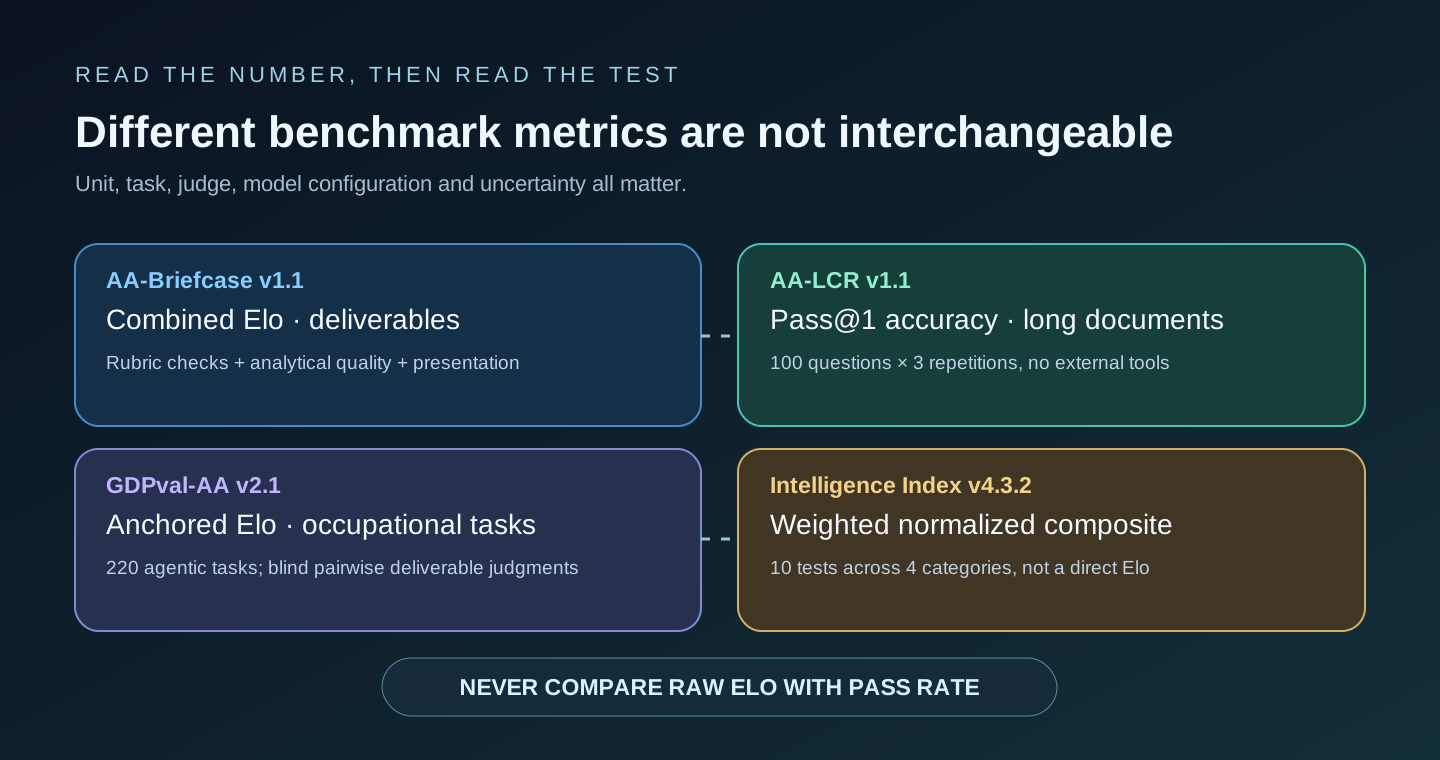
AA-Briefcase v1.1 evaluates sophisticated knowledge-work deliverables using combined Elo ratings. AA-LCR v1.1 measures long-context reasoning as accuracy on controlled tasks. GDPval-AA v2.1 compares agent-produced professional deliverables using anchored Elo. The Artificial Analysis Intelligence Index v4.3.2 aggregates ten different evaluations with explicit weights. Elo, percentages and normalized index points are different units; never compare them directly.
Use the specific benchmark that matches your workload, preserve model/version/effort settings, and validate real outcomes—including retries, latency and cost—before choosing a production model.
AI model benchmarks explained: compare the test before comparing the score
Searches for “best AI model benchmark”, “AA-Briefcase v1.1” and “AA-LCR v1.1” often reflect different intentions. Some users want a model that writes professional reports; some need factual retrieval across a long document; others want a broad model-capability index. A leaderboard is useful only when its measured task resembles what you need. The benchmark version is part of the result, not a decorative suffix.
| Benchmark | Tests | Reported metric | Do not infer |
|---|---|---|---|
| AA-Briefcase v1.1 | Multi-file, professional knowledge-work deliverables | Combined Elo and components | Universal agent reliability or job performance |
| AA-LCR v1.1 | Reasoning over long source documents | Pass@1 accuracy, aggregated over repeats | Perfect recall of any million-token prompt |
| GDPval-AA v2.1 | Agentic real-world occupational tasks | Anchored Elo from pairwise judgments | Accuracy percentage or actual economic productivity |
| Intelligence Index v4.3.2 | Weighted aggregation of ten evaluations | Normalized composite index | Direct Elo or probability of correct answers |
These are versions currently tracked by SXF. Methodologies and model placements can change; for live positions consult each benchmark page and the official Artificial Analysis site. We deliberately do not invent a combined “best overall model” from incompatible metrics.
What is the Artificial Analysis Intelligence Index?
The Artificial Analysis Intelligence Index is a composite measure, not an individual exam. Its current v4.3.2 methodology combines ten evaluations across agentic work (30%), coding (20%), general capability (30%), and scientific reasoning (20%). The published weights are: AA-Briefcase 15%, GDPval-AA 10%, AutomationBench 5%, Terminal-Bench 10%, SciCode 10%, AA-Omniscience 15%, GDP.pdf 10%, AA-LCR 5%, Humanity's Last Exam 10%, and CritPt 10%.
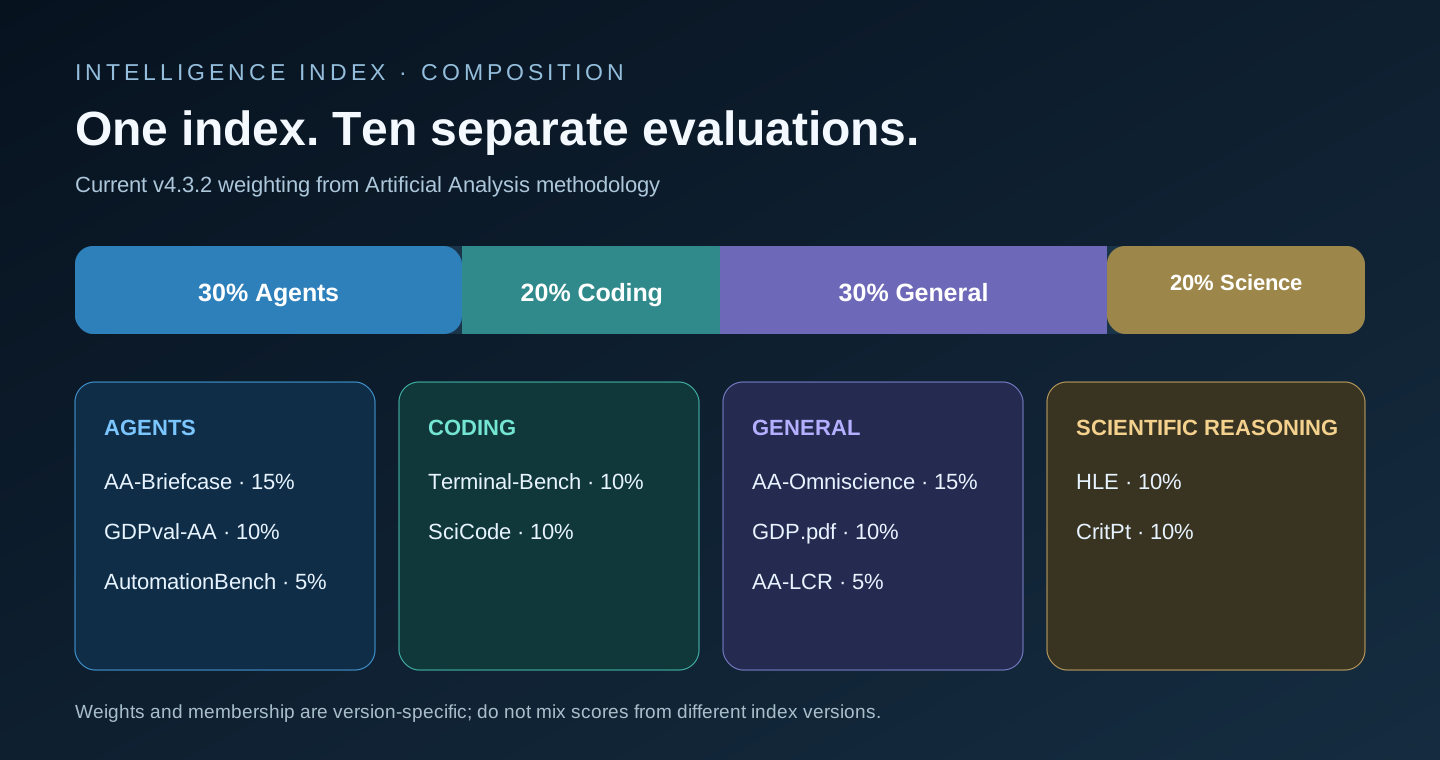
The index normalizes heterogeneous benchmark outcomes before combining them. Consequently, raw scores from an individual test cannot simply be summed with Elo or accuracy percentages to reproduce an index number. A model can lead on long-document reasoning but place differently on coding agents. Changes to benchmark versions, mixture, scoring or normalization can also move a score without an underlying model update.
Decision rule: use the index to shortlist broadly capable systems, then test the specific components relevant to your workload. The authoritative method and live values are at Artificial Analysis Intelligence benchmarking methodology and SXF Intelligence Index results.
AA-Briefcase v1.1: evaluating real knowledge-work deliverables
AA-Briefcase evaluates whether an AI agent can produce useful artifacts for professional tasks such as analyzing a body of materials, working with spreadsheets, preparing presentations or writing structured reports. The benchmark measures outputs and deliverables, not just the next token or answer to a multiple-choice question.
The v1.1 methodology combines rubric-based checks with judgments of analysis and presentation quality; published Combined Elo values summarize relative performance under the evaluator's particular conditions. Elo is a relative ranking scale anchored to its evaluation population, judging protocol, and reference models. It is not an “82% accurate” interpretation and is not interchangeable with GDPval-AA Elo.
Before using a result for procurement, inspect the evaluated model revision, reasoning effort, whether tools were enabled, artifact formats, and any evaluator interventions. For your own adoption test, review five to ten representative outputs manually, checking numerical correctness, editability, citations, professional layout and time to acceptance. See AA-Briefcase v1.1 observed model results and the official benchmark.
AA-LCR v1.1: long-context reasoning is more than a context-window number
AA-LCR tests reasoning over supplied lengthy documents. Its v1.1 public benchmark reports accuracy on a controlled set of 100 questions, repeated across three runs with no external tools under the stated evaluation configuration. The metric is Pass@1 accuracy, not Elo.
Large advertised context windows are a capacity statement; they do not establish that a model can find, reconcile or reason about every relevant passage. Long-context tasks can fail because a clue is buried, two paragraphs contradict each other, or a model guesses a plausible answer instead of grounding it in the source. High performance on short questions is not automatically evidence of strong long-context reasoning.
When designing your own test, distribute necessary evidence throughout documents, include deliberate distractors, request citations to precise passages, and evaluate multi-hop conclusions separately from exact text retrieval. Compare a single-context approach with a retrieval-and-rerank pipeline where practical. For evaluated snapshots see AA-LCR v1.1 scores and Artificial Analysis long-context evaluation.
GDPval-AA v2.1: can models perform economically relevant professional tasks?
GDPval-AA evaluates agent outputs on real-world professional tasks. The methodology's v2.1 revision covers 220 agentic tasks, with independently judged deliverables and anchored Elo comparisons. This is different from the OpenAI GDPval dataset itself: dataset construction, evaluator tasks, tooling and model harnesses must be distinguished from the scoring protocol of a particular third-party implementation.
The evaluation asks which deliverable is stronger for an occupational assignment; it does not directly quantify money saved by a business, worker displacement or suitability for unsupervised deployment. Models may perform well under the benchmark's fixed time budget and still need review to meet enterprise rules or stakeholder needs. The outcome depends on the prompts, agent scaffolding, scoring judge and comparison anchors.
For decision-making, recreate small benchmark-like projects from your own organization and grade against acceptance criteria. Track rate of first-pass approval, manual edits required, total labor, and cost per accepted deliverable. Visit the GDPval-AA v2.1 benchmark page and evaluation methodology.
Elo, Pass@1 and normalized scores: how to interpret the numbers
| Metric | What it indicates | What to verify |
|---|---|---|
| Pass@1 / accuracy | Fraction of tasks answered correctly on first candidate | Task set, repeat aggregation, scoring and uncertainty |
| Combined or anchored Elo | Relative outcome based on paired comparisons | Opponent pool, anchors, judge and confidence interval |
| Normalized composite | Weighted representation of heterogeneous tests | Components, weights, normalization, missing data |
| Cost per accepted result | Total spend divided by work accepted | Retries, tools, human review and failure rates |
| Latency P50 / P95 | Median and tail execution time | Serving tier, hardware, queue time and tool use |
The most common mistake is treating index points as percentages, or comparing scores measured with different evaluator versions as though nothing had changed. An 1,300 Elo in one benchmark is not “higher intelligence” than 80% accuracy on a separate task. Check whether differences exceed realistic uncertainty, especially when model positions are close.
How to evaluate an AI model for your actual workload
- Define the job. Specify whether you need document reasoning, coding, research deliverables or long-horizon autonomous work.
- Choose a matching benchmark. AA-LCR for document reasoning, AA-Briefcase or GDPval-AA for deliverables, specialist tests for coding and tools.
- Freeze model conditions. Record model ID, date, temperature, reasoning effort, prompt, external tools, token budget and evaluator version.
- Build a blind internal test set. Include typical requests, complex edge cases, policy conflicts and intentionally unanswerable prompts.
- Score outputs with evidence. Combine task-specific hard checks, expert review and a consistent rubric. Do not count unsupported fluent prose as a success.
- Repeat and report variance. Multiple trials expose unstable performance; report confidence and failure cases rather than only averages.
- Account for full economics. Measure retries, human editing time, latency, safety constraints and cost per accepted outcome.
- Monitor drift. Re-run representative tasks when models, tools or prompts change and check if old benchmark findings still apply.
For repeatability, use SXF's 25-test agent evaluation checklist and AI agent reliability metrics. A scorecard built on identical conditions is more informative than a leaderboard screenshot without version history.
Seven benchmark mistakes that distort AI model decisions
- Confusing benchmark scope with general intelligence: professional document skills do not imply robotics, coding or safe autonomy.
- Mixing different units: Elo, Pass@1 and composite indices measure unlike things.
- Ignoring agent scaffolds: browser access, code execution and tool orchestration can be part of what is measured.
- Using stale model IDs: the same public model family can change across revisions or deployment settings.
- Assuming context length equals reasoning accuracy: large windows still require careful source grounding.
- Ignoring judge bias: blind pairwise ratings and rubrics can reflect evaluator preferences.
- Overlooking cost and reliability: a model that wins a narrow test can be too slow or inconsistent in production.
AI model benchmark FAQ
What is the Artificial Analysis Intelligence Index?
It is a normalized weighted composite of ten evaluations covering agents, coding, general capability and scientific reasoning in version 4.3.2. It is not a direct Elo rating or percentage correct.
What does AA-Briefcase v1.1 measure?
AA-Briefcase v1.1 evaluates AI agent performance on professional knowledge-work deliverables using a combined evaluation framework and Elo-style relative comparisons.
What is the AA-LCR v1.1 benchmark?
AA-LCR v1.1 measures long-context reasoning over documents using Pass@1 accuracy on controlled questions with repeated measurements. It does not measure total usable context capacity alone.
What does GDPval-AA v2.1 measure?
GDPval-AA v2.1 assesses agentic occupational deliverables across 220 tasks using anchored Elo judgments. Its ratings are not equivalent to worker productivity percentages.
Can I compare Elo and accuracy percentages?
No. Elo is a relative comparison-based rating; accuracy is a fraction of correctly completed items. Their numbers cannot be compared or combined without a documented normalization framework.
Which AI benchmark should I trust?
Trust a benchmark only within the capability and conditions it actually tests. Review task design, model configuration, evaluator, reproducibility, uncertainty and relevance to your intended workload.
Does a top leaderboard position prove a model is best for business?
No. Business performance also depends on task fit, deployment security, reliability, latency, cost, review requirements and the quality of final outcomes on representative work.
How often should benchmark results be refreshed?
Recheck after model, tool, evaluation or scoring-method changes. Preserve the benchmark and model version alongside every historical score rather than overwriting unrelated snapshots.
Primary sources and editorial method
Methodology and benchmark definitions are taken from Artificial Analysis, with model results cross-referenced against SXF's versioned evaluation pages. Percentages, Elo ratings and composites remain in their original units. This article does not assert an invented model ranking or claim an independently measured score where no such test was performed.