SXF / ECONOMIC INTELLIGENCE / 2026
Is the AI Bubble About to Burst?
What an AI bubble burst could mean for your job, savings, electricity bills and everyday technology—using company filings, central-bank warnings and three transparent SXF scenarios, not a crash countdown.
DIRECT ANSWER / IS AI A BUBBLE?
Is AI a bubble in 2026?
There is measurable AI investment and valuation risk, but no verified basis to declare an inevitable AI crash. The strongest evidence is a historic infrastructure spending surge, concentration in a small number of firms, and increasingly complex financing. The strongest counter-evidence is real revenue growth, widespread AI adoption and continuing demand for computing capacity. A bubble can develop around a useful technology: some assets could be overpriced even if AI remains essential.
In October 2026, the IMF Global Financial Stability Report warned that disappointing AI profits or investment could trigger a market correction. On November 16, Federal Reserve Governor Michael Barr highlighted debt growth, circular financing and obligations linked to AI data centers. These are risk assessments, not announcements that the bubble has burst. The Associated Press reported fresh AI-stock volatility on November 17; a volatile trading session is not proof of systemic failure.
This article is published as a dated evidence snapshot. Projections are attributed to their publishers; our scenarios are editorial stress tests, not probability forecasts or individualized financial advice.
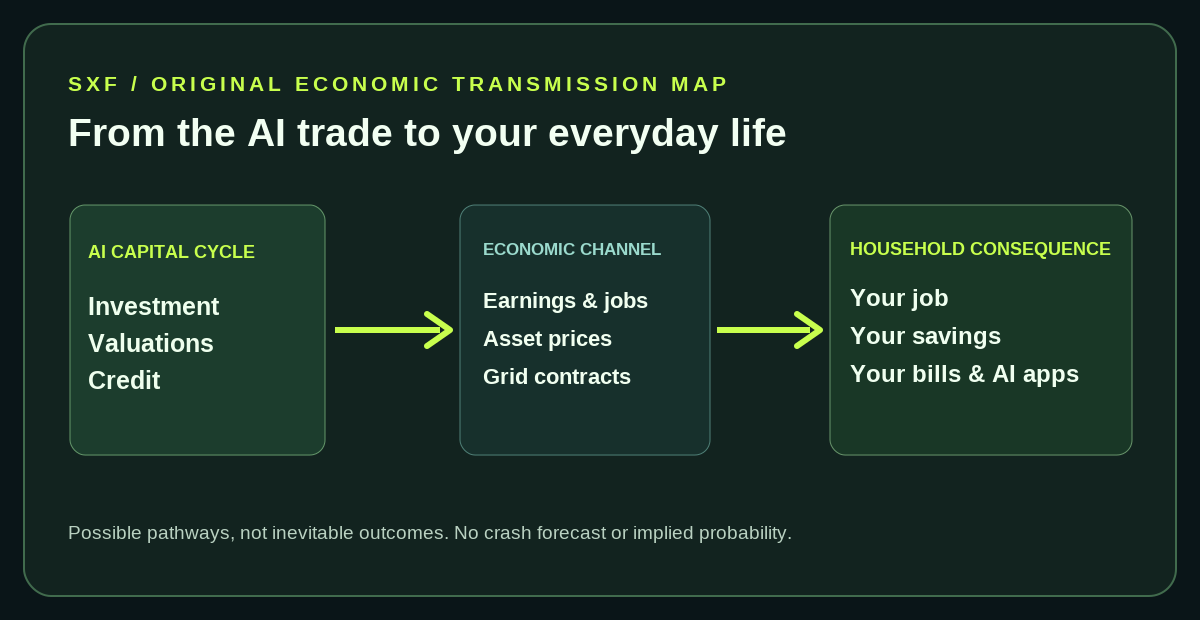
01 / DEFINITIONS FIRST
What is an AI bubble, and what would “bursting” actually mean?
An AI bubble is a situation in which market prices or investment plans depend on expectations of future AI profits that may prove unsustainably optimistic. Calling the technology transformative is not sufficient to justify any particular price. Calling a company overvalued is not the same as claiming that its products do not work.
There are at least three different bubbles commentators often confuse. An equity valuation bubble means investors pay too much for future earnings. An infrastructure overbuilding cycle means more chips, buildings or electricity connections are installed than paying customers need at profitable prices. A business-model bubble means AI providers find it hard to convert intense usage into durable profits after inference, training, sales and infrastructure costs. The three can overlap, but none logically guarantees the others.
Valuation reset
Share prices fall even while model usage and sales keep growing. Households with concentrated holdings feel this first.
Investment slowdown
Cloud companies pause orders, construction and hiring. Some suppliers lose work while useful AI products continue.
Credit or demand shock
Financing becomes difficult and weaker operators cannot cover obligations. Broader spending and employment may suffer.
Was the dot-com crash proof that the internet failed?
No. After the dot-com downturn, many internet companies failed and some assets became cheap, yet the underlying network remained valuable. The comparison is instructive but imperfect: today's largest AI investors often have mature cash-generating businesses, whereas project-level borrowers can be more fragile. Historical analogy cannot tell us which AI assets are currently mispriced or what a market correction will look like.
The Federal Reserve's November 16 speech makes a similar analytical distinction: past rail, road and fiber investments sometimes looked overbuilt, but surviving infrastructure proved useful. The policy challenge is financing and allocation, not whether computers can learn useful tasks.
02 / FOLLOW THE CASH
What does the actual 2026 AI spending evidence show?
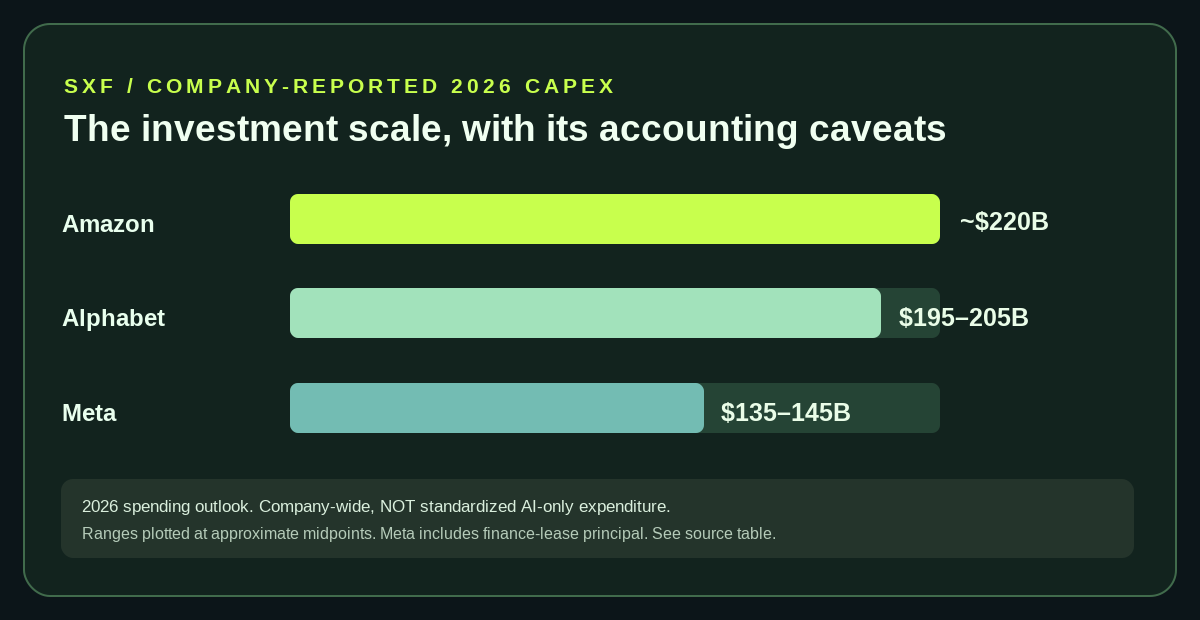
Capital expenditure (capex) buys long-lived assets such as servers, networking, buildings and related infrastructure. It is one of the clearest observable measures of the AI buildout, but the numbers below are company-wide spending, not a separate, standardized “AI-only capex” line. The distinction matters because these companies also fund search, retail, social platforms, ordinary cloud services and non-AI infrastructure.
All three figures come from IEA Powering Artificial Intelligence (October 2026), IEA Key Questions on Energy and AI (2026) and the IMF's October 2026 stability analysis. They describe different measures and time periods; do not add them together.
How much are Amazon, Alphabet, Meta and Microsoft investing?
| Company | Disclosed figure | Period and definition | What it does—and does not—prove |
|---|---|---|---|
| Amazon | About $220B | Expected 2026 cash capital expenditures (Q3 statement, Oct 29) | Large investment commitment; not a measure of AI-specific revenue or profit. |
| Alphabet | $195B–$205B | 2026 total capex guidance (Q3 call, Oct 2026) | Includes broader technical infrastructure; Google Cloud and Search have different monetization paths. |
| Meta | $135B–$145B | 2026 capex guidance, including principal payments on finance leases (Q3 results) | Investments support ads and other services too; finance-lease treatment differs from peers. |
| Microsoft | $45.2B | Capital expenditures in its fiscal Q1 2027 (three months ended Sep 30, 2026) | Quarterly, not annual: do not add directly to 2026 full-year guidance figures. |
Read this before quoting the table: Amazon's cash capex, Meta's finance-lease-inclusive measure, Alphabet's capex and Microsoft's fiscal-quarter figure are not perfectly comparable. This dossier intentionally does not publish a misleading “sum of the big four” or label all spending “AI investment”. Company guidance is forward-looking and can change.
Are strong revenues already disproving the bubble thesis?
No—but they deserve weight. In its Q3 2026 report, Meta reported $64.6B in revenue and an increase of 26% year over year, while its operating expenses also rose and its spending plans remained high. Alphabet's Q3 earnings call reported strong Cloud growth and total infrastructure spending of $51.4B in that quarter. Growing usage and earnings make “everything is fake” an untenable description; they do not determine whether every marginal data center or expensive equity valuation earns its required return.
The relevant question is incremental economics: Does an extra dollar spent on capacity produce enough durable, attributable cash flow over the equipment's useful life to cover operating costs, financing, depreciation and the opportunity cost of capital? Providers rarely break out that exact figure for AI alone. SXF therefore tracks the difference between reported fact and unproven payback claim.
Why financing structure matters
The Federal Reserve identified rapid growth in advanced-computing debt, circular financing and complex obligations as possible amplification channels. Circularity can arise when a company invests in an AI startup that buys compute from the investor or its partners; money can flow between firms before any independent end-customer demand has been demonstrated. Such structures are not automatically deceptive, but they require careful evaluation of who ultimately bears the risk and whether revenues depend on continuing capital injections.
Borrowing backed by a well-capitalized parent is not equivalent to project debt supported by a single tenant. Long-dated leases, power contracts and guaranteed capacity can outlive a technology generation. Conversely, strong cloud utilization and recurring customer revenue can support financing. A single headline debt total does not tell you which projects are viable.
03 / TWO SIDES, SAME EVIDENCE
Is the AI boom sustainable? The strongest bull case and bubble case
AI becomes enduring infrastructure
- Customers continue paying for measurable productivity and better digital products.
- New models lower costs per task faster than demand increases, improving margins and accessibility.
- Cloud, software and enterprise workflow revenue gradually monetizes expensive compute capacity.
- Governments and utilities build grids and policies that support useful new demand without shifting excessive costs onto residents.
- Surviving hardware and infrastructure retain value even when some stock multiples compress.
Weak point: every claim requires evidence of utilization, profitability and efficiency—not just capability announcements.
Expectations outrun paying demand
- Capex and depreciation rise faster than incremental AI revenue or free cash flow.
- Price competition makes model access cheaper while infrastructure and power remain costly.
- Chip generations turn over rapidly, stranding capacity before it is paid back.
- Debt, commitments or circular business relationships amplify a slowdown.
- High market concentration exposes broadly held funds to a small group of issuers.
Weak point: high spending is not proof of a bubble if future earnings and social benefits justify it.
The Bank of England's July 2026 Financial Stability Report discussed concentrated AI-linked equity markets and debt-financed infrastructure. It also modeled a severe hypothetical equity correction. That exercise is a resilience test, not a prediction that the S&P 500 will fall a particular amount. The useful takeaway is that asset concentration can magnify shocks even when the technology's benefits persist.
04 / ORIGINAL SXF SCENARIO LAB
What happens if the AI bubble bursts? Three intelligent scenarios for 2027–2030
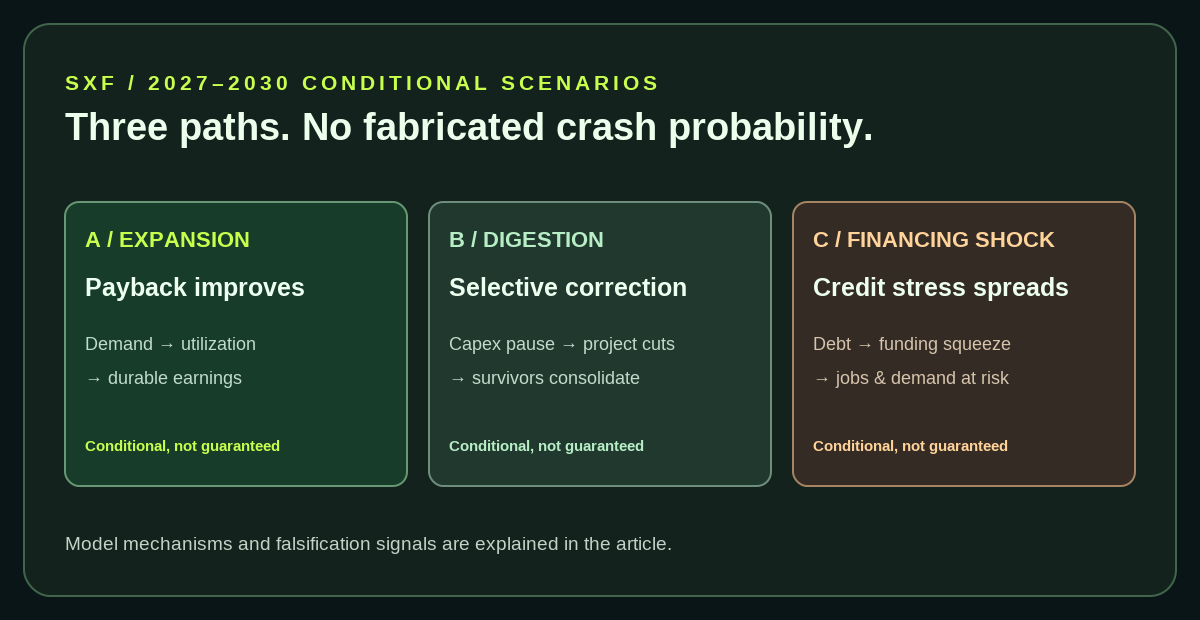
SXF uses three conditional pathways. They are not equally likely by assumption, have no assigned odds and are not independent of interest rates, geopolitics or wider economic shocks. The purpose is to make it possible to ask what evidence would support—or disprove—each story.
1. Continued AI expansion — returns begin catching up with spending
Trigger: reported enterprise revenue and cost savings become recurring and verifiable, data-center utilization remains healthy and the returns on additional infrastructure improve. Earnings growth increasingly comes from AI-enabled products rather than just fresh investment or inter-company deals.
Likely economic channel: infrastructure hiring persists, software and professional work change rapidly, new services become affordable and grid pressure needs managing. Some overvalued shares could still decline without derailing the broader buildout.
What would invalidate it: repeated capex increases with weakening unit economics, chronic idle capacity, lower renewal rates or meaningful credit impairment. SXF interpretation, not a company forecast.
2. A selective correction — strong AI firms survive, weaker projects fail
Trigger: capital guidance flattens, prices for compute normalize, venture funding tightens and cloud firms prioritize making existing capacity earn its keep. Some new projects are delayed or cancelled, but mainstream AI usage continues.
Likely economic channel: layoffs and construction slowdowns cluster in specific businesses and regions; consumer AI prices might fall for commodity tasks, while premium features remain costly. Stock indexes can wobble because large AI-linked firms carry heavy index weight. Local power planners face risk from unused promised loads.
What would invalidate it: demand and profits reaccelerate across independent end customers, or severe funding stress spreads beyond individual projects. Our base editorial posture is to keep this middle path open—not to assign it a numerical probability.
3. Sharp AI bubble burst — a market repricing spreads into the real economy
Trigger: multiple major forecasts disappoint, leveraged projects struggle to refinance, lenders demand higher yields, new capacity loses buyers and market confidence erodes. Cross-company guarantees and concentrated holdings amplify losses.
Likely economic channel: a drawdown in AI-linked shares reduces portfolio values; credit tightens for weaker firms; affected construction, chip, cloud and startup hiring contracts. A consumer spending slowdown can follow through wealth and income effects. This does not mean ChatGPT or cloud computing instantly stops working.
Institutional stress benchmark: the IMF's October 2026 scenario describes possible level declines by 2028 of up to 0.4% in global GDP, 1.3% in investment and 0.6% in consumption in an AI-unwind scenario. These are conditional modeled effects, not measured losses, SXF forecasts, or universal outcomes.
What could happen in the first 90 days of a serious AI correction?
Days 1–30: stock volatility, earnings revisions, wider borrowing spreads and additional scrutiny of infrastructure commitments may appear before job or tariff changes. Months 2–3: management teams can cut procurement, defer projects and pause hiring; private valuations and new financings may adjust with a lag. Months 4–18: contractors, regions and utility projects feel the consequences, depending on their exposure and financing. 2028–2030: the lasting question is how much installed capacity supports real productivity versus how much becomes stranded.
This is a transmission timetable for analysis, not an event calendar or a claim that these phases are underway.
Which scenario is SXF leaning toward right now?
We do not have enough standardized evidence to put a defensible probability on any pathway. The spending and debt evidence increases the stakes; revenue and actual adoption make a blanket “AI is worthless” thesis unconvincing. Our working rule is to treat selective corrections as possible even under successful long-term adoption. That position can be falsified by sustained multi-quarter profit and utilization improvements or by a wider credit deterioration. Evidence should move the view, not a viral headline.
05 / SXF ORIGINAL INTERACTIVE RESEARCH
SXF AI Bubble Monitor: the signals that matter more than headlines
This publication-date evidence monitor connects six observable classes of signals to the scenario framework. It is a hand-reviewed snapshot as of November 17, 2026—not a live market feed, real-time stock screener or automated crash detector. Click a scenario to review its mechanisms and the evidence that would change our assessment.
IEA: major data-center operators expected to spend over $700B in 2026.
IEA data ↗Revenue is reported; standardized AI-only returns on new capacity are not.
Alphabet Q3 ↗Fed raises advanced-computing debt, circular financing and obligations.
Fed speech ↗IEA projects 485 TWh (2025) to 950 TWh (2030) for all data centers.
IEA outlook ↗OECD finds both complementary and displacement channels across tasks.
OECD analysis ↗Bank of England flags a narrow set of AI-linked firms dominating returns.
BoE analysis ↗Explore a conditional scenario
Independent customer revenue and efficient capacity utilization improve alongside spending.
- What would support it
- Recurring revenue, higher utilization and improved unit economics.
- What would challenge it
- Orders accelerate while cash conversion and demand quality deteriorate.
- What households notice
- Faster tool adoption, changing skills demand and localized grid investment.
How does SXF decide whether to change the analysis?
A revision requires evidence across at least two independent channels, such as company demand plus financing, or reported capex plus utility cancellations. A single stock-price move does not establish a change in underlying productivity. We also separate quarterly spending from multi-year contractual commitments and guidance from money actually spent.
06 / YOUR WORK
Will the AI bubble bursting cost people their jobs?
It could affect some jobs, but effects would not be uniform or identical to AI automation. A sudden cut in data-center funding can reduce demand for construction contractors, semiconductor supply chains, specialist consultants and venture-backed startup hiring. Separately, AI tools can change administrative, creative and analytical tasks even if equity prices remain strong. These are different labor-market processes and should be measured separately.
The OECD's July 2026 research describes three simultaneous channels: automation of tasks, creation of new tasks and improvements in productivity. High AI exposure does not by itself mean a job is likely to disappear. The OECD also notes different risks for routine work and that foundational, technical and social skills remain important.
| Worker / business | If the buildout expands | If investment contracts | Low-regret response |
|---|---|---|---|
| Data-center construction & utilities | Demand for approved projects and grid skills | Delayed builds and uneven regional workload | Transferable electrical and infrastructure skills; assess project pipeline |
| AI startups & suppliers | Rapid hiring, harder-to-measure quality | Funding gaps, consolidation and selective layoffs | Evaluate runway, customers and revenue concentration |
| Office / service employees | Task redesign and productivity changes | Cost cutting may coexist with AI adoption | Learn verification, workflow design and human judgment |
| Small businesses | Cheaper tools and new digital services | Vendor churn, service withdrawal, price changes | Export data and maintain more than one provider option |
Will AI replace all jobs if the bubble does not burst?
No evidence supports a blanket “all jobs” claim. Tasks within jobs change at different rates; organizational adoption, regulation, customer expectations and capital budgets matter. An AI boom may accelerate investment in workplace tools, while a bust may slow some deployment and simultaneously pressure employers to reduce costs. The net employment outcome is therefore uncertain. Consult the OECD's August 2026 assessment of young workers before attributing youth labor trends solely to AI.
For readers interested in the technology rather than financial markets, SXF's guide to agentic AI explains where autonomous tools are moving beyond simple chat, while our use-case atlas examines the organizational tasks most likely to be reshaped.
07 / YOUR SAVINGS
What happens to your savings, pension or 401(k) if AI stocks crash?
Exposure depends on what you actually own. Someone holding a diversified global pension fund may still have substantial indirect exposure to a handful of large technology companies; someone holding short-term savings outside equities has a different risk profile. If AI-linked shares fall sharply, broad index funds can decline through the market-cap weights of those companies. The size of any loss is not knowable from a generic “AI bubble” headline.
The Bank of England identifies concentration as a possible channel for larger market moves. Its July 2026 stress exercise includes a sharp, explicitly hypothetical equity-market shock to study resilience; it is not a price target. The IMF additionally identifies reduced consumption through wealth effects in its adverse AI-investment scenario.
How much could a concentrated stock sleeve move your portfolio?
This simple arithmetic illustration is not a prediction. It assumes one part of a portfolio moves by your chosen percentage and the rest stays flat, without taxes, fees, rebalancing or correlated changes.
Reality can differ materially because other assets may also fall, rise or correlate with AI-linked firms. Do not use this illustration to time the market or select investments.
Should you sell every technology stock?
This article cannot determine that for any reader. A risk review should start with concentration, investment horizon, liquidity needs, fees, tax consequences and tolerance for losses. Panic selling after a headline can lock in a decline; assuming a single sector will always rebound is also a gamble. Consider a qualified independent financial professional for decisions involving retirement savings or major liabilities.
08 / YOUR ELECTRICITY BILL
Could an AI bubble make electricity bills higher—or lower?
Both outcomes are possible; grid rules decide who pays. Data centers increase electricity load in particular locations. If new lines or generation are built and costs are recovered broadly from existing customers, household bills can face upward pressure. If a large user pays its incremental costs and better utilizes existing infrastructure, it can spread fixed costs across more demand. The IEA's October 2026 report explicitly says household electricity-bill effects are not clear-cut.
Even a spending crash might not promptly lower bills. Long-lived assets, regulated cost recovery, stranded capacity, energy commodity prices and ongoing unrelated load growth can all persist after projects are cancelled. Conversely, strong demand does not automatically mean a particular household's price rises if the tariff allocates costs appropriately.
What do the real energy forecasts say?
The IEA's 2026 central case estimates 485 terawatt-hours of global electricity use by all data centers in 2025 and projects about 950 TWh by 2030. This is not a prediction that every AI query uses twice as much power: improvements in efficiency, more users, larger workloads and other data-center activities all contribute. The IEA says AI-focused data centers can grow faster than the total.
The SXF three-question utility test
- Who pays for new capacity? Check a utility filing or regulator decision: existing households, the developer, or a mix?
- Is the project contractually committed? A public announcement or grid queue entry may never become a fully funded load.
- Who bears abandonment risk? If the customer leaves, do take-or-pay contracts, collateral or exit fees protect other ratepayers?
This matters as much as headline energy consumption. For a separate explainer of cooling, withdrawals and water consumption, read SXF's AI water and electricity footprint guide. Its per-query measurement caveats are different from the financial question analyzed here.
09 / TOOLS PEOPLE ACTUALLY USE
Would ChatGPT, Gemini or everyday AI apps disappear if an AI bubble bursts?
No automatic connection exists between falling AI stocks and an immediate shutdown of AI applications. Infrastructure and products can be acquired, repriced, consolidated or operated profitably by survivors. Yet smaller providers relying on cheap venture capital or subsidized compute can change terms or close. Consumers might encounter fewer free tiers, delayed features, tighter usage limits or service migrations. Competition could also make commodity AI tasks cheaper. No single direction is certain.
Prices are set by more than share valuations: model inference efficiency, chips, electricity, cloud rental, distribution, competitive dynamics and user willingness to pay all matter. A provider can lower API prices while increasing paid-subscription tiers. For a technical but accessible bridge, see SXF's AI agent cost research and model pricing intelligence—their compute economics help explain why high usage does not guarantee high margin.
What should a regular user do before relying on one AI service?
Keep copies of original files; confirm export options for important projects; use ordinary backups; check cancellation and portability terms; and avoid storing your only copy of irreplaceable work inside an unverified chat. For sensitive data decisions, see SXF's personal-information removal guide. Resilience and privacy are related, but a crash scenario does not justify uploading private material to multiple services without a reason.
10 / EVIDENCE THAT WOULD MOVE THE THESIS
Seven warning signs of an AI bubble burst—and seven things they cannot prove alone
| Indicator | Why it matters | Why one observation is insufficient |
|---|---|---|
| 1. Capex vs free cash flow | Costs can outpace cash generation | Upfront investment can precede returns for years. |
| 2. AI revenue quality | Tests whether usage turns into recurring third-party payment | Reported total cloud revenue includes non-AI activities. |
| 3. Data-center utilization | Idle compute impairs payback | New facilities ramp gradually; no standardized public utilization series. |
| 4. Credit spreads & refinancing | Funding stress can transmit into projects and suppliers | Interest rates may move for economy-wide reasons. |
| 5. Long-term obligations | Leases and power commitments can survive demand changes | Many contracts have flexibility or creditworthy counterparties. |
| 6. Hiring & project cancellations | Shows transmission to the real economy | Changes may reflect non-AI business cycles or local permitting. |
| 7. Market concentration | A small group of shares can dominate index movements | High market cap alone is not evidence of mispricing. |
What would make SXF more optimistic?
Published, comparable disclosures showing sustained incremental customer revenue, durable free cash flow after infrastructure requirements, reliable independent demand and clear economic payback. Improved energy integration and falling cost per completed task would strengthen the case too.
What would make SXF more concerned?
Several reporting periods of worsening cash conversion alongside still-rising spending; widening credit stress; project cancellations outside isolated geography; commitments far beyond demonstrable end-user demand; or results that are mostly dependent on firms financing their own customers. We would seek corroboration across independent sources before changing the headline assessment.
11 / LOW-REGRET ACTIONS
What should you do now if you are worried about the AI bubble?
Strengthen portability
Map which tasks involve AI, document outcomes, broaden skills and maintain a practical job-search buffer if your employer depends on speculative financing. Do not treat industry headlines as a personal layoff forecast.
Understand concentration
Read your pension or fund allocation, distinguish cash from equities, and avoid reacting to a single session. Any portfolio changes should match personal circumstances and professional advice where appropriate.
Follow the local tariff
Review utility rate cases, local grid proposals and who funds data-center connections. National AI investment headlines rarely tell you your next monthly bill.
Build a backup plan
Export your important work, check subscriptions and data controls, and keep workflows portable. A provider's profitability is less relevant than your ability to retain data and switch safely.
The highest-quality risk decision is often a boring one: improve information quality, understand actual exposure and avoid false certainty. For advanced readers, SXF also publishes benchmark methodology, model selection frameworks and agent reliability research to distinguish technical progress from commercial claims.
12 / FAQ / DIRECT-SEARCH ANSWERS
AI bubble explained: the questions people search for
Is the AI bubble going to burst in 2026?
No credible source can confirm that a burst is inevitable by a particular date. IMF and Federal Reserve officials warn about valuation and financing risks, while company reports show real spending and revenue. SXF treats the outcome as uncertain and uses conditional scenarios.
What happens if the AI bubble bursts?
Possible outcomes range from AI-related stocks falling without a major real-economy shock to halted data-center builds, tighter startup financing, layoffs in exposed businesses and weaker spending. The severity depends on debt, valuations, demand and how widely losses spread.
Will an AI bubble burst cause a recession?
Not necessarily. The IMF modeled an adverse AI investment unwind affecting global output, investment and consumption, but that conditional scenario is not a recession forecast. Other economic conditions and policy responses matter.
How much are Big Tech companies spending on AI in 2026?
The IEA expects more than $700 billion in 2026 capex by major data-center operators. Company statements disclose large full-company amounts; definitions differ and not all spending is exclusively for AI.
Will an AI bubble burst lower electricity bills?
Not automatically. Electricity bills depend on local generation, tariffs, grid investments and who bears the cost of abandoned projects. The IEA says large data-center loads can raise or sometimes relieve cost pressure depending on the charging structure.
Will AI stocks crash while AI still succeeds?
Yes, that is possible. Market prices reflect future profit expectations, while technology adoption may continue even when investors pay less for those expected profits.
Will ChatGPT become free if the AI bubble bursts?
There is no reliable basis for that prediction. AI product pricing depends on competition, inference costs, paid demand and provider business models; prices and free tiers can move in different directions.
Which jobs are most at risk from an AI bust?
Projects reliant on speculative infrastructure financing and startup funding could feel cuts first, but outcomes vary. This is distinct from job task automation, which the OECD describes as having both complementary and displacement effects.
Is the AI bubble like the dot-com bubble?
Both involve investment excitement around a potentially important technology, but financing, business maturity, distribution, regulation and physical infrastructure differ. The analogy highlights risks rather than proving an identical crash.
Is there an accurate AI bubble crash indicator?
No single validated indicator predicts a crash date. A credible assessment compares sustained revenue and utilization with capex, free cash flow, leverage and obligations, while considering market concentration and macroeconomic forces.
13 / PRIMARY DOCUMENTATION
Sources, definitions and SXF research methodology
Reviewed November 17, 2026. This report prioritizes public primary documents and dated financial disclosures over anonymous market claims. When the source is a company, numbers are company-reported; when the source is a regulator or international body, scenario figures reflect that institution's modeling assumptions, not real-world measured outcomes.
- IEA, Powering Artificial Intelligence, October 14, 2026 — >$700B hyperscaler capex, billing and grid cost-allocation mechanisms.
- IEA, Key Questions on Energy and AI, 2026 — 485 TWh actual estimate in 2025 and 950 TWh central projection in 2030.
- IMF, World Economic Outlook, October 2026 and Global Financial Stability Report Chapter 1 — conditional GDP, investment and consumption effects in an AI unwind.
- Federal Reserve, Governor Barr, November 16, 2026 — advanced-computing debt, circular financing and historic infrastructure comparison.
- Federal Reserve, Financial Stability Report, November 13, 2026 — financial-system vulnerability context.
- Amazon Q3 2026 earnings release, October 29 — approximate $220B expected cash capital expenditure in 2026.
- Alphabet Q3 2026 earnings call — $195B–$205B 2026 capex outlook and disclosed cloud/technical-infrastructure figures.
- Meta Q3 2026 results — $135B–$145B 2026 capex including finance-lease principal.
- Microsoft FY27 Q1 earnings call, October 28 — $45.2B quarterly capital expenditures.
- OECD, Skills in the AI Age, July 2026 and OECD, Youth Labour Markets & AI, August 2026 — nuanced task, skill and employment evidence.
- Bank of England, Financial Stability Report, July 2026 — concentration and hypothetical stress-test scenarios.
- Associated Press, November 17, 2026 — contemporaneous market volatility; editorial context, not proof of a burst.
What is original SXF work here?
The three-scenario transmission framework, six-signal monitor, household portfolio arithmetic, time-ordered shock map and utility risk checklist were developed by SXF / AI for this guide. They are desk-based transparent frameworks. We have not independently audited corporate accounts, polled households, conducted longitudinal market tests or estimated scenario probabilities. We do not portray any illustrative results as observed trials.
Update policy: The snapshot remains dated. If new official data changes the analysis, SXF will document a revised date and source rather than silently rewrite historical claims. Corrections: info@sxf.si. Nothing in this guide constitutes securities, employment, legal or household energy-tariff advice.