SXF GUIDE / AI AGENTS
What Is Agentic AI?
How AI Agents Actually Work
Agentic AI is the shift from AI that mainly answers to AI that can pursue an outcome: plan a task, choose tools, act in software, observe what happened, recover from mistakes and continue. This guide explains that shift from first principles—with real 2026 examples, practical use cases, architecture, limits, safety controls and a clear map from a single agent to multi-agent systems, super agents and the much bigger AGI question.
Agentic AI is AI that can pursue a goal through actions, not just generate a response.
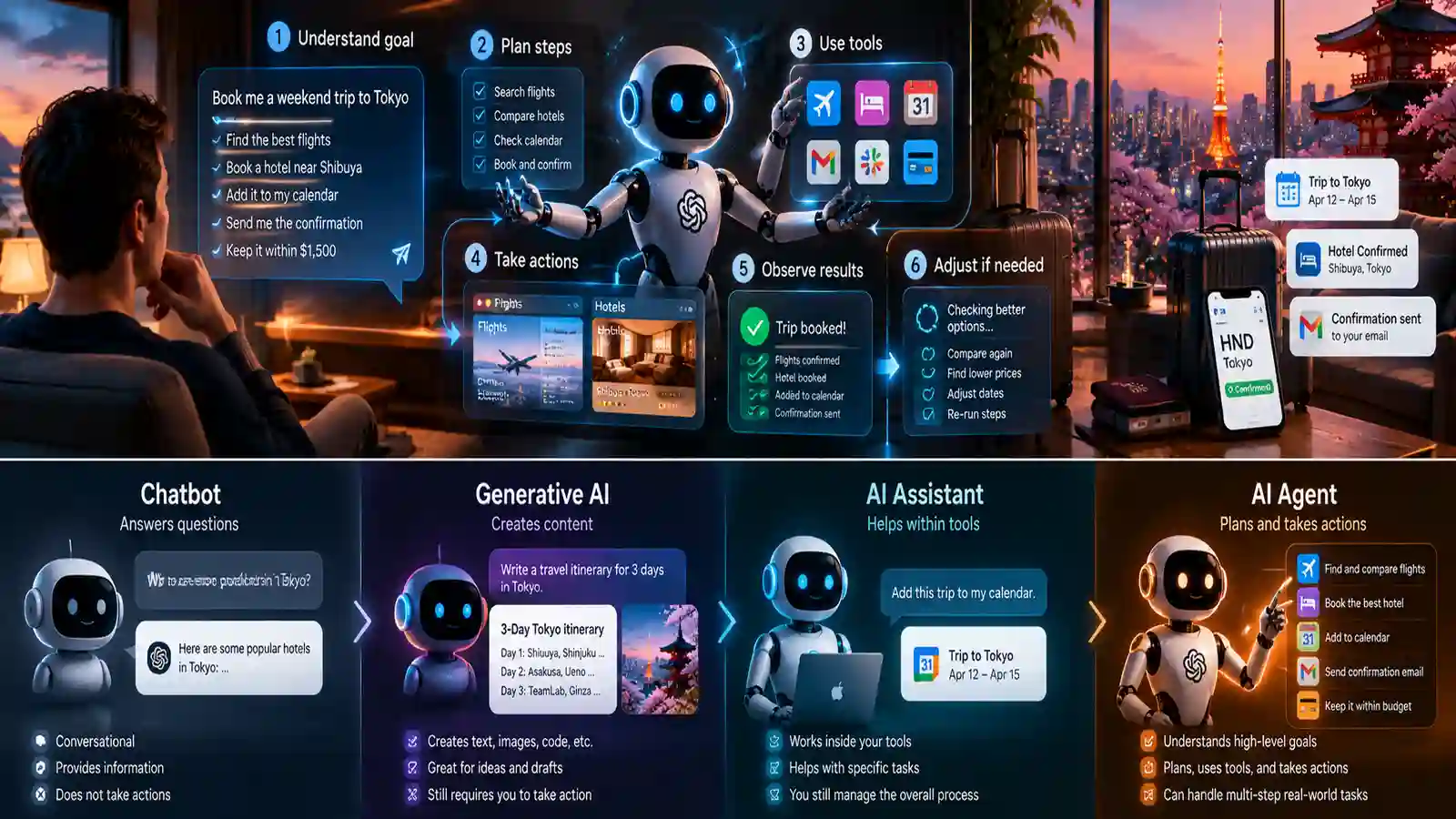
An AI agent usually combines a capable model with instructions, tools, state or memory, permissions and an execution loop. It interprets a goal, decides what to do next, uses a tool or environment, observes the result, and then chooses whether to continue, retry, verify, ask for help or stop. The important shift is ownership of the execution loop: a chatbot waits for the next prompt; an agent can keep working toward an outcome.
THE 20-MINUTE DIFFERENCE
You ask a chatbot to find a flight. You ask an agent to finish the trip.
You type: “Find me a morning flight to Berlin next Thursday under my company travel limit.”
A chatbot can search its knowledge or browse, summarize options and tell you which flight looks best. Useful—but the execution loop still belongs to you. You open the airline. You compare baggage rules. You enter the passenger details. You add the trip to your calendar. You forward the itinerary. You file the receipt.
An agentic system can be designed to take a different kind of responsibility. It can clarify the travel policy, search current options, compare constraints, prepare the booking, stop at the payment boundary for approval, add the confirmed trip to your calendar and place the receipt in the right expense workflow.
The intelligence may come from the same family of language models. The difference is what surrounds the model—and how much of the job the system is allowed to own.
That is the simplest way to understand agentic AI. It is not “AI with a personality,” and it is not automatically AGI. It is an execution architecture: models are placed inside a loop with tools, state, rules and enough autonomy to move a task forward.
Google Cloud's 2026 definition emphasizes autonomous decision-making and action, while its agentic-workflow guidance describes systems that interpret a high-level goal, plan steps and adjust to runtime conditions. OpenAI describes the same product shift from another angle: knowledge work is moving from short chatbot interactions toward delegated, long-horizon tasks that agents can pursue for minutes or hours while using tools and environments.
DEFINITION
What is agentic AI?
Agentic AI is a broad term for AI systems designed to pursue goals with a meaningful degree of autonomy. Instead of only returning content, an agentic system can decide what intermediate steps are needed, select tools, take actions, inspect results and continue until it reaches a completion condition.
There is no single global standards body that enforces one definition of “agentic AI.” Vendors and researchers use the term somewhat differently. Some use it for a single autonomous agent. Others reserve it for larger systems that coordinate several agents. The stable idea underneath the terminology is goal-directed action over multiple steps.
The main product is content: text, code, images, audio, analysis or another generated response.
The model is part of a control loop that can operate tools and environments until the task is complete or must be escalated.
That distinction is more useful than asking whether a product “has agents” in its marketing. If the user still has to manually execute every consequential step, the system is closer to an assistant. If the system can own the loop—within defined boundaries—it is behaving agentically.
BUILDING BLOCK
What is an AI agent?
An AI agent is a software system that uses an AI model to pursue a goal on behalf of a user, application or organization. The model provides reasoning and language capability, but the surrounding software gives it the ability to act.
A useful mental model is:
Remove the tools and the agent may still reason, but it cannot change anything outside the conversation. Remove state and it may lose track of a long task. Remove permissions and it cannot act in protected systems. Remove the execution loop and it becomes a one-shot model call.
This also explains why two products using the same base model can feel completely different. One may expose only chat. Another may surround the model with a browser, terminal, file system, application connectors, memory, approval gates and a scheduler. The second system has a much larger action surface.
THE CORE LOOP
How do AI agents actually work?
Most agent designs can be reduced to a loop. The implementation details vary, but the logic is remarkably consistent.
Goal
The user or another system provides an outcome: fix this bug, research this market, reconcile these invoices, prepare this trip.
Plan
The agent interprets constraints and decides on a next step. Some systems create an explicit plan; others plan implicitly one action at a time.
Choose a tool
The model selects a capability: search, browser, code execution, database query, API call, file edit, message draft or specialist agent.
Act
The surrounding software executes the requested action within the permissions and sandbox assigned to the agent.
Observe
The result comes back: a web page, command output, API response, changed file, error, new data or confirmation.
Decide again
The agent checks progress and chooses to continue, retry, change strategy, verify, ask for approval or stop.
This action–observation loop is what turns a language model into an acting system. The model does not literally click a mouse or write to a database by magic. An execution layer interprets the model's selected action, enforces rules, performs the operation and returns the result.

ANATOMY
The seven layers behind a useful AI agent
The model gets most of the attention, but production agents are systems. Reliability comes from the layers around the model.
Interprets goals, reads observations, generates plans and selects actions. Different steps can use different models.
Defines the role, objective, constraints, completion criteria and how the agent should respond to uncertainty.
Search, browser, code execution, APIs, files, databases, SaaS connectors, MCP servers or other callable capabilities.
Tracks intermediate results, decisions, IDs, progress and variables so the workflow does not depend on replaying an unlimited transcript.
Persistent preferences or retrieved knowledge can improve continuity, but memory needs provenance, limits and update rules.
Decides when the model is called, when tools execute, when retries happen, when verification is required and when work is complete.
Determines what the agent can read, change, send, buy, deploy or delete—and which actions require human approval.
Google Cloud calls the surrounding execution environment an agent framework or agentic harness: infrastructure that lets a model interact with external tools, remember relevant state and execute multi-step tasks. That framing is useful because it prevents a common misconception: the model is not the whole agent.
CLEAR THE TERMINOLOGY
Agentic AI vs generative AI vs chatbot vs AI assistant
These categories overlap. A modern product can behave like a chatbot in one mode and an agent in another. The table describes the typical execution model rather than rigid product labels.
| System | Main unit of value | Can use tools? | Can continue without another prompt? | Typical outcome |
|---|---|---|---|---|
| Chatbot | Conversation turn | Sometimes | Usually limited | Answer or recommendation |
| Generative AI | Generated content | Optional | Not required | Text, code, image, audio or analysis |
| AI assistant | User support | Often | Usually user-led | Help completing a task |
| AI agent | Delegated task | Core capability | Yes, within boundaries | Executed work |
| Agentic system | Workflow or objective | Yes, often many | Potentially extended | End-to-end process or coordinated result |
REAL EXAMPLES / 2026
What do AI agents look like in the real world?
The easiest way to understand the category is to look at systems that already own more than one step of a task.
1. Coding agents
Coding agents can inspect a repository, edit multiple files, execute commands, run tests and iterate after failures. OpenAI's 2026 long-horizon Codex experiment is a useful illustration: a coding agent ran for roughly 25 hours on one build task, consuming about 13 million tokens and generating roughly 30,000 lines of code. OpenAI presented it as an experiment rather than a production guarantee, but it demonstrates the direction of travel: software work can be delegated as a long-running objective rather than requested one snippet at a time.
2. Research agents
Anthropic's Research architecture uses a lead agent that develops a research strategy and creates specialist subagents to investigate independent directions in parallel. The workers return findings to the lead agent, which synthesizes the result and can decide that more research is needed. Anthropic reported a 90.2% improvement over a single-agent configuration on one internal research evaluation—but also much higher token consumption. The result is not “multiple chat windows”; it is orchestration.
3. General work agents
OpenAI describes ChatGPT Work as an agent that can act across applications and files, break a goal into smaller steps and stay with complex projects for hours. The interesting change is not the brand. It is the interface: the user increasingly delegates an outcome rather than manually prompting each transformation.
4. Browser and computer-use agents
Computer-use systems can operate software through a browser or graphical interface when a suitable API is unavailable. OpenAI's Agents API computer-use documentation describes an agent that navigates an OpenAI-hosted browser, observes pages and chooses subsequent actions. This makes agents more general—but also exposes them to interface ambiguity, sign-in boundaries and untrusted content.
5. Business automation agents
Business agents connect judgment to existing operational systems. A traditional automation might say, “when form X arrives, copy field Y into CRM Z.” An agentic workflow can interpret an unstructured request, determine which record matters, choose a path, ask for missing information and adapt when the workflow does not match a pre-written branch. Zapier's 2026 use-case guide highlights the same distinction: the value is messy, multi-step work where rigid automation alone becomes difficult to maintain.
PRACTICAL USE CASES
Eight AI agent use cases that make sense today
Agents are most useful when the work has a clear outcome but the path contains interpretation, variable inputs or tool choices. They are less useful when every step is deterministic and a normal script can do the job more reliably.
Research and analysis
Search many sources, follow promising leads, compare evidence, extract facts, maintain notes and assemble a cited report.
Why an agent?The next search depends on what the previous search found.
Coding and engineering
Understand a codebase, plan changes, edit files, run tests, inspect failures and iterate until the acceptance criteria are met.
Why an agent?Software tasks create feedback loops rather than one-shot code generation.
Customer service
Interpret an issue, retrieve account context, check policy, propose a resolution, update the ticket and escalate exceptions.
Why an agent?The correct workflow varies with customer state and policy.
Back-office operations
Reconcile documents, classify exceptions, collect missing data, update systems and route cases that require judgment.
Why an agent?Inputs are often unstructured and incomplete.
Sales and account work
Research accounts, prepare meeting context, update CRM fields, draft follow-ups and surface next actions for approval.
Why an agent?The task spans information gathering, synthesis and several systems.
Personal productivity
Organize travel research, prepare schedules, compare purchases, maintain task lists and assemble information across files and the web.
Why an agent?The user delegates coordination instead of micromanaging prompts.
Security assistance
Triage alerts, gather context, explain suspicious activity and perform bounded investigation steps under strict policies.
Why an agent?Investigation paths change as new evidence arrives.
Reporting and data workflows
Collect data, query systems, clean outputs, explain anomalies and produce a finished report or artifact.
Why an agent?The workflow combines structured tools with interpretation and presentation.
HOW AGENTS TOUCH SOFTWARE
API action vs browser action: the same goal, very different reliability
An agent needs an interface to act. The strongest interface is usually the most structured one available.
The agent submits known parameters to a defined operation. Inputs and outputs can be validated, permissions scoped and failures handled deterministically.
The agent interprets a visual interface, clicks controls and adapts to changing pages. It can work where no API exists, but the environment contains more surprises and untrusted content.
A good agent architecture does not use computer control just because it looks impressive. If a stable API can create the calendar event, use the API. If the only way to finish a legacy workflow is through a web interface, browser use can be the fallback.
STATE & MEMORY
Does an AI agent remember what it is doing?
“Memory” is often treated as one feature, but production agents need several different kinds of context.
Useful for continuity, but long transcripts become expensive and noisy.
IDs, decisions, completed steps, pending items, constraints and intermediate outputs belong here.
Documents, databases and search results can be retrieved instead of permanently packed into the prompt.
User preferences or durable facts can improve continuity, but need clear provenance, privacy controls and update rules.
Anthropic's multi-agent research system illustrates why structured state matters. Its lead agent saves a research plan to memory so the strategy survives even if the active context must be truncated. The lesson is broader: good agents do not confuse “remember everything” with “preserve the information required to make the next correct decision.”
MULTI-AGENT SYSTEMS
Can multiple AI agents work together?
Yes. A multi-agent system uses two or more agents with separate roles, context, tools or objectives. The most common production pattern is an orchestrator-worker architecture: one lead agent decomposes the objective, delegates bounded tasks to specialists and integrates their outputs.
This architecture is useful when work can genuinely happen in parallel. Research is a strong example: one subagent can investigate competitors, another pricing, another regulation and another technical architecture. Each has a clean context window. The orchestrator then compares and synthesizes the findings.
But multiple agents are not automatically smarter. Anthropic reports that its agents typically use around four times more tokens than normal chat interactions and its multi-agent systems around fifteen times more than chats in the described research setup. Coordination also creates failure modes: duplicated work, contradictory findings, runaway delegation and uncertain responsibility.
If one agent plus tools can reliably complete the task, adding five more agents usually buys complexity before it buys capability.
FROM AGENT TO SUPER AGENT
When does an AI agent become a “super agent”?
“Super agent” is not a formal scientific threshold. In current industry usage, it usually describes a higher-level system that owns a broader workflow and can orchestrate specialist agents, models and tools rather than acting as one narrow worker.
Responds to the user.
Helps the user perform work.
Owns a bounded multi-step task.
Coordinates multiple agents or specialists.
Orchestrates a broader end-to-end outcome across agents, tools and systems.
Claims about general intelligence—not simply architecture or tool access.
The last distinction matters. An agent can look dramatically more capable than its base model because the system gives it memory, tools, parallel workers and time. That is system-level capability amplification. It does not prove the model has become AGI.
For the deeper architecture, see AI Super Agents in 2026 and How to Build an AI Super Agent. For the larger intelligence question, see the SXF Superintelligence hub.
REALITY CHECK
What AI agents still get wrong
Agents are powerful precisely because they turn model outputs into actions. That also means ordinary model weaknesses can compound across a workflow.
A vague objective can produce a perfectly executed wrong plan.
A small mistake early in a ten-step workflow can change every later observation and decision.
An agent may keep trying an impossible route, wasting time, money and tool calls instead of escalating.
Web pages, documents and tool outputs may be wrong, malicious or designed to manipulate an agent.
A browser button may look successful while the underlying transaction failed, or a tool may return partial data.
The same model can choose different plans across runs, which makes evaluation and debugging harder than deterministic software.
Long tasks involve repeated model calls, tool calls, retries, browsing and sometimes several agents operating in parallel.
Anthropic describes the “last mile” from an agent prototype to production as unusually difficult because errors compound across trajectories. OpenAI's long-horizon work shows the other side of the same coin: when an agent becomes more persistent, it also gets more opportunities to take an unintended action. Reliability has to be measured across the whole task, not only the quality of one response.
AUTONOMY
How much autonomy should an AI agent have?
Autonomy should not be one global switch. It should increase or decrease with the reversibility and impact of the action.
| Action | Typical risk | Reasonable default |
|---|---|---|
| Search public information | Low | Allow automatically; verify important claims |
| Read approved files | Low–medium | Scope access to required folders/data |
| Edit a draft or sandbox | Medium | Allow with versioning and rollback |
| Send an external message | Medium–high | Preview or approval for sensitive communication |
| Deploy to production | High | Independent checks + explicit approval |
| Move money / change permissions | High | Strict limits, policy validation and human approval |
| Delete critical data | Very high | Keep outside autonomous authority or require strong multi-step approval |
OpenAI's internal Codex deployment uses this kind of layered approach: sandboxing defines where the agent can operate, network policies constrain outbound access, approvals govern boundary-crossing actions and telemetry records prompts, tool use and approval decisions. The principle generalizes far beyond coding: autonomy should be bounded by consequence.
SAFETY & SECURITY
Are AI agents safe?
They can be useful and controllable, but an agent has a larger security surface than a chatbot because it can take actions. The most important risks are not mysterious. They emerge where language, tools, identity and authority meet.
Least privilege
Give an agent the minimum data and tool permissions needed for its current job.
Prompt-injection defense
Treat web pages, documents, emails and retrieved content as untrusted data that may contain instructions designed to redirect the agent.
Sandboxing
Run code and computer actions inside constrained environments with clear filesystem and network boundaries.
Approval gates
Require humans—or an independently governed review layer—for high-impact or irreversible actions.
Independent verification
Validate outputs and outcomes with deterministic checks, policies or separate reviewers where possible.
Auditability
Record tool calls, state changes, permissions, errors and approvals so an operator can reconstruct what happened.
OWASP's Top 10 for Agentic Applications 2026 highlights risks including agent goal hijacking, tool misuse, identity and privilege abuse, agentic supply-chain vulnerabilities and cascading failures. These categories make one principle clear: when a model can act, security must govern the execution path, not just filter the final text.
SXF covers the technical controls in depth in AI Agent Security in 2026 and the most important instruction-layer attack in Prompt Injection in AI.
DECISION GUIDE
When should you use an AI agent—and when should you not?
The best agent use case is not “anything an LLM can touch.” Agents earn their complexity when the path to an outcome is variable and requires judgment.
The task has a clear outcome but the steps vary depending on information discovered during execution.
The work crosses tools or environments and requires interpretation between actions.
The agent can inspect results and recover from common failures before escalating.
Every branch is known in advance and deterministic automation can execute it more cheaply and predictably.
The action is irreversible, safety-critical, legally sensitive or difficult to verify after execution.
You cannot define what success means or reliably observe whether the task was completed correctly.
MEASURE OUTCOMES
How do you evaluate an AI agent?
A chatbot can be evaluated response by response. An agent needs trajectory-level metrics because the path matters.
Measure completed objectives, not whether the final explanation sounded confident.
Use deterministic validation, reference datasets, tests or expert review where appropriate.
A nominally autonomous agent that constantly needs steering may not save work.
Agents can solve the task and still be economically poor.
Count model tokens, tools, browser runtime, infrastructure and human review—not only one API call.
Parallelism can reduce wall-clock time but increase spend and coordination complexity.
Track prohibited tool use, approval bypass attempts, unexpected network access and unsafe actions.
Test missing data, tool failures, altered interfaces, ambiguous requests and adversarial content.
WHAT COMES NEXT
Agentic AI is turning software from a tool into a delegated worker layer
The important change is not that every app will contain a chat box. It is that more software will accept an objective instead of a sequence of clicks.
Google Cloud describes an “agentic era” in which a single intent can trigger a chain of specialized agents that preserve state and collaborate. OpenAI frames the same shift economically: the unit of knowledge work moves from individual interactions to delegated long-horizon tasks. Those are vendor perspectives, but they point at a common architectural trend.
Three things are likely to matter more as agents improve:
Better reliability over time
The frontier is not only smarter answers. It is maintaining a coherent objective across hours of tool use, errors and changing state.
More explicit identity and permissions
Organizations will need to know which agent acted, on whose behalf, with which credentials and under which policy.
More orchestration
High-value systems will increasingly route tasks across different models, specialist agents, deterministic services and human approval points.
That does not automatically lead to AGI or superintelligence. Agentic architecture and intelligence are different axes. A moderately capable model with excellent tools can accomplish more than a stronger model trapped in a chat box. A future AGI could also be deployed with little autonomy. The two questions—how intelligent is the model? and how much of the world can the system act on?—should remain separate.
FAQ
Common questions about agentic AI and AI agents
What is agentic AI?
Agentic AI describes AI systems designed to pursue goals through multiple steps rather than only generate a single response. An agentic system can interpret an objective, plan or choose a next action, use tools or software, observe the result, update its state and continue until it reaches a stopping condition or asks for human help.
What is an AI agent?
An AI agent is a software system that uses an AI model inside an execution loop to pursue a goal on behalf of a user or application. The surrounding system usually provides instructions, tools, state or memory, permissions and rules for deciding when the task is complete.
What is the difference between agentic AI and generative AI?
Generative AI is primarily about producing content such as text, images or code from an input. Agentic AI uses model outputs as part of a larger loop that can choose tools, take actions in external systems, observe results and continue working toward an outcome.
What is the difference between an AI agent and a chatbot?
A chatbot mainly returns conversational responses. An AI agent can own more of the execution loop: it may plan, search, call APIs, use a browser, edit files, run code or trigger workflows, then inspect what happened and decide what to do next.
How do AI agents work?
Most AI agents combine a model with instructions, tools, task state, an execution environment and a control loop. The model interprets the goal, chooses an action, the system executes it, the result returns as an observation and the agent decides whether to continue, retry, verify, escalate or stop.
What are examples of AI agents in 2026?
Current examples include coding agents that edit repositories and run tests, research agents that search and synthesize information, work agents that operate across files and web applications, customer-service agents that use business systems, and automation agents that coordinate actions across connected apps.
Can an AI agent send emails?
Yes, if the agent is connected to an email tool or application and has permission to send. Good deployments separate drafting from sending when the message is sensitive, external or difficult to reverse.
Can an AI agent spend money?
Technically yes if it is connected to a payment or purchasing system with the required authority, but high-impact financial actions should normally be bounded by spending limits, policy checks and explicit approval.
Can AI agents work while I am away?
Some products support scheduled, triggered or long-running work, but this is a product and deployment feature rather than an automatic property of every AI agent. The system still needs an execution environment, credentials, state and stopping rules.
Can multiple AI agents work together?
Yes. Multi-agent systems use two or more agents with separate roles, tools or context. A lead agent can delegate research or specialist tasks to subagents and combine their results, but the architecture adds cost, coordination complexity and new failure modes.
Are AI agents safe?
They can be deployed safely only when their authority matches the risk of the task. Important controls include least-privilege access, sandboxing, human approval for consequential actions, prompt-injection defenses, independent verification, logging and the ability to revoke credentials or stop execution.
Are AI agents AGI?
No. An AI agent is an architecture for using a model to pursue tasks and take actions. It can be built from models that are not AGI. Agentic behavior, multi-agent systems and super-agent orchestration can increase system-level capability without proving human-level general intelligence.
PRIMARY SOURCES
Research used for this guide
Definitions and current capability claims were checked against primary product, engineering and security sources available on September 30, 2026. Vendor performance claims are identified as vendor-reported rather than treated as independent SXF benchmarks.
CONTINUE THE AGENT STACK