SXF / AI · ORIGINAL BUSINESS AUTOMATION RESEARCH
AI Agent Use Cases: 50 Business Scenarios, Costs, Risks & ROI
SXF Agent Opportunity Atlas — What Should You Actually Automate with AI? A source-backed buyer and engineering reference with 50 editorial scenarios, an interactive decision index, an ROI calculator and a reproducible fault-injection lab.
Reviewed October 22, 2026 · Original research methodology disclosed · No fabricated deployment claims
AI agent use cases: the direct answer
AI agents are most plausible for variable, multi-step work requiring evidence gathering and judicious tool selection. Use deterministic automation for repeatable procedures, AI assistance for drafting, and human-controlled decisions when consequences or permissions are high. This guide catalogues 50 original candidate workflows, not fifty proven vendor deployments.
Businesses usually gain more from testing the simplest reliable approach than from choosing maximum autonomy. The SXF Agent Opportunity Atlas below lets you filter the opportunities, estimate hypothetical ROI, choose a governance pattern and reproduce a local reliability experiment. The goal is to make automation choices explainable, falsifiable and auditable.
New to the underlying architecture? Start with What Is Agentic AI? Definition, How It Works & Examples to see the basic agent loop and real-world examples before evaluating these fifty candidate workflows.
What counts as an AI agent versus an ordinary workflow?
| Approach | Core logic | Example | Ownership |
|---|---|---|---|
| Rule-based workflow | Predefined triggers and actions | Categorize tickets from explicit routing rules | Rules and authorized system operator |
| AI-assisted task | AI drafts or extracts; human owns output | Create a first-draft customer reply | Human reviewer |
| Bounded AI agent | Model can select tools and next steps within explicit permissions | Investigate multi-system issue and propose resolution | Human accountable owner; agent tool access restricted |
| Human-controlled decision | AI may organize evidence but cannot finalize the consequence | Approve hiring, payment or clinical treatment | Qualified human decision maker |
Anthropic emphasizes practical differences between fixed workflows and agents, and Google Cloud describes multiple orchestration patterns. Neither architecture is automatically the best choice. Anthropic's engineering guidance and Google Cloud pattern selection provide useful starting principles.
Explore 50 AI agent use cases by industry, autonomy and risk
The fifty cards below cover ten domains and are classified as 15 agent candidates, 14 deterministic workflows, 11 AI-assisted tasks and 10 human-owned decisions. Every card exposes a candidate KPI and a guardrail. This is a research taxonomy, not performance data from deployed companies.
AI Agent Examples: turn a scenario into a decision
Use these AI Agent Examples to find a task like yours, filter by department, architecture and risk, then select Evaluate this case to see whether a deterministic workflow, AI assistance or a bounded agent is worth testing. Validate the recommendation against your own workflow data.
50 of 50 cases
Route incoming support tickets
Classify intent, severity and required team from an incoming ticket.
KPI: Correct route rate
Control: Review ambiguous or security-sensitive tickets
Draft contextual customer replies
Retrieve order and policy context before preparing a suggested reply.
KPI: Human-approved answer rate
Control: Agent cannot promise refunds without approval
Investigate multi-system escalations
Search ticket history, incident status and logs to propose next steps.
KPI: Resolved with verified evidence
Control: Read-only tools first; escalation needs human owner
Summarize customer conversations
Create a cited handoff summary from long chat histories.
KPI: Reviewer correction minutes
Control: Redact personal data and verify commitments
Process refund requests
Prepare eligibility checks and a proposed refund for human sign-off.
KPI: Escalation accuracy
Control: Never disburse funds without explicit authorization
Research prospective business accounts
Combine permitted public sources into sourced prospect briefs.
KPI: Cited verified facts per brief
Control: No scraping of prohibited data or unsupported claims
Qualify inbound leads
Validate required fields and score based on documented rules.
KPI: Qualification precision
Control: Audit bias and provide manual override
Personalize sales outreach drafts
Draft account-specific email copy from approved factual signals.
KPI: Accepted drafts per hour
Control: Human sends; respect contact and privacy laws
Update CRM after meetings
Extract follow-ups and propose CRM updates from meeting notes.
KPI: Correct CRM fields
Control: Confirm before writing records
Negotiate contract price
Prepare counteroffer options within policy for human negotiation.
KPI: Terms approved without exceptions
Control: Human negotiator authorizes binding terms
Repurpose webinar to campaign snippets
Extract time-coded highlights and draft channel-specific posts.
KPI: Approved clips per hour
Control: Verify quotations and media rights
Plan multi-channel launch assets
Search a brand knowledge base and schedule draft asset work.
KPI: On-brand approval rate
Control: No automatic campaign publication
Analyze campaign performance anomalies
Investigate metrics across dashboards and propose hypotheses.
KPI: Verified root-cause findings
Control: Never change ad spend without approval
Generate product description variants
Draft variants grounded in the approved product catalog.
KPI: Correct approved descriptions
Control: Fact-check claims and restricted terms
Approve regulated promotional claims
Gather legal/medical claim evidence for specialist sign-off.
KPI: Unsupported claim rate
Control: Qualified human approves all final claims
Triage bug reports against source code
Search code and issue history to propose likely root causes.
KPI: Verified bug reproduction rate
Control: Read-only investigation first
Generate test cases from requirements
Propose boundary and regression tests from versioned specs.
KPI: Passing meaningful tests
Control: Developer verifies expected behavior
Open draft pull requests
Propose scoped code edits and run tests in an isolated branch.
KPI: Reviewed PR acceptance rate
Control: Require tests and human merge
Update dependencies automatically
Apply pinned upgrade rules and run deterministic CI tests.
KPI: Successful nonbreaking upgrades
Control: Review supply-chain issues and major releases
Deploy changes to production
Evaluate release gates and prepare deployment plan.
KPI: Rollback and incident rate
Control: Human or documented release policy authorizes production
Summarize incident alerts
Group related telemetry into analyst-friendly incident briefs.
KPI: Actionable alert precision
Control: Maintain evidence trail; analyst owns disposition
Investigate access anomalies
Read identity signals and logs to propose account-risk triage.
KPI: Validated incident findings
Control: Least privilege and security-team control
Reset compromised credentials
Verify identity, prepare remediation and request approval.
KPI: Unauthorized reset count
Control: Identity controls must be deterministic
Find outdated internal documentation
Search and flag stale runbooks using timestamps and context.
KPI: Confirmed stale pages
Control: Editors review changes
Classify service-desk requests
Apply routing rules to common password, device and access questions.
KPI: Correct category and handoff
Control: Privilege changes need separate approval
Extract invoice fields
Parse invoice totals and match line items against purchase orders.
KPI: Field accuracy / exception rate
Control: Deterministic reconciliation before posting
Explain budget variances
Gather ledger and forecast evidence for analyst review.
KPI: Reconciled explanations
Control: No unapproved ledger edits
Forecast cash-flow scenarios
Construct bounded what-if scenarios from approved assumptions.
KPI: Forecast error and assumption traceability
Control: Finance owner approves forecast
Monitor suspicious reimbursement claims
Screen policy mismatches and assemble auditor evidence.
KPI: Human-confirmed exceptions
Control: No automatic accusation or disciplinary action
Release vendor payments
Prepare a verified payment packet from approved invoices.
KPI: Incorrect or unauthorized payments
Control: Dual authorization for actual transfers
Route purchase orders to vendors
Check stock, terms and approvals and prepare vendor orders.
KPI: Order exceptions per 100
Control: Respect spending limits and human approval
Investigate shipment disruptions
Query tracking and supplier feeds to suggest recovery options.
KPI: Verified delay resolution time
Control: Operator confirms rerouting
Maintain inventory reorder suggestions
Combine demand signals and stock policy to propose quantities.
KPI: Stockout and excess inventory
Control: Purchases remain approved actions
Write shift handover summaries
Convert structured logs and free-form notes into checklists.
KPI: Handover omission rate
Control: Shift lead checks critical changes
Control physical equipment
Provide diagnostics and advisory recommendations only.
KPI: Safety-critical incident count
Control: Safety-rated deterministic controls remain primary
Draft job descriptions
Produce inclusive role drafts from approved competency requirements.
KPI: Approved description quality
Control: Check local employment policy
Answer employee policy questions
Retrieve handbook clauses and cite current approved policy.
KPI: Policy citation accuracy
Control: Escalate ambiguous legal/personal cases
Schedule onboarding steps
Trigger fixed access, orientation and training checklist tasks.
KPI: On-time onboarding completion
Control: Access controlled by IT
Rank candidates for hiring
Organize job requirements and evidence for human assessors.
KPI: Fairness and documented review
Control: Do not delegate consequential hiring decisions
Summarize training feedback
Aggregate anonymized themes from permissioned responses.
KPI: Human-reviewed theme fidelity
Control: Protect employee privacy
Find contract renewal obligations
Search agreements for dates, notices and relevant clauses.
KPI: Human-verified obligation recall
Control: Lawyer reviews interpretation
Prepare regulatory change briefs
Monitor authoritative sources and compare policy text.
KPI: Citation completeness and freshness
Control: Counsel validates applicability
Draft a first-pass NDA summary
Extract key differences against approved templates.
KPI: Clause omission rate
Control: No autonomous legal sign-off
Validate vendor due-diligence packets
Apply required evidence checklist and request missing documents.
KPI: Evidence completeness
Control: Compliance owner makes acceptance decision
Issue binding legal advice
Assemble research and candidate analyses for counsel.
KPI: Reviewer-confirmed analysis
Control: Licensed professional makes final judgement
Review literature across sources
Search paper metadata and assemble a citation-grounded synthesis.
KPI: Verified citations and coverage
Control: Check evidence strength and retractions
Clean recurring data imports
Apply schema rules, deduplication and logged transformations.
KPI: Data validity and lost-row rate
Control: Keep raw copies and rollback
Build exploratory chart narratives
Explain chart trends using approved numeric datasets.
KPI: Verified facts per chart
Control: Never invent data or causal claims
Investigate sudden KPI shifts
Select tools dynamically to triangulate possible causes.
KPI: Confirmed root-cause rate
Control: Analyst reviews causal explanations
Approve medical treatment conclusions
Collect relevant references for clinician interpretation.
KPI: Safety escalation compliance
Control: Clinician owns treatment decisions
No matching cases. Try a different search or clear the filters.
Which AI agent opportunities fit each department?
| Domain | Good starting hypothesis | What often should remain bounded |
|---|---|---|
| Customer support | Multi-system investigation; recommended replies | Refunds and account changes |
| Sales and marketing | Sourced account research, campaign anomaly analysis | Unapproved outreach or ad spend |
| Software engineering | Bug investigation, draft PRs, test generation | Direct production changes |
| IT and security | Anomaly triage and read-only incident research | Identity reset and privilege modification |
| Finance and operations | Variance investigation, shipment disruption analysis | Payments and safety-critical controls |
| HR and legal | Policy retrieval and contract clause collection | Hiring and binding legal judgment |
| Research and analytics | Cited literature synthesis, anomaly investigation | Unverified data or unsupported causal inference |
Each candidate becomes a real use case only after an identified organization validates the workflow against representative data, constraints and acceptance criteria. Never present a proposed workflow as a documented industry success story.
SXF Agent Opportunity Index: a transparent decision heuristic
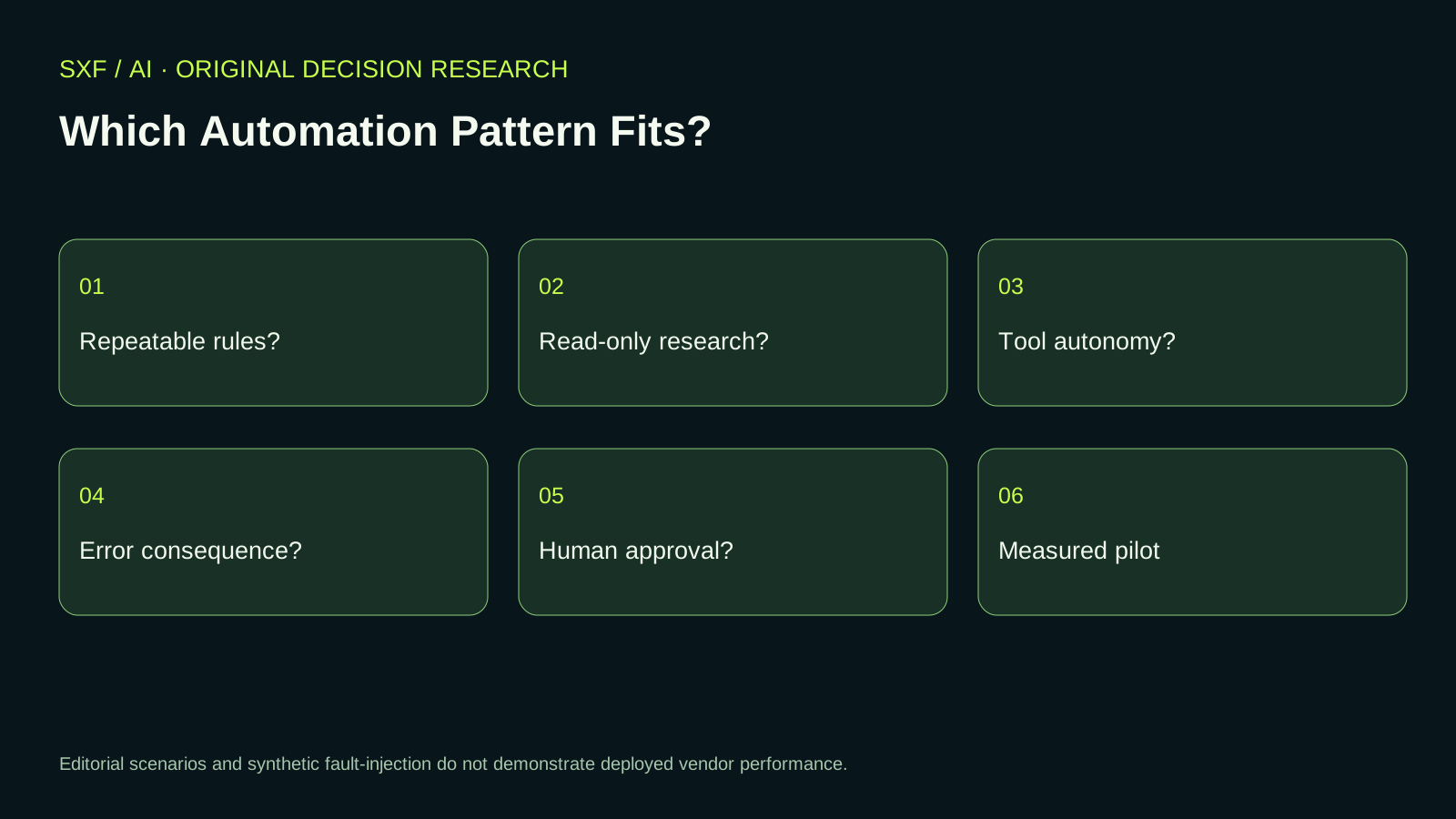
The SXF index is a qualitative screening aid based on repeatability, impact, cost of errors, access privileges and likely savings. A numeric summary does not replace a risk assessment. High consequence, high access or high error risk creates an explicit human-control warning regardless of score.
Select a case above to see its editorial classification, then enter your own company measurements.
Not a validated readiness assessment.
Document the weights, domain-specific overrides, human responsibility and excluded costs before turning a screening result into a pilot plan. Read the methodology.
AI agent ROI calculator: does automation actually save money?
Compare an existing deterministic workflow with a proposed AI agent using your own assumptions, including platform cost, per-task costs, human review and unsuccessful cases. ROI depends on verified acceptance, not how many agent actions were attempted.
For the model component of your estimate, check SXF model API pricing and compare AI models side by side to understand pricing and capability trade-offs. Account for tools, retries, platform fees and human review separately. For marketing workflows specifically, the AI marketing agent comparison sets out eight tools by use case, pricing limits and evidence level.
Existing automation: actual or estimated cost
Use measured costs when possible. Enter the share of tasks that still need full manual handling in your current workflow.
Proposed agent inputs above are assumptions, not measured vendor performance.
Complete the cost assumptions to compare the options.
Hypothetical planning scenarios only.
This estimator is intentionally conservative about failed tasks returning to human staff, but does not capture financial loss from a wrong answer, legal review or integration disruption. Any real-world ROI claim requires actual baseline and postdeployment observation. See the SXF AI Agent Cost research for a deeper total-cost discussion.
SXF original fault-injection experiment: when an agent retries a side effect
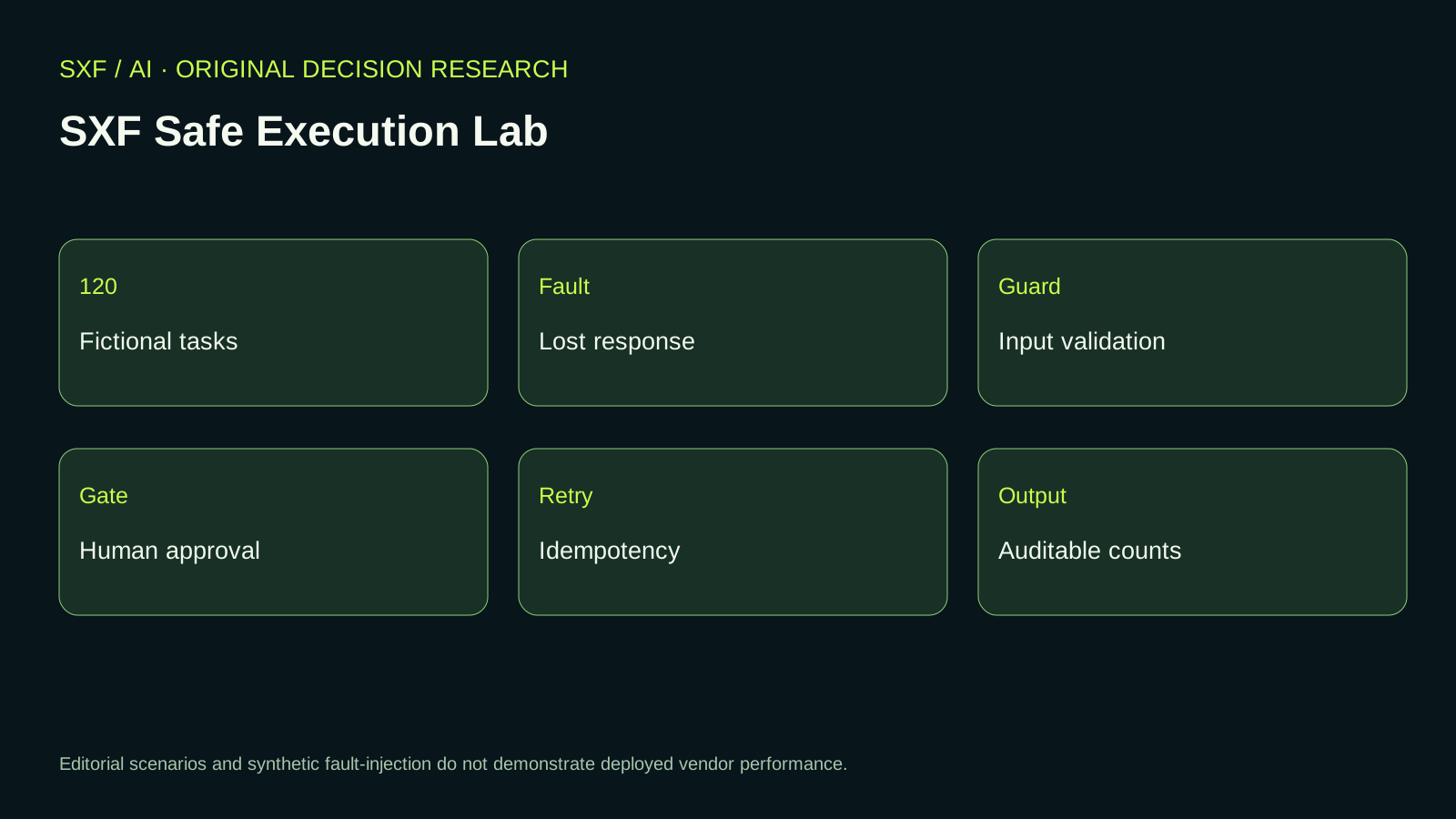
SXF supplies an executable standard-library Python simulator for 120 fictional tasks. A deterministic fault schedule creates malformed input, required-but-missing human approval, and responses lost after a simulated side effect. The code compares naive at-least-once execution with a guarded policy that checks inputs, authorization and idempotency keys. Its purpose is to demonstrate control-path failure modes, not to measure any agent framework's performance.
| Injected condition | Naive executor | Guarded executor |
|---|---|---|
| Invalid input | May continue with unsafe/incorrect payload | Reject or escalate before action |
| Missing authorization | Can issue an unapproved side effect | Blocks consequential action |
| Response lost after side effect | Retry can duplicate action | Idempotency key prevents duplicate application |
| Reliability claim | No real company failure rate inferred | No provider benchmark inferred |
Run python sxf-agent-workflow-lab.py to inspect the assertions and event counters. The lab uses no API key or external dependency. For operational evaluation, see 25 production agent tests.
Reference architecture: safe agent versus safe workflow
| Layer | Practical design requirement |
|---|---|
| Task intake | Validate request, rights, tenant and intended outcome |
| Planning and routing | Choose fixed workflow where possible; use bounded agent only as necessary |
| Tool privileges | Least privilege, read-only default, bounded budgets |
| Human approvals | Separate irreversible decisions and payments from model choice |
| Execution | Idempotency, retries, timeout and explicit state |
| Evidence and review | Store source links, outcome criteria, reviewer and version |
| Monitoring | Track accepted results, error cost, latency, incidents and drift |
The agent is one component, not the authorization authority. Production systems need a separate policy enforcement point. See agent authorization, security, and deployment architecture.
How to validate an agent use case before investing
- Map the existing workflow: staff time, task frequency, exception types and cost of a wrong outcome.
- Choose the minimum necessary autonomy: rules first, AI-assisted suggestion second, tool-selecting agents only where needed.
- Pre-register a measurable acceptance threshold: accuracy, downstream effects, supported citations and human approval triggers.
- Test permissioned data: happy paths, ambiguous requests, injected instructions, retries, missing tools and rate limits.
- Record actual economics: vendor invoices, platform, retries, human review and rework per accepted result.
- Roll out gradually: read-only / recommendation phase, shadow mode, gated actions, monitoring and rollback.
Use NIST AI RMF's governance concepts to document harms and controls; they are not a numeric certification of safety. Before any pilot, use SXF's 25-test AI agent evaluation checklist and scorecard to specify measurable outcomes, tool-use checks and safety gates.
When you should not automate: the expensive exceptions
| High-consequence decision | Safer AI role | Control owner |
|---|---|---|
| Payment or payout | Collect and reconcile evidence | Authorized finance approvers |
| Hiring or employee sanctions | Summarize admissible policy evidence | Human HR/legal decision maker |
| Medical treatment | Summarize clinical sources with uncertainty | Qualified clinician |
| Legal advice and binding signature | Extract and cite relevant clauses | Qualified counsel |
| Security access removal | Propose incident context and evidence | Authorized identity/security operator |
| Physical industrial controls | Diagnostic assistance only | Safety-rated control system and operator |
Prompt injection, leaked credentials, overbroad privileges and unverified source information can make even apparently simple automations dangerous. Follow access controls, consent requirements and privacy rules. See prompt injection and observability.
Real-world evidence versus editorial opportunities
Evidence tier A: independent, repeatable task trials with methods and raw measurements. Tier B: vendor or customer-reported case studies with a defined setting. Tier C: original editorial use-case designs without deployment evidence. All fifty SXF Atlas cards are Tier C. They illustrate feasible investigation targets, not proven ROI.
We intentionally avoid invented company deployments, unsupported success percentages and unsourced monthly search claims. Organizations can submit an audit-ready case study with consent and verifiable before/after metrics for a future evidence update. Commercial partnership never substitutes for research validation.
Frequently asked questions about AI agent use cases
What are the best AI agent use cases for businesses?
Useful initial candidates include multi-source research, complex support escalation triage, incident investigation and supplier disruption analysis. Repeatable tasks with fixed rules often fit ordinary automation better. Validate on your own data.
What is the difference between AI agent examples and automation examples?
AI agents may select tools and adapt their next actions based on observations; deterministic workflows execute predefined steps; AI assistance drafts or classifies without independently controlling consequential actions.
How much does an AI agent cost per month?
There is no universal monthly cost. Model inference, tool calls, hosting, retries, human review, failure handling and integration all contribute. SXF provides a configurable scenario calculator.
How do I calculate AI agent ROI?
Compare baseline labor costs to new inference/platform/review/residual labor costs, subtract one-time integration, and account for error losses and uncertainty not captured by simple arithmetic.
Which tasks should not be fully automated by AI agents?
Irreversible payments, consequential hiring decisions, medical treatment, legal sign-off, physical safety and privileged security actions need appropriately qualified human or deterministic authorization controls.
Do AI agents replace normal workflow automation?
No. A predictable workflow is often cheaper, easier to verify and easier to govern. Use agent autonomy only when open-ended decision-making genuinely creates value.
Are the fifty SXF examples real client deployments?
No. All 50 entries are original editorial design scenarios labeled as such, with proposed metrics and safeguards. They are not field-tested examples from fifty companies.
Did SXF execute its own agent experiment?
SXF publishes a reproducible deterministic fault-injection Python lab using 120 fictional tasks. It evaluates control logic for approval and duplicate actions; it does not call a commercial AI model.
How can I measure an AI agent's success?
Measure accepted task completion, human escalation, harmful or unauthorized actions, factual grounding, latency, error recovery and all-in cost per accepted result on a representative, independently reviewed test set.
Which industries can use AI agents?
Support, sales, marketing, software, IT, finance, operations, HR, legal research and analytics can use bounded AI workflows subject to domain-specific privacy, professional standards and approvals.
Research methods, primary sources and further reading
Editorial candidates were independently classified by SXF; architecture principles were checked against official NIST guidance and provider engineering publications. The local experiment measures control logic, not agent intelligence or enterprise productivity. The ROI estimator is a fully exposed assumed-cost model, not a measured industry benchmark.
- NIST AI RMF — Govern, map, measure and manage AI risk
- NIST Generative AI Profile — Generative AI-specific risk profile
- Anthropic: Building Effective Agents — When simpler workflows beat open-ended agents
- Google Cloud: Choose an Agentic AI Design Pattern — Agent orchestration pattern selection
- OpenAI Practical Guide to Building Agents — Tool use, safety and agent engineering
- OWASP GenAI Security Project — Security risks and access-control considerations
- SXF Production Agent Deployment — SXF practical implementation and reliability
- SXF AI Agent Cost Research — Total cost and ROI sensitivities
- SXF Agent Evaluation Scorecard — Acceptance testing and evaluation templates