SXF RESEARCH EXPLAINER
What the technical evidence means.
TECHNICAL ANALYSIS / 01
How do you apply for ChatGPT for Academic Researchers?
OpenAI says applications for the new round open Monday, November 23, 2026, and eligible applicants are reviewed on a first-come, first-served basis until 50,000 grants are awarded. Researchers already on a qualifying waitlist should receive instructions before the opening. The article does not claim that every university employee qualifies or that applying guarantees approval.
Prepare to verify your academic eligibility using OpenAI's official program access page rather than third-party forms. Make sure your collaborators actually need access and verify local institutional research-data policies before uploading unpublished work. For a broader view of published research methodology, see SXF's research collection.
Check primary-source evidence ↗
TECHNICAL ANALYSIS / 02
Do 50,000 grants mean 150,000 individual awards?
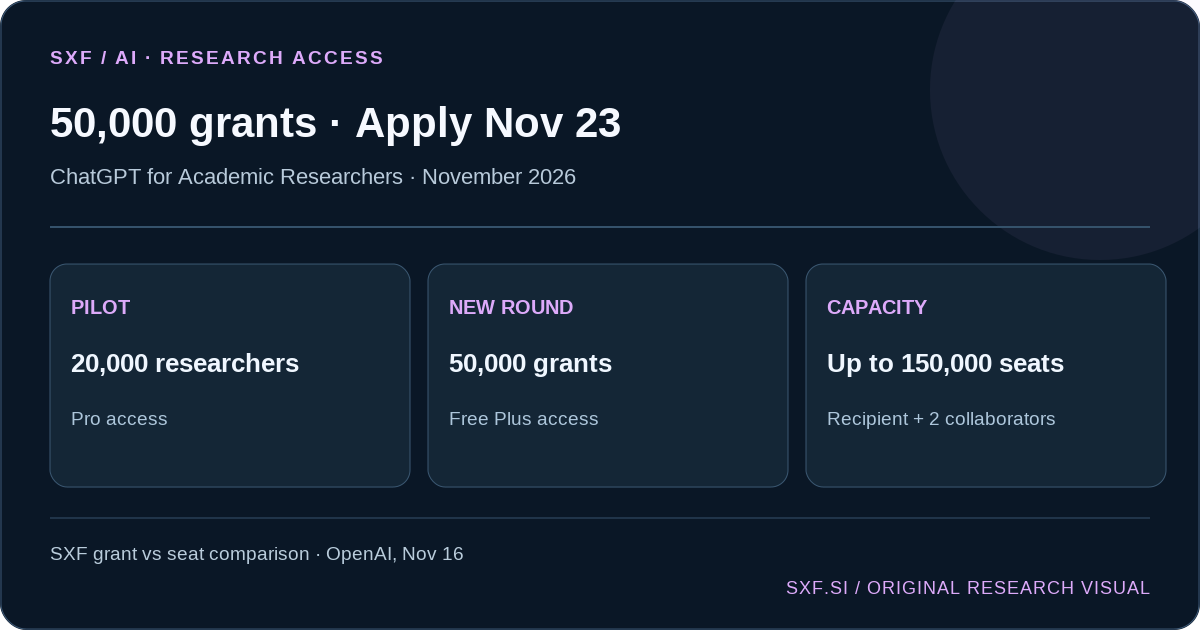
No. Each award covers one primary recipient and up to two collaborators, so 50,000 grants could support up to 150,000 researcher seats if all grants used the maximum allowance. These are maximum supported seats, not an announcement of 150,000 separate winning applications or an already achieved participation total.
OpenAI reports 20,000 participants across 33 countries in the pilot and an overall goal of up to 200,000 people. The pilot used ChatGPT Pro, but the upcoming round gives free ChatGPT Plus because usage analysis suggested most pilot research tasks fit Plus limits. This avoids implying that the two entitlements are identical.
Check primary-source evidence ↗
TECHNICAL ANALYSIS / 03
What did the pilot show about scientific productivity?
OpenAI points to a companion study surveying over 1,800 pilot researchers. Respondents estimated their comparable work, at the same quality, would have taken almost twice as long without AI. This is a perceived counterfactual from surveyed participants, not measured time saved in a randomized controlled trial.
Research tasks vary widely: literature searching, data preparation, coding, visual analysis and manuscript revision introduce different risks. A transparent lab study should compare completed outputs against an agreed accuracy and reproducibility checklist while measuring actual analyst hours. Use human reviewers for citations and factual validity, especially when generated claims feed published papers.
Check primary-source evidence ↗
TECHNICAL ANALYSIS / 04
SXF lab checklist: safe collaboration across disciplines
Define whether each task handles confidential participants, personal health information, licensed data or unpublished results; an offer of free Plus access does not override consent and university data-governance requirements. OpenAI says program-shared data are not used to train models by default, but teams must still read applicable retention, access and product settings.
Run a bounded pilot: record the research question, input datasets, model version, generated code, independent validation, citations and human revision time. Compare with your existing workflow on a comparable task set. This approach tests whether AI improves research productivity without assuming every faster draft also strengthens scientific evidence.
Check primary-source evidence ↗