SXF RESEARCH EXPLAINER
What the technical evidence means.
TECHNICAL ANALYSIS / 01
What is ChatGPT for Sales, and what changed in November 2026?
ChatGPT for Sales is an OpenAI sales-oriented experience built around a Sales plugin and partner integrations. The November 17 launch connects activities that sellers normally perform in separate systems: finding accounts, reading opportunity history, preparing a call, summarizing a conversation and proposing follow-up actions. It does not announce a new standalone CRM database or a requirement to migrate customer records away from the existing system.
The meaningful change is access to connected customer context while using conversational workflows. Earlier generic prompts could produce fluent pitch text from information pasted by a seller; this approach can use information from permitted third-party tools. That difference raises the value of current data, but also makes permissions, record freshness and source attribution more important than writing style. For background, see SXF's AI agent use cases guide.
Check primary-source evidence ↗
TECHNICAL ANALYSIS / 02
Which CRM and sales tools can ChatGPT for Sales connect to?
OpenAI's published examples cover Salesforce, HubSpot, Close CRM and monday CRM for account history; Apollo, Clay and Common Room for prospect signals; Gong, Otter.ai and Granola for meeting context; and Docusign, Ironclad and PandaDoc for agreements. These are different workflow roles. A call-notes service may produce meeting evidence, while the CRM remains the location of the opportunity record; connecting both does not make those records automatically consistent.
The announced count of more than 30 covers new and expanded partner plugins, not a flat list of universally available connectors. An administrator should inspect the actual plugin permissions, authentication scope, write actions, freshness and missing fields for each service. A useful acceptance test is to compare an AI-produced account brief against the source CRM and the underlying meeting record, then review every proposed update before posting it.
Check primary-source evidence ↗
TECHNICAL ANALYSIS / 03
How do you install and configure the Sales plugin?
OpenAI provides a Sales plugin installation entry point in the launch announcement. For Business and Enterprise organizations, an admin opens the Admin Console, chooses the workspace and enables Sales and approved partner plugins. Team members then complete any required account connection. Availability depends on plan, geography and workspace settings, so an absent plugin is not evidence that the entire Sales product has been withdrawn.
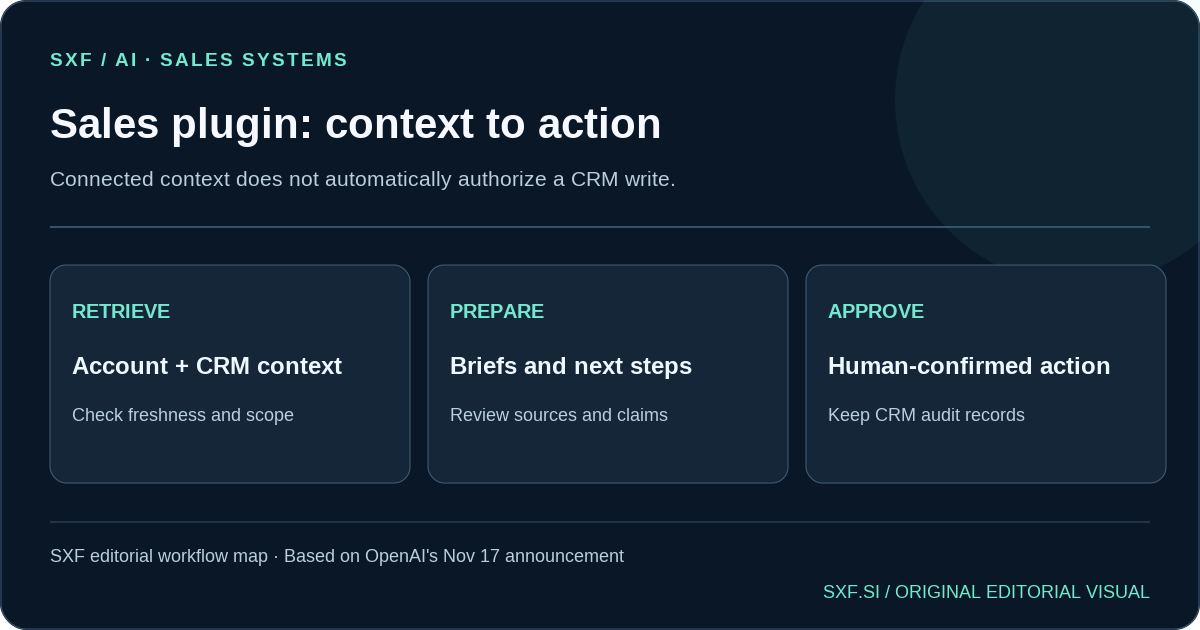
SXF recommends a narrow pilot: select one CRM, one meeting-notes provider and a small authorized account sample. Assign plugin owners, grant only necessary scopes, test which actions are read-only and which can alter records, and require human confirmation before outbound mail or opportunity-stage changes. The AI agent authorization guide explains how to design those permission boundaries before exposing live customer data.
Check primary-source evidence ↗
TECHNICAL ANALYSIS / 04
ChatGPT for Sales vs a CRM: what should each system own?
A CRM stores customer identities, opportunities, activity histories and business rules. ChatGPT for Sales can help interpret connected data and prepare workflows around that record. It is therefore better understood as an assistant across tools, not as a reliable replacement for the CRM's access controls, data validation, mandatory fields or audit history. A sales summary that sounds complete may still omit an objection mentioned in a call or confuse an older opportunity with a current deal.
For a practical comparison, test the same five representative seller tasks with the ordinary CRM workflow and with the Sales plugin: retrieve the right account, summarize a meeting accurately, draft follow-up, propose CRM field changes and flag an at-risk deal. Score citation to records, required human corrections, update correctness and minutes actually saved. The SXF marketing agent lab offers useful context on checking task completion rather than taking polished AI output as success.
Check primary-source evidence ↗
TECHNICAL ANALYSIS / 05
SXF analysis: where could sales-agent automation create risk?
The largest operational risk is not awkward prose but acting on inaccurate or overly broad data. A connector can expose sensitive contact notes, prior negotiations and private account context to an AI workflow. Before approving an external email or CRM mutation, verify the source account ID, contact permissions, factual claims, commercial figures and the intended recipient. Data quality defects may be amplified when a persuasive summary becomes a team decision.
Sales teams should keep a measurement ledger separating suggested actions from accepted ones and accepted ones from verified business results. Track reviewed briefs, seller edits, false account matches, missed commitments, duplicate CRM records and subsequent outcomes. The provider's public customer testimonials do not demonstrate causation for another team. A reasonable next step is a documented pilot with a rollback owner, not a forecast of guaranteed revenue growth.
Check primary-source evidence ↗