SIGNAL / OPEN SOURCE

Hugging Face and OpenRouter integration: new inference routing explained

SOURCEHugging Face
PUBLISHEDNovember 16, 2026
LAYEROpen Source
SIGNAL SCORE30/100
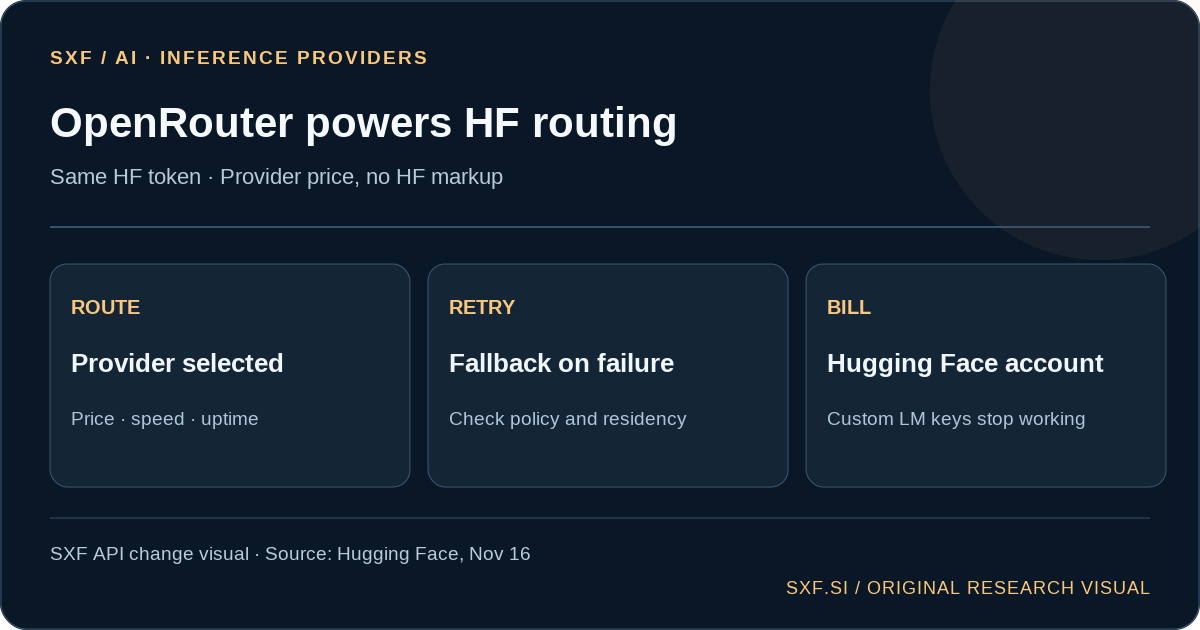
SXF technical diagram showing a Hugging Face token entering OpenRouter, provider selection, retries, provider pricing and session-based caching.
SXF original provider-routing diagram based on the November 16 Hugging Face announcement, not a live measured benchmark.

SXF VERIFIED BRIEF

Hugging Face replaced its own language-model inference router with OpenRouter's multi-provider router while keeping its existing Hugging Face token integration.

WHY IT MATTERS

Provider selection, fallback and caching affect reliability and costs as much as the model name; a backward-compatible API change can still break custom-key billing setups.

WHAT TO VERIFY

The published error and latency improvements are OpenRouter-reported measurements, not SXF tests or guaranteed outcomes. Model/provider prices and availability change over time.

SXF RESEARCH EXPLAINER

What the technical evidence means.

Source-grounded analysis

TECHNICAL ANALYSIS / 01

What changed for Hugging Face Inference Providers?

Hugging Face moved its language-model inference routing to OpenRouter. The company says applications can keep using their Hugging Face token and the same integration code, while requests are sent to an available provider selected according to routing policy. The router aims to retry on a different provider if the first attempt is rate-limited or fails.

The partnership does not mean Hugging Face has merged its model hub into OpenRouter, or that every model is guaranteed available. A model still needs a serving provider, and routing eligibility depends on current backends. For context on running weights outside hosted providers, the SXF llama.cpp v1.0 overview explains local-library versioning and integration testing.

Check primary-source evidence ↗

TECHNICAL ANALYSIS / 02

How much does Hugging Face OpenRouter cost?

Hugging Face states that it bills the provider's price on the user's Hugging Face account without an extra platform markup. Eligible PRO users receive $2 in monthly compute/inference credits and Team or Enterprise organizations receive $2 per seat. Those credits do not imply that every model is free or that two providers charge the same list rate.

The article compares an average $0.28 input and $1.62 output per million tokens for open-weight models against $1.27 and $6.36 for closed models on its cited platform data. These are historical averages from the stated dataset, not a quote for a particular model, region or batch. Check current model/provider pricing before allocating a production budget.

Check primary-source evidence ↗

TECHNICAL ANALYSIS / 03

What is the new routing, retry and cache policy?

The announcement documents model suffixes such as :fastest and :cheapest to favor throughput or price, and a specific provider suffix to pin a route. OpenRouter also uses live provider measurements and retries failed calls. That can improve resilience, but it may change which processing service receives a request and therefore matters for governance and data handling.

Prompt caching can benefit from sticky provider selection: passing a stable X-HF-Session-Id can keep a conversation on a backend with its prompt cache. An application should measure cache hit rates, total spend, latency and failed-call retries, rather than inferring universal savings from platform-wide statistics. Our agent deployment guide outlines how to audit external-service calls.

Check primary-source evidence ↗

TECHNICAL ANALYSIS / 04

SXF migration audit: which integrations might break?

The crucial exception to 'your code stays the same' is custom provider API keys for language-model calls. Hugging Face says those no longer work through the new language-model route; billing now goes through Hugging Face or its organization account. Image/video provider keys are described as continuing to work, and the media-generation routing remains separate.

Before shipping, inspect the authentication source, selected provider, invoice owner, data-region restrictions and response contract. Send a fixed set of safe test prompts across default, cheapest and pinned policies, then compare success rate, time to first token, token billing and model availability. These would be tests to run, not results already measured by SXF.

Check primary-source evidence ↗

SXF FIELD GUIDE / EVIDENCE-LED COMPARISON

Routing modes, charges and key compatibility

The table summarizes the November 16 API change and the practical migration decisions it creates.

ChoicePublished behaviorOperator implication
Default routeBalance price, speed, reliabilityMonitor provider and retries
:fastest / :cheapestOptimize throughput or listed priceResults and cost may vary
:provider suffixSpecify a particular serving providerUseful for routing policy checks
HF account billingProvider price, no HF markupReview usage and account credits
Custom LM provider keyNo longer supported via HF language routeMigrate authentication and billing

Benchmarks and routing outcomes depend on backend conditions and should be verified on real workloads. Check the original evidence ↗

READER QUESTIONS

Hugging Face OpenRouter integration FAQ

Do I need a separate OpenRouter key?

Hugging Face says existing users can make supported calls through their Hugging Face token; language-model billing flows through the Hugging Face account.

Can I keep custom provider keys for language models?

No. Hugging Face identifies this as a breaking change in the new OpenRouter-backed language-model route.

Does Hugging Face add an additional markup?

The November 16 announcement states that it charges the provider's list price without a Hugging Face markup.

PRIMARY-SOURCE FACTS

What the evidence establishes.

Reviewed 2026-11-17
Announcement date

The Hugging Face post is dated November 16, 2026. Primary evidence ↗

Routing migration

Language-model requests made through Inference Providers now pass through OpenRouter rather than the previous custom router. Primary evidence ↗

Shared access

Hugging Face users can use their existing token with supported open-weight models through its API. Primary evidence ↗

Provider network

The article describes OpenRouter routing among more than 80 providers. Primary evidence ↗

API formats

OpenAI Chat Completions, OpenAI Responses and Anthropic Messages styles are supported by the router. Primary evidence ↗

Routing priorities

Default routing balances provider price, speed and reliability and retries a failed provider request when possible. Primary evidence ↗

Provider suffixes

The post documents :fastest, :cheapest and named-provider suffixes on model IDs. Primary evidence ↗

Cache affinity

Stable X-HF-Session-Id values support conversation-level provider stickiness for prompt caching. Primary evidence ↗

Billing

Hugging Face states provider list pricing without its own markup and $2 monthly inference/compute credits for eligible PRO users and per Team/Enterprise seat. Primary evidence ↗

Key breaking change

Custom provider API keys no longer work for language-model requests routed via OpenRouter, while image/video provider keys continue. Primary evidence ↗

Traffic claims

The article attributes the 46% lower capacity errors and 16.9% faster time-to-first-token figures to OpenRouter's own measurements. Primary evidence ↗

Non-language media

Image, video and audio generation continue through Hugging Face Inference Providers rather than OpenRouter. Primary evidence ↗

LIMITATIONS

Provider coverage depends on whether at least one backend serves a given model. Hugging Face's examples and OpenRouter's routing improvements are vendor-reported and cannot predict the latency, availability or price of every deployment. A user's existing own-provider-key integration for language models requires migration; sensitive data and residency policies should be checked per provider.

PRACTICAL TAKEAWAYS

What readers can check next.

Verification checklist

  1. Identify language-model integrations with custom provider keys.
  2. Review provider routing and data-handling restrictions.
  3. Test cheapest, fastest and pinned route behavior on real workloads.
  4. Track prompt-cache affinity with a stable session identifier where appropriate.
  5. Reconcile Hugging Face billing and available monthly credits.

Read the related SXF guides

TOPICSOpen Source AI
MODELSNo named model detected