SIGNAL / TOOLS

OpenAI Daybreak for NATO cyber defense: deployments, evidence and limits

SOURCEOpenAI
PUBLISHEDNovember 17, 2026
LAYERTools
SIGNAL SCORE38/100
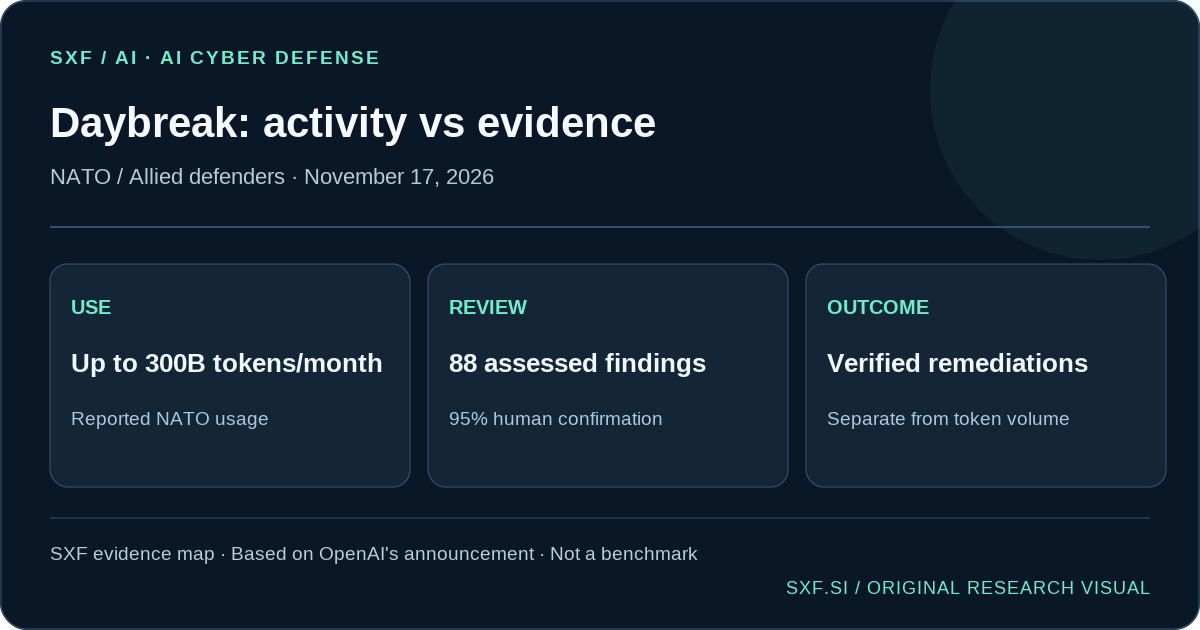
SXF editorial figure comparing NATO Daybreak usage, Crossed Swords training, human confirmed findings and independently retested fixes.
SXF original evidence map based on the OpenAI announcement; no security assessment was carried out by SXF.

SXF VERIFIED BRIEF

OpenAI disclosed more detail about NATO and allied defenders' use of Daybreak models in authorized security workflows and training, including token consumption and specific agency investigations.

WHY IT MATTERS

AI-generated potential vulnerabilities only matter after human verification, patches and safe deployment. Large usage volumes cannot establish that real systems are more secure.

WHAT TO VERIFY

Usage, the reported percentage of confirmed findings and agency examples are attributed to OpenAI or partner reporting; none is an independent benchmark of autonomous cybersecurity performance.

SXF RESEARCH EXPLAINER

What the technical evidence means.

Source-grounded analysis

TECHNICAL ANALYSIS / 01

What is OpenAI Daybreak doing for NATO's cyber defenders?

OpenAI says NATO's Communications and Information Agency receives access to advanced cyber models for legitimate defensive work across Allied networks. Tasks include reviewing software, investigating suspicious activity, testing potential vulnerabilities and drafting or checking fixes. The report frames Daybreak as support for named defenders rather than an unrestricted automated actor that can modify national infrastructure.

The separate Crossed Swords exercise provides a training context: teams built, deployed and evaluated AI agents in a technical environment, with humans acting as operators. Exercises reveal workflow and oversight needs, but simulated tasks should not be presented as proof of reduced incidents on operational networks. For background on permission and approval controls, see the SXF AI agent security guide.

Check primary-source evidence ↗

TECHNICAL ANALYSIS / 02

What does 300 billion tokens per month tell us?

OpenAI describes NATO usage as reaching up to 300 billion combined raw input and output tokens in a month. This is a ceiling-style usage statement, not a disclosed average, invoice, unique-user count or measurement of time saved. It mixes prompts and outputs, and lacks the workload split required to calculate a credible price or a per-investigation efficiency measure.

A serious operational analysis would track cases evaluated, accepted findings, human-review time, remediation throughput, model call failure and recurring model cost. SXF's proposed measurement is confirmed, fixed vulnerabilities per review hour, reported with severity and repeat checks; that unit is much closer to defensive value than comparing token volumes alone.

Check primary-source evidence ↗

TECHNICAL ANALYSIS / 03

How strong is the ENISA and CERT-EU vulnerability evidence?

OpenAI reports four ENISA-associated findings with published fixes and describes a joint review of 27 projects. It also quotes a 95% confirmation proportion among 88 candidate issues assessed by software maintainers across tested models. Those denominators matter: the confirmed set was reviewed by humans, so the proportion cannot establish the number of missed vulnerabilities or prove 95% accuracy on arbitrary code.

The announced CERT Polska RouterOS examples and Ukraine deployment show different environments and governance requirements. Where software advisories or fixes are public, readers should inspect the vendor's disclosure rather than rely on a headline. The SXF GitHub AI Scan explainer covers the equally important distinction between enabling a scanning tool and completing an actionable security review.

Check primary-source evidence ↗

TECHNICAL ANALYSIS / 04

SXF analysis: a more useful defensive AI scorecard

Separate four stages: model suggests a potential issue; an authorized human validates exploitability; the owner ships a patch; an independent retest confirms remediation. A tool may look impressive at stage one while remaining operationally weak at stages two through four. For sensitive targets, log which analysts authorized access and which changes were subject to peer review.

For a reproducible pilot, choose a bounded set of permitted repositories, measure verified high-impact findings per analyst-day, track false leads and patch regression rates, and compare against the same team without AI assistance. No benchmark in this article was run by SXF; this is a practical evaluation design, not a claim about NATO's actual measured efficiency.

Check primary-source evidence ↗

SXF FIELD GUIDE / EVIDENCE-LED COMPARISON

Reported activities versus what they actually demonstrate

These figures come from OpenAI's November 17 statement; the third column records missing evidence and must not be read as criticism of individual security teams.

Public figure or caseWhat it supportsWhat remains unknown
Up to 300B tokens/monthModel use at considerable reported scaleWorkload, cost and security impact
Crossed Swords 2026AI-agent training with human operatorsOperational incident reduction
88 reviewed issues; 95% confirmedHuman confirmation among a selected candidate setRecall, false negatives and baseline
CERT Polska: six vulnerabilitiesVendor-coordinated security research and fixesGeneral success rate across all targets

SXF comparison describes evidence levels, not independently measured deployment outcomes. Check the original evidence ↗

READER QUESTIONS

NATO Daybreak cyber defense questions

Is NATO using OpenAI Daybreak?

OpenAI says it works with NATO's Communications and Information Agency on authorized cyber defense and supported the 2026 Crossed Swords training exercise.

Does 300 billion tokens mean 300 billion attacks stopped?

No. It is a reported combined token consumption figure, not an attack count or measured defensive outcome.

Does the 95% figure measure detection accuracy?

No. It refers to maintainers' confirmation of selected candidate issues in a particular review; unreported misses prevent that interpretation.

PRIMARY-SOURCE FACTS

What the evidence establishes.

Reviewed 2026-11-17
Announcement date

OpenAI published the report on November 17, 2026. Primary evidence ↗

Agency collaboration

OpenAI works with NATO's Communications and Information Agency to support cybersecurity for NATO institutions. Primary evidence ↗

Usage scope

The announcement reports up to 300 billion raw input and output tokens per month of NATO usage. Primary evidence ↗

Exercise

OpenAI supported the 2026 Crossed Swords exercise organized by the NATO CCDCOE. Primary evidence ↗

Agent training

The Crossed Swords stream included participants building, deploying and evaluating AI agents while maintaining human oversight. Primary evidence ↗

European partners

OpenAI says it has provided access to defenders including ENISA, France's ANSSI and agencies in Germany and Poland. Primary evidence ↗

ENISA cases

OpenAI reports that ENISA used its models to identify four vulnerabilities in software used by EU institutions and that fixes were published. Primary evidence ↗

Joint review

The OpenAI account describes a joint ENISA/CERT-EU review of 27 software projects and 88 potential issues assessed by maintainers. Primary evidence ↗

Human confirmation

The report attributes a 95% confirmation rate among those 88 assessed issues across the models tested; this is not recall or a general detection accuracy measure. Primary evidence ↗

Polish case

OpenAI says CERT Polska identified six MikroTik RouterOS vulnerabilities and coordinated remediation with the vendor. Primary evidence ↗

Ukraine

The Ukrainian Ministry of Digital Transformation is described as using Daybreak to aid defense of civilian infrastructure. Primary evidence ↗

LIMITATIONS

This is a vendor account and partner-reported activity, not an independently randomized deployment study. 'Up to' tokens describe consumption rather than constant monthly demand. A 95% confirmation rate among preselected reviewed findings does not measure false negatives, vulnerability prevalence, incident reduction, or general system accuracy. Authorized scope and human review remain essential.

PRACTICAL TAKEAWAYS

What readers can check next.

Verification checklist

  1. Keep defensive testing within documented authorization.
  2. Separate reported token volume from confirmed security results.
  3. Validate vulnerabilities with qualified maintainers.
  4. Measure patches and retests rather than model suggestions alone.
  5. Do not extrapolate 95% confirmations to detection accuracy.

Read the related SXF guides

TOPICSOpenAIAI Security
MODELSNo named model detected