SIGNAL / TOOLS

ChatGPT Wallet rollout begins in dots for eligible US Pro users

SOURCEOpenAI
PUBLISHEDNovember 13, 2026
LAYERTools
SIGNAL SCORE46/100
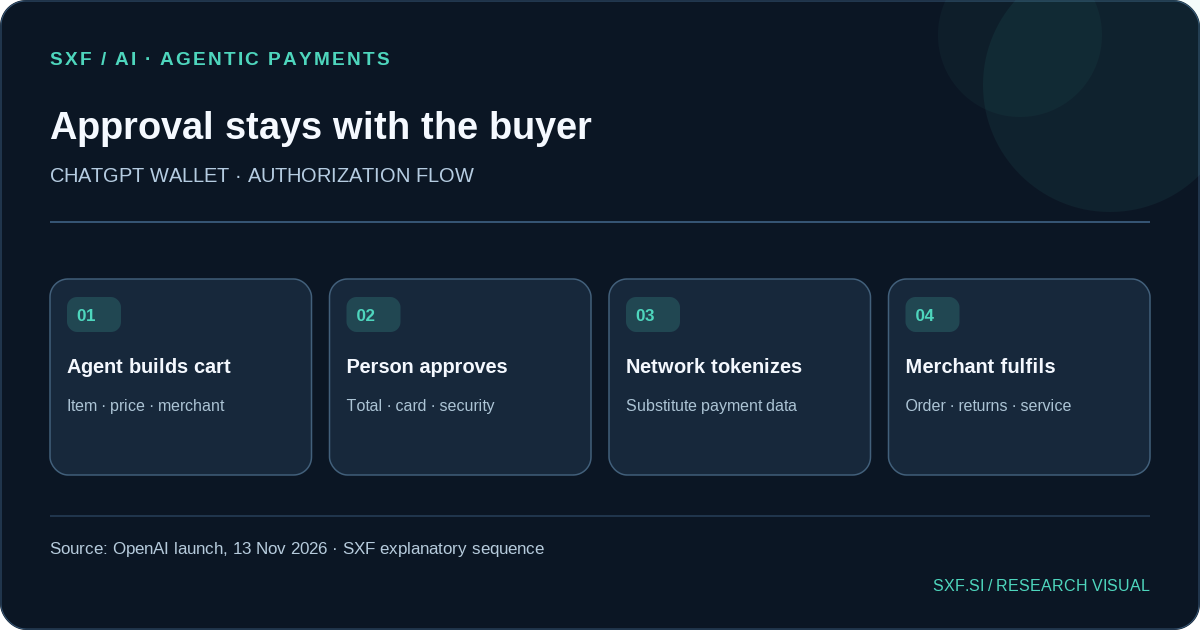
Original SXF payment-flow diagram showing agent cart, human approval, network payment token and merchant fulfillment.
SXF editorial process diagram based on OpenAI's November 2026 announcement; not a screenshot of the Wallet interface.

SXF VERIFIED BRIEF

On November 13, 2026, OpenAI announced ChatGPT Wallet and began a limited rollout through dots for eligible US ChatGPT Pro subscribers. This launch requires a person to review and approve each purchase; it does not make checkout available in every ChatGPT session.

COMPLETE GUIDE

For the full explanation of payment security, refunds and merchant setup, see the complete ChatGPT Wallet guide.

WHY IT MATTERS

The launch establishes a boundary between an AI agent finding an item and a person authorizing a payment. Card-network tokens protect actual card details, while merchants still handle the order, delivery, refunds and customer service.

ROLLOUT STATUS

At launch, eligible users are US-based ChatGPT Pro subscribers aged 18 or older with supported US-issued cards, subject to gradual rollout. OpenAI announced no general availability date for Plus or countries outside the US; pre-authorized spending rules remain future plans.

SXF RESEARCH EXPLAINER

What the technical evidence means.

Source-grounded analysis

TECHNICAL ANALYSIS / 01

What OpenAI actually launched on November 13, 2026

The announcement introduces ChatGPT Wallet as a payment feature rolling out through dots, not a universal purchase button in every ChatGPT conversation. The initial audience is eligible US-based ChatGPT Pro subscribers aged at least 18 who have supported US-issued cards. An announcement of a rollout is not proof that every account has access on day one.

The launch also keeps shopping discovery distinct from payment authorization. OpenAI says users review and approve each purchase, and the merchant remains responsible for the order and customer relationship. The related SXF report on Businesses in ChatGPT covers a separate merchant-discovery surface; a listing does not itself demonstrate wallet acceptance.

Check primary-source evidence ↗

TECHNICAL ANALYSIS / 02

How does the approval and card-token flow work?

First, a user saves an eligible payment card. When an agent prepares to purchase, the person checks the actual items, total and card, then passes a security step such as Face ID or fingerprint verification. Only after that authorization does a payment network supply substitute card credentials for the transaction. OpenAI states that the agent and merchant do not receive the user's actual card details.

An authorization record is important, but it does not settle all possible disputes: a user still needs the merchant's order confirmation, refund path and card-provider process where relevant. The SXF agent-security guide describes why restricting what an agent can do, logging approvals and guarding against malicious page instructions remain separate controls from payment tokenization.

Check primary-source evidence ↗

TECHNICAL ANALYSIS / 03

What does a business need to change to accept agent-led purchases?

OpenAI asks merchants to keep accurate product facts and available inventory, to review whether their CDN and firewall inadvertently reject legitimate signed agent traffic, and to coordinate with fraud and payment processors. These are practical integration tasks: a successful payment token can still be declined by an antifraud rule that assumes every automated browser is hostile.

SXF's recommended prelaunch test is a controlled checkout matrix: a currently available item, a price change during checkout, out-of-stock rejection, a declined card, a refund request and a duplicated agent action. Record which actor approved each transaction and whether the order, billing and customer-support systems agree. Do not weaken bot protection globally just to make tests pass.

Check primary-source evidence ↗

TECHNICAL ANALYSIS / 04

SXF analysis: where does purchase authority end?

The current approval boundary is a specific purchase with a visible total and payment choice. OpenAI also discusses future spending limits and categories for pre-authorized buying, but those ideas should be evaluated as future safeguards rather than assumed available now. A future delegation system would need ways to revoke authority, resolve ambiguous items and cap exposure when inventory or price changes.

A useful comparison is the difference between browsing, deciding and paying. An agent can research options without financial permission; a purchase still creates an order and payment obligations. For more complex workflows, the SXF production-agent guide sets out approvals and rollback patterns that can be adapted into merchant acceptance testing without claiming they guarantee a risk-free transaction.

Check primary-source evidence ↗

PURCHASE AUTHORIZATION / EXPLAINED

The four checkpoints in an agent-assisted payment

A payment has distinct decision makers. This sequence separates OpenAI's described flow from SXF's additional operational check.

  1. 1 · Prepare Agent gathers the intended item, seller, price and total for the user to review.
  2. 2 · Approve User examines the purchase details and passes the required security check.
  3. 3 · Tokenize The network supplies substitute payment credentials rather than the actual stored card details.
  4. 4 · Fulfil and resolve Merchant processes the order, handles delivery and manages returns or eligible disputes.

This is a simplified explanation of the announced flow, not a certification of an individual merchant's implementation. Check the original evidence ↗

READER QUESTIONS

ChatGPT Wallet: availability and safety questions

Is ChatGPT Wallet available to ChatGPT Plus users?

The initial November 2026 rollout is described for eligible US ChatGPT Pro subscribers aged at least 18 using dots. OpenAI did not announce broad Plus availability.

Does an agent receive the actual card number?

OpenAI says the wallet uses card-network payment tokens so the agent and merchant do not receive the user's actual card details.

Can an agent make purchases without asking first?

The announced initial flow requires user review and a security check for every purchase. OpenAI describes wider pre-authorized delegation as future work.

PRIMARY-SOURCE FACTS

What the evidence establishes.

Reviewed 2026-11-15
Launch date

OpenAI announced ChatGPT Wallet on November 13, 2026. Primary evidence ↗

Initial availability

The first rollout is in dots for Pro subscribers aged 18+ in the US with eligible US-issued cards. Primary evidence ↗

User approval

Each purchase requires users to review items, total and selected card and pass a security check, such as biometrics. Primary evidence ↗

Credential handling

Networks create a payment token substituting for the real card details when an authorized charge is processed. Primary evidence ↗

Partners

OpenAI lists American Express, Mastercard and Visa as payment-network partners. Primary evidence ↗

Merchant contract

Businesses retain customer relationships, pricing, fulfilment, returns and service responsibilities. Primary evidence ↗

Card protections

OpenAI says card rewards and existing protections for eligible disputes continue to apply. Primary evidence ↗

Merchant compatibility

OpenAI advises businesses to maintain product data and avoid blocking valid signed agent requests in CDN or firewall settings. Primary evidence ↗

Risk providers

The launch points to payment and fraud providers as part of avoiding accidental declines for legitimate agent purchases. Primary evidence ↗

Future delegation

Spending limits and advance authorization for some categories are described as prospective developments. Primary evidence ↗

LIMITATIONS

The announcement describes design intentions and a limited rollout, not an independently audited fraud rate or a guarantee that every merchant accepts the wallet. Network tokenization alone does not prevent misleading merchant information, compromised accounts or purchase errors. Financial and dispute outcomes remain governed by the user's card and merchant terms; no future pre-approval feature should be presented as generally available.

PRACTICAL TAKEAWAYS

What readers can check next.

Verification checklist

  1. Check plan, age, country and card eligibility before trying the feature.
  2. Review every item, total, card and merchant before authorizing.
  3. Keep merchant receipts and check your bank or card statement.
  4. Test fraud, refunds, inventory changes and repeat requests in controlled environments.
  5. Treat future delegated purchases as planned, not already enabled.

Read the related SXF guides

TOPICSOpenAI
MODELSNo named model detected