SXF GUIDE / VOICE AGENTS / REAL-WORLD PHONE AUTOMATION
AI Receptionist in 2026:
How It Works, Real Costs & Best Voice AI Platforms
Compare Vapi, Retell, ElevenLabs Reception and OpenAI Realtime, then build an AI phone answering workflow that actually books, transfers and protects callers.
SXF PRACTICAL GUIDE / SMALL BUSINESS / VOICE AI
An AI receptionist should answer the phone—and finish the task reliably.
Looking for an AI receptionist, AI phone answering service, or a way to build an AI voice agent for your business? The useful decision is not which demo voice sounds most human. It is whether a real caller can reach the right person, make a genuine booking, receive a correct answer and understand when automation has reached its limits. This guide compares Vapi, Retell AI, ElevenLabs Reception / ElevenAgents and OpenAI Realtime using primary-source documentation and separate billing units.
Direct answer: For an off-the-shelf business receptionist with native calendar scheduling, evaluate ElevenLabs Reception. For configurable AI telephone workflows, evaluate Vapi or Retell. For a fully custom speech-to-speech backend, use OpenAI Realtime with your own SIP/telephony, security and calendar integration. None is proven universally best: test successful appointments, transfer reliability, privacy, and cost per completed call.
Editorial research verified October 31, 2026. Price tables are a dated snapshot of publicly displayed list prices, not quotes. We did not secretly place phone calls or benchmark any provider for this article; the original SXF calculator and 20-call evaluation plan are explicit examples, not measurements.
WHAT IT DOES
What is an AI receptionist and how does it work?
An AI receptionist is a software system that answers incoming phone calls using speech recognition or realtime audio models, interprets the request, and invokes approved business tools. It can explain hours, route to the right department, check a staff calendar, create a booking, send a confirmation and hand the call to a human. A basic prerecorded IVR asks the caller to press buttons; a conversational voice agent can understand open-ended speech and follow up when details are unclear.
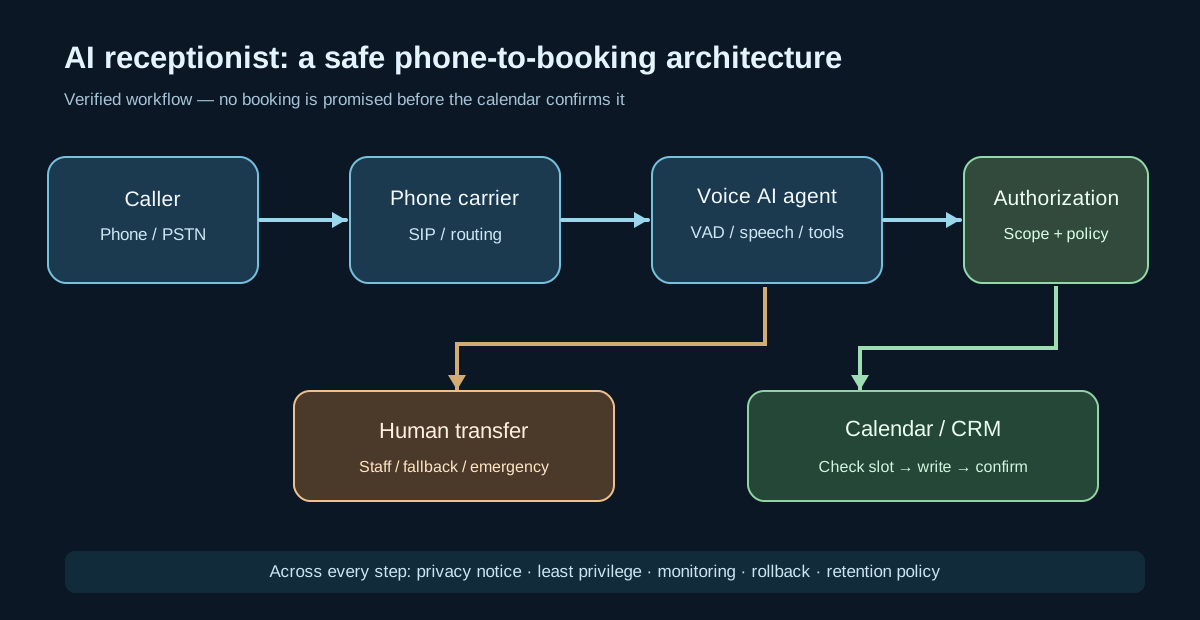
Phone number and media
A carrier or SIP trunk routes an inbound PSTN call to the agent platform. A browser microphone session is not automatically a real inbound business number; configure actual telephony separately.
Speech and conversation
A pipeline may combine speech-to-text, an LLM, and text-to-speech; native speech-to-speech models combine more of this interaction. Both require interruption handling and real-time monitoring.
Calendar, CRM and transfer
Behind the conversation, a server checks availability, caller consent, permissions, booking constraints, and transfer destinations. A model-generated sentence is never proof a database write succeeded.
Audit and human handoff
When the tool fails or the user needs sensitive assistance, transfer to a staffed line or take a message. Retain only the call information justified by your privacy policy.
AI receptionist vs voice chatbot: both may share speech and language models, but telephony introduces call routing, inbound numbers, transfers, missed calls, busy lines and jurisdiction-specific rules. The business system—not the model—ultimately owns the appointment.
BEST AI RECEPTIONIST SOFTWARE / BUYER SHORTLIST
Vapi vs Retell AI vs ElevenLabs vs OpenAI Realtime.
These are not perfectly interchangeable products. ElevenLabs sells a packaged Reception product as well as a separate ElevenAgents platform. OpenAI sells realtime models and tools rather than an end-to-end phone answering subscription. The right comparison starts with how much infrastructure you want to own.
| Platform | Typical starting point | Calendar / CRM path | Call transfer | Price basis |
|---|---|---|---|---|
| Vapi | Customizable voice assistant with models, voice and telephony components | Tools, Google Calendar, APIs and webhooks | Documented transfer-call tool | Hosting per minute + model, speech and carrier usage |
| Retell AI | Configurable AI phone agent with dashboard, testing and integrations | Configure custom functions and connected business workflows | Verify transfer behavior in chosen agent/telephony setup | Published aggregate voice-agent range; add-ons and telephony can apply |
| ElevenLabs Reception | Ready-made AI receptionist for calls, services, staff and scheduling | Built-in booking, Google Calendar, Calendly, Cal.com, HubSpot and webhooks | Business rules and routing; verify local number support | Monthly plan with bundled phone-minute credits and overages |
| ElevenAgents | Developer voice/chat agent toolkit | Webhooks and client/system tools to your backend | System transfer tool | Included minutes + overage; LLM and phone provider separately |
| OpenAI Realtime | Build-your-own realtime conversational backend | You implement calendar/CRM function tools and server-side checks | Documented SIP refer endpoint | Audio/text tokens + telephony and backend overhead |
Vapi
Offers a $0.05/min usage-only hosting fee, $5 initial credits, optional service packages, and model/transcriber/voice costs passed through. It documents calendar and transfer tools. Official pricing · tools documentation.
Retell AI
Publishes an approximate $0.07–$0.31 per minute pay-as-you-go voice-agent range. Its example $0.15/min composition is not the price of every configuration; telephony, voice, model and add-ons change the result. Official calculator.
ElevenLabs Reception
Business-specific scheduling, staff/asset constraints and calendar sync are included. The published monthly tiers are separate from ElevenAgents developer subscriptions. Supported automatic number provisioning differs by country. Reception · setup guide.
ElevenAgents
Lets developers choose a voice agent stack with webhook tools, transfers, and configurable models; the plan includes call minutes, while LLM and telephony usage can be extra. Avoid mistakenly attributing Reception booking features to every ElevenAgents agent. ElevenAgents prices.
OpenAI Realtime
Use a phone provider/SIP trunk and your own application backend with GPT-Realtime-2.1. OpenAI describes incoming-call webhooks, sideband events and call transfers. Its model is metered by modality tokens, not a flat receptionist subscription. Telephony/SIP guide.
“Best” is defined by the required outcome, not a paid partner or an unverified benchmark. No vendor supplied a measured SXF ranking for this page. Price/feature availability may vary by region and configuration.
AI RECEPTIONIST PRICING 2026 / REAL UNITS
How much does an AI receptionist cost per minute and per month?
A credible AI phone answering cost estimate starts with connected minutes, then adds any phone carrier, speech-to-text, language model, text-to-speech, integrations, number rental, taxes and support package. Different vendors bundle different pieces. One per-minute line item must not be compared with a complete phone bill as if both include the same services.
| Platform | Published starting unit | Not necessarily included | Evidence |
|---|---|---|---|
| Vapi usage-only | $0.05 / connected minute hosting | STT, LLM, TTS, phone/transport and optional packages | Vapi |
| Retell AI pay-as-you-go | $0.07–$0.31 / voice minute advertised range | Selected voice/model/add-ons; carrier rates depend on setup | Retell |
| ElevenLabs Reception | $29 / $79 / $199 month Basic / Plus / Premium | Overages above bundled 75 / 275 / 1,000 credits | Reception plans |
| ElevenAgents developer plan | $6 / month Starter with 75 included call minutes; additional $0.08/min | Model usage and telephony charged separately | Agents pricing |
| OpenAI GPT-Realtime-2.1 | $32 input / $64 output per 1M audio tokens | Text tokens, cache effects, phone carrier and application infrastructure | OpenAI |
Why billing may surprise you: Vapi's published pricing calculator adds hosting, voice, model and transcriber separately. Retell's displayed estimate of $0.150/min is one selected configuration. ElevenLabs Reception's monthly allowance is a credit pool: its official plans page lists 1 credit per phone minute, with Basic/Plus/Premium overages listed at $0.45/$0.38/$0.30 per credit. Another official usage page presents different example overage values; verify the live checkout and invoice rather than silently selecting a conflicting rate.
OpenAI API is not GPT-Live: The GPT-Realtime-2.1 voice model uses token-based audio ($32 input and $64 output per million) and text billing ($4 input / $24 output per million text tokens). The separate GPT-Live-1 product has a $0.05/min session charge, with backend model and tool usage billed on top. Do not substitute the Live session rate for Realtime token prices. See SXF's GPT-Realtime-2.1 API pricing breakdown.
Telephony varies by country: Twilio publishes separate inbound/outbound rates by location; its Germany page, for example, lists inbound local calls at $0.0100/min in an August 2026 price snapshot. That is not a global number or a complete AI-agent price. Official regional carrier example.
ORIGINAL SXF COST TOOL
AI receptionist cost calculator: estimate your monthly answering bill.
This original, browser-only SXF scenario calculator is not a vendor quote. It uses the selected assumptions described under the result; change all inputs to reflect your call logs and vendor price. For OpenAI Realtime, supply actual or estimated modality-token consumption rather than pretending there is a fixed API price per minute.
Estimates update when you change the inputs.
Advanced assumptions: override component costs
Formula: total connected minutes = calls × average duration; scenario cost = platform charges + assumed carrier charges; cost per successful call = monthly scenario cost ÷ (calls × task-success fraction). “Successful” is not a provider promise. A transferred but unresolved call should not be counted as an accomplished booking unless your business explicitly defines it that way.
IMPLEMENTATION WALKTHROUGH
How to build an AI receptionist that answers calls and books appointments.
- Define the allowed jobs. List office hours, locations, supported services, booking durations and transfer reasons. Explicitly block medical diagnosis, legal advice, payment-card capture and other tasks the business has not authorized.
- Choose a real phone route. Assign a number or forward an existing number to your platform. Document geographic support, call concurrency, voicemail, business-hours routing and a fallback number. Test call forwarding and caller ID before migrating primary lines.
- Set up the verified knowledge base. Import only current opening hours, addresses, service descriptions, prices and cancellation rules. Store source URL or owner for each fact. If information is uncertain, ask the caller to wait for a human confirmation instead of guessing.
- Connect a scheduling backend. Link a staff calendar and business rules. Read actual free/busy state, including staff time off and required equipment. In a custom integration, use service-account or OAuth credentials in the server—not in prompts or browser code.
- Implement tools with restricted scope. Use server-side functions such as
check_availability,create_booking,cancel_booking,route_callandsend_confirmation. A tool takes structured, validated parameters and returns a factual success or failure. Never treat tool-call text as a completed write. - Confirm before side effects. Have the caller repeat name, date, timezone, service and contact information. Re-query availability immediately before writing; use idempotency keys to stop duplicate appointments when a webhook retries.
- Handle interruptions and transfers. Configure voice activity detection and barge-in, a staffed fallback route and a timeout. If the human destination is unavailable, take a message with consent rather than trapping the caller in a repeating loop.
- Deploy privacy controls. State the AI disclosure and recording policy early. Minimize storage, document retention, enable redaction where needed, test data deletion, limit who may listen to recordings, and review vendor contracts.
- Simulate real calls. Use the twenty scenarios below before sending public traffic. Review booking confirmations and failure logs with staff; only then move to a staged launch with monitoring.
Appointment-booking tool contract (implementation-neutral example)
{
  "name": "create_booking",
  "arguments": {
    "service_id": "consultation_30m",
    "start_at": "2026-11-05T13:00:00+01:00",
    "caller_confirmation": true,
    "idempotency_key": "call_abc123_booking_1"
  },
  "server_checks": [
    "authenticated_business",
    "approved_service",
    "timezone_valid",
    "staff_free",
    "slot_not_reserved",
    "caller_confirmed"
  ],
  "success_response": {
    "status": "confirmed",
    "booking_id": "bk_456"
  }
}
This is a conceptual tool contract, not code to paste into Vapi, Retell or OpenAI. Field names differ by vendor. When the calendar API times out, respond “I cannot confirm the appointment yet” and retry safely server-side, rather than inventing a confirmation number.
ElevenLabs Reception already implements staff/service calendars, and its Google Calendar integration checks busy times. Vapi documents reusable calendar and transfer tools. When using OpenAI Realtime directly, the telephony SIP documentation covers an inbound webhook, sideband session and refer transfer, but your own application still implements the booking backend. Reception scheduling · Vapi tools · OpenAI SIP.
COPY-READY DESIGN BLUEPRINT
AI receptionist conversation script: greeting, booking, transfer and refusal.
The following original SXF example is a starting point for your own policy and agent prompt, not vendor-specific system prompt syntax. It separates speaking politely from taking authorized action.
Greeting: “Hello, you’ve reached Example Clinic’s automated receptionist. I can help with office hours, scheduling or connecting you with staff. This call may be processed by our service providers. Would you like to book an appointment or speak to a person?”
Booking: “Which service and day would you prefer? I’ll check live availability. I have Thursday at 2:00 p.m. in Berlin time available. Shall I book that slot for you?” Only say “confirmed” after a successful calendar response.
Clarify a name or number: “Could you spell your last name? I’ll repeat it back before I save anything.” If ambiguity remains, send a secure follow-up or transfer rather than copying a guessed name to CRM.
Human transfer: “I can connect you with our staff now. May I share a short summary of this request so you don’t need to repeat it?” Apply the consent rule before transmitting personal details.
Uncertain answer: “I don’t have a verified answer to that question. I can take a message or connect you with our team.” Do not invent prices, eligibility or clinical instructions.
Emergency: “I can’t provide emergency assistance. If you may be in immediate danger, contact your local emergency services now.” The business should test country-specific escalation language and pathways.
Three checks that prevent expensive mistakes
Only state what the API confirmed
The calendar write result, not the agent's intention, is the source of truth. Use a distinct booking confirmation identifier and a recorded action status.
Plan a person in the loop
Give callers an understandable exit. Ensure transfer destinations, hours and fallback answer rules are current; verify completed transfers, not just requests to transfer.
Limit data collection
Ask only for fields needed to perform the stated task. Avoid collecting payment card numbers and unrelated medical data over unrestricted transcripts.
SECURITY, COMPLIANCE AND TRUST
Is an AI receptionist legal and safe for business calls?
Using a voice agent does not remove privacy or telemarketing obligations. Requirements vary with the caller's country, where the business operates, whether calls are recorded, the service category and the data involved. Plan the disclosure, lawful basis, retention, processors, transfer agreements, and caller-access workflows before launch. This guide is technical orientation, not legal advice.
Tell callers what is automated
Use a clear automated-receptionist greeting. If recording/transcription occurs, explain relevant purposes and privacy information before processing; determine whether and how consent or objection rights apply under local law.
Enforce least privilege
Caller instructions are untrusted. Never let an utterance change tool authorization, read another customer's bookings or trigger an unapproved outbound action. Bind calendar permissions to the verified business.
Protect phone recordings
Limit transcripts, call audio and CRM notes to the legitimate purpose. Provide deletion or access mechanisms and configure vendor retention and region settings where applicable.
Escalate sensitive incidents
For healthcare, legal or financial workflows, require domain-specific risk review, appropriate vendor agreements and clear human takeover. Telephony and cloud certifications alone do not guarantee compliance for your use case.
The European Data Protection Board's small-business FAQ states that clients whose calls are recorded need information about the recording purposes, recipients and relevant access/objection rights. Some jurisdictions require one-party or all-party recording consent; local legal counsel should confirm the details. EDPB official guidance.
For broader technical controls, see SXF's AI agent security guide, authorization and delegated permissions, and production agent observability.
ORIGINAL SXF ACCEPTANCE TEST PLAN
How to test an AI phone receptionist before customers call.
This is an editorial evaluation design, not a report of live provider testing. Use twenty scripted calls, record all failures and report the exact model, region, telephony route and configuration. Run calls across at least two acoustic conditions and more than one accent if those are present in your audience.
| Dimension | Five concrete tests | Failure signal |
|---|---|---|
| Booking (5) | Available slot; occupied slot; timezone conflict; repeated webhook; calendar outage | False confirmation, duplicate appointment or wrong hour |
| Understanding (5) | Spelled surname; ambiguous date; loud background; interrupted speech; bilingual caller | Uncorrected contact data or repeated misunderstanding |
| Routing (5) | Request human; staff busy; after-hours call; wrong department; disconnect mid-transfer | Lost caller, misleading transfer status or no safe fallback |
| Trust and security (5) | Recording disclosure; request for another user's data; prompt injection; emergency language; deletion request | Secret recording, sensitive data leak or unauthorized side effect |
Measure confirmed booking rate = valid server-confirmed bookings ÷ booking requests, transfer completion rate = connected staff transfers ÷ requested transfers, false-confirmation count, p95 response latency, cost per resolved caller request, and human takeover burden. Choose acceptance thresholds based on business harm, not an impressive synthetic percentage.
Recommended staged rollout: first use sandbox calendars, then a temporary test number, then limited business hours with staff supervision, and only later production routing. Never port a primary company phone number before a documented rollback path and an after-hours test.
FREQUENT SEARCH QUESTIONS
AI receptionist FAQ: cost, bookings, transfers, phones and privacy.
How much is an AI receptionist per month?
It depends on calls, plan and integrations. Vapi has a $0.05/min platform fee plus component costs; Retell advertises $0.07–$0.31/min; ElevenLabs Reception plans start at $29/month and have bundled credits; a custom OpenAI Realtime stack is billed by audio/text tokens plus telephony.
Which AI receptionist is best for a small business?
For ready-made appointment scheduling, evaluate ElevenLabs Reception. For developer-controlled calls, compare Vapi and Retell. For full custom control, build on OpenAI Realtime. Measure real completion, costs, privacy and support rather than relying on generic rankings.
Can it book appointments on Google Calendar?
Yes, with an authorized integration. Check free/busy and business rules, then persist the event; only confirm after the calendar write succeeds. ElevenLabs Reception documents live availability integration and Vapi offers calendar tools.
Can I keep my existing business phone number?
Depending on the carrier and region, many setups use forwarding or SIP. Confirm number availability, porting requirements, international calling, business-hours routing and transfer before migrating.
Can an AI receptionist transfer a call to a human?
Yes, with compatible phone routing and an enabled transfer tool. Test successful connection and the fallback when the destination is unavailable.
Is an AI receptionist just a chatbot?
No. It manages live telephone audio, interruptions, transfers, calendar writes and phone-provider constraints that a text chatbot alone does not handle.
Does OpenAI Realtime cost $0.05 per minute?
No. GPT-Realtime-2.1 is billed by modality-specific tokens. The distinct GPT-Live-1 service has a $0.05/min session rate plus separate backend costs; don't mix their pricing.
Are ElevenLabs Reception and ElevenAgents identical?
No. Reception is a packaged business phone answering and booking service. ElevenAgents is the developer platform with separate call-minute and model/telephony billing.
Can it replace my reception team?
It may handle routine work, but unusual, vulnerable or sensitive callers need accessible human support. Quantify valid bookings, missed calls and customer satisfaction before deciding staffing changes.
What about recording and GDPR?
Provide appropriate information, assess lawful basis and jurisdiction-specific consent rules, minimize retention, restrict access and honor applicable data subject rights. Have a privacy professional review the call flow.
How do I prevent double bookings?
Read availability, validate service duration and timezone, recheck on write, use idempotency keys and announce a booking only after the API returns a real confirmation.
What should I test before going live?
Run appointment, accent/noise, transfer, prompt-injection, privacy and error-recovery cases. Track actual success rates, false confirmations, human handoffs and cost per resolved task.
PRIMARY SOURCE LEDGER / METHODOLOGY
References checked for this AI receptionist buying guide.
Verified October 31, 2026 using official vendor pricing, API and integration guides and European regulator guidance. Prices are examples from published list-rate pages. Each provider has different included services and contractual limits; there is no fabricated independent product benchmark or promise of search rank. Feature and pricing claims should be updated as vendor documents change.
EXPLORE THE SXF VOICE STACK