SXF / AI INTELLIGENCE · AGENTIC PAYMENTS & COMMERCE
ChatGPT Wallet Explained:
How AI Agents Pay — and What Changes Next
OpenAI's ChatGPT Wallet lets eligible dots complete shopping transactions with a human-approved, network-tokenized payment. This independent SXF guide explains the November 2026 launch, security and availability, the merchant playbook, and the economics of a market where AI agents increasingly act for shoppers.
QUICK ANSWER
What is ChatGPT Wallet, and how does it work?
ChatGPT Wallet is OpenAI's agentic payment wallet, announced on November 13, 2026. In the initial U.S. rollout, an eligible ChatGPT Pro user's dot can shop at a merchant; the user must review the cart, amount and payment card and approve each purchase with a security check. A payment network then issues substitute card credentials, so the agent and merchant do not receive the user's original card details. Merchant checkout and fraud controls still apply. Source: OpenAI.
محتويات المقالIN THIS GUIDE
01 / THE DEFINITION
What is ChatGPT Wallet? A direct answer for 2026
ChatGPT Wallet is a payment wallet for AI-agent purchases introduced by OpenAI on November 13, 2026. It allows an eligible user's dot to initiate a purchase at a merchant, while the human reviews the exact items, order total and selected card and approves each payment with a security check. Rather than showing the original card details to the agent or retailer, the payment network issues a substitute payment token for the transaction.
That makes Wallet more specific than “shopping with ChatGPT.” A conversational assistant can help compare products without purchasing anything. An agent-led purchase adds browser navigation, checkout, payment authorization, transaction risk and eventual fulfillment. ChatGPT Wallet addresses the payment authorization boundary, not every other problem in buying online.
OpenAI's announcement explicitly names American Express, Mastercard and Visa as launch partners. Importantly, this does not mean every card on those networks or every online merchant is eligible. The product began with a limited U.S. release through dots, rather than a general payment button available to all ChatGPT users. Read OpenAI's November 13 announcement.
At launch, the agent can prepare a transaction, but the user must approve each purchase. OpenAI describes bounded preapproval—such as categories, time windows and spending caps—as a longer-term direction, not a feature users can already switch on.
The general concept sits within agentic AI: systems that can take tool-mediated actions toward a goal. The related concept of agentic commerce extends this to discovery, comparison, cart preparation, payment and post-sale tasks. Wallet is one component of that broader stack.
02 / TRANSACTION ANATOMY
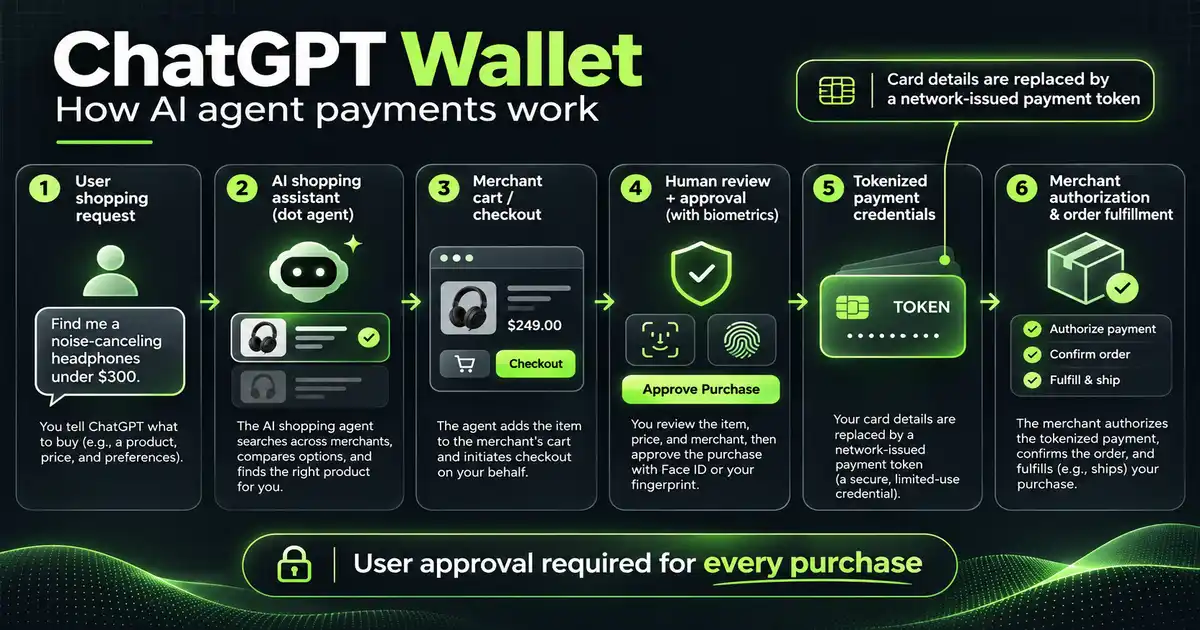
How does ChatGPT Wallet work? The exact payment flow
The launch flow has a deliberately visible approval point. OpenAI says an eligible user can add a card once, then review the purchase and approve it without entering the raw card number each time. The sequence below combines the steps OpenAI confirms with the remaining responsibilities of normal merchant and payment infrastructure.
Ask a dot to find or purchase a specified product. Product selection, inventory and merchant access can still constrain completion.
The agent uses the retailer's site and checkout flow. Merchants may need to permit signed agent requests and avoid unnecessary bot blocks.
Before payment, the user sees the cart items, total amount and selected card. A mismatch should be treated as a reason to stop, not an acceptable substitution.
OpenAI describes Face ID or a fingerprint check as examples. The approval creates a record of the transaction that the user authorized.
After approval, the payment network issues substitute card credentials. The agent and merchant do not receive the underlying card details, according to OpenAI.
Existing risk checks, payment authorization, stock validation, confirmation, fulfillment, returns and support still matter. User approval is not a guarantee of order acceptance.
A concrete example: ordering a laptop charger
Imagine asking a dot to buy a compatible charger under $45. The agent locates an offer and reaches a checkout showing $39 for the charger and $6 for shipping. The user should see the actual total, $45, and approve that specific cart. If stock changes and the merchant substitutes a $59 charger, the agent should seek fresh user approval rather than treat the earlier request as a blanket spending authority. This is an illustrative safe-design scenario, not a documented Wallet test.
Why the approval record matters: if a dispute later arises, the parties need to distinguish what the human approved from what the agent proposed, what the payment provider authorized and what the retailer shipped. For a deeper treatment of delegation and audit evidence, see SXF's AI agent authorization guide.
02A / TECHNICAL ARCHITECTURE / SXF ORIGINAL
How does ChatGPT Wallet process a payment? The technical architecture
Direct answer: an AI dot prepares a transaction at a merchant, but the user reviews and authorizes the purchase. A payment provider, network or issuer supplies a substitute payment credential, and the merchant's existing checkout uses payment infrastructure to request authorization. The card issuer decides whether to authorize the charge; the merchant decides whether to accept and fulfill the order. These are separate decisions, not one AI action. OpenAI launch announcement · Wallet terms, sections 4–6.
- 01 / INTENTCustomer + AI dot
The person sets product preferences; the agent discovers candidates and proceeds toward the seller's checkout.
Agent task, not permission to spend - 02 / MERCHANTCart + final offer
The store provides the SKU, final payable amount, shipping, delivery and recurring-payment conditions.
Merchant controls terms and inventory - 03 / HUMAN CONTROLReview + secure approval
The user checks the merchant, items, total and selected card, then confirms this purchase using a security check.
Critical approval boundary - 04 / PAYMENT CREDENTIALWallet + token provider
After approval, a provider, network or issuer can produce a substitute payment credential linked to the card.
No original card details to agent - 05 / CARD RAILSMerchant PSP + issuer
The merchant's processor/acquiring route submits payment; issuer authorization and fraud controls can still decline.
Payment authorization ≠ order - 06 / SELLERConfirm + fulfill
The merchant accepts or rejects the order and remains responsible for shipping, support, cancellations and refunds.
Merchant of record retains obligations
Which records should a merchant reconcile?
| Record | What it establishes | What it does not establish |
|---|---|---|
| Human approval | The purchase details that the user consented to. | That an issuer authorized the card charge. |
| Payment authorization | The issuer permitted a transaction attempt under its rules. | That the merchant accepted, captured or shipped the order. |
| Merchant confirmation | The seller registered an order under its own system. | That fulfillment is complete or the item cannot be returned. |
| Refund / dispute events | A merchant refund request, issuer dispute or resolution status. | That every pending payment will automatically disappear. |
OpenAI's terms require renewed approval if a material detail changes before submission. For support and fraud investigation, link the approval record, redacted payment attempt identifier and merchant order ID without retaining card security codes or full PANs in chat logs. See the authoritative Wallet terms.
03 / ELIGIBILITY
ChatGPT Wallet availability: who can use it, and where?
As announced November 13, 2026, ChatGPT Wallet began a limited rollout to ChatGPT Pro subscribers aged 18 or over in the United States with eligible U.S.-issued cards, through dots. An eligible user may still have to wait for the rollout to reach their account. No public date for worldwide release was included in the announcement.
| Requirement | Initial launch status | Practical interpretation |
|---|---|---|
| Country | U.S. only | Do not assume availability in Europe or elsewhere. |
| Plan | ChatGPT Pro | Being a ChatGPT user or having a different subscription is not sufficient for the described initial access. |
| Age | 18 or older | Adult eligibility is explicit. |
| Card | Eligible U.S.-issued card | Network partnership does not guarantee eligibility for every card. |
| Interface | dots | This is not presented as a universally available ChatGPT checkout button. |
| Merchant acceptance | Varies in practice | Sites and fraud systems may still block or decline agent orders. |
OpenAI has not published a comprehensive merchant compatibility directory or a universal expansion timetable in its launch post. Treat any third-party claim that Wallet works at “every store” or “in every country” with caution. The authoritative starting point for new availability announcements is OpenAI's product page.
If you cannot see Wallet in your dot, it does not necessarily indicate a misconfigured card: region, plan, eligibility and staged rollout can all matter.
04 / FACTS VS FORECAST
What ChatGPT Wallet does today—and what OpenAI has only proposed
Confusing planned autonomous purchases with shipping functionality would mislead readers and merchants. The table separates OpenAI's launch claims from future ambitions and SXF's analysis.
| Capability | Status on Nov. 15, 2026 | Evidence / caveat |
|---|---|---|
| Add a card once | Launched for eligible users | Subsequent purchases do not require typing the original card details again. |
| Review cart and total | Launched requirement | Every purchase requires human review. |
| Biometric-style security check | Launched requirement | OpenAI names Face ID and fingerprint as examples. |
| Network payment token | Launched core design | The payment network generates substitute credentials after approval. |
| Use existing merchant checkout | Supported design | Site access and risk/authorization systems can still impede transactions. |
| Keep eligible card rewards/protections | OpenAI launch claim | Actual protections remain subject to card and dispute eligibility. |
| Preapprove all purchases under a budget | Future direction | Not described as available in the initial launch. |
| Fully autonomous recurring shopping | Not established | No claim of generally available unattended subscriptions or spending. |
| Global, all-card compatibility | Not established | Initial U.S. eligibility is limited. |
Merchant plugins, WebMCP tools and product feeds are optional ways to improve agent interaction, not prerequisites to an agent using the browser. OpenAI says sites can be navigated without a plugin or product feed. A merchant choosing more structured integrations should evaluate actual demand and maintenance cost rather than assuming a mandatory rebuild.
05 / TRUST & CARD RAILS
Is ChatGPT Wallet safe? Tokenization, approval, fraud and limits
Wallet's strongest announced security controls are per-purchase human authorization and network-issued substitute payment credentials. These are meaningful boundaries, but they address different risks. Approval reduces the chance that a compromised agent silently spends without the user's final consent. Tokenization reduces exposure of the original card details. Neither guarantees that the proposed product, merchant, price or delivery address is legitimate.
What payment tokenization actually means
After approval, a network issues tokenized credentials that function as substitutes for the underlying card number, security code and expiry. OpenAI says the original card details are not shared with the agent or retailer. The token is not simply “encrypted card data sent to the agent”; it is a payment-network substitute that existing payment flows may accept. What restrictions apply to particular tokens—including usage scope and reuse—must not be assumed without the relevant payment provider's documentation.
Who controls what?
| Actor | Primary responsibility | Failure to watch |
|---|---|---|
| User | Approve the exact cart, amount and card | Click-through approval, account compromise or confusing presentation. |
| AI agent | Search and execute within delegated task | Prompt injection, wrong item or stale price. |
| OpenAI Wallet / dots | Coordinate purchase approval and token handoff | Product access, integration or user-consent failure. |
| Payment network / issuer | Provide token credentials; evaluate payment | Declines, insufficient funds, eligibility or issuer rules. |
| Merchant | Price, inventory, fulfillment, returns and support | Incorrect offer data, anti-bot blocks, fraud flags and refund friction. |
Threats the wallet does not eliminate
- Prompt injection: a malicious product page may try to alter the agent's task or steer it to a different merchant. The agent should treat page text as untrusted input, never a new authorization source.
- Cart drift: taxes, shipping, substitutions, coupons and availability can change after product selection; a safer workflow rechecks the exact amount at approval time.
- Social engineering: the user can still be manipulated into approving a fraudulent purchase or visiting an impersonated seller.
- Account takeover: protection of the ChatGPT account, device and payment account remains necessary.
- Risk-system disagreement: even a fully approved token may be refused by a merchant or issuer.
- Post-purchase risk: non-delivery, damaged goods, returns and chargebacks still depend on merchant and card processes.
The transaction should be bound to an immutable purchase intent: merchant identity, item identifiers, quantity, currency, final payable amount, delivery context, selected card and time. If material details change, the system should request renewed approval. This is SXF's recommended control, not a claim that every Wallet integration already enforces it.
Security teams should apply the same boundaries discussed in our AI agent security guide and prompt-injection analysis. An authenticated agent is not equivalent to an authorized payment.
06 / PRACTICAL IMPLEMENTATION
ChatGPT Wallet for merchants: a readiness checklist
OpenAI published a Commerce Partner Playbook alongside Wallet. The initial recommendations focus on reliable product discovery, recognizing agent access and working with payment and fraud vendors. Merchants are not required to install a ChatGPT plugin or product feed for agent browser access; those are potential optimizations rather than entry tickets.
1. Make product information machine-readable and accurate
Maintain product names, variants, stock, prices, currency, shipping, returns and tax policies consistently across the storefront and structured feeds, if you use them. A product an agent can discover but cannot reconcile to an actual purchasable SKU is likely to generate abandoned carts or wrong orders. OpenAI also mentions claiming and verifying a business in ChatGPT and maintaining current product feeds as a discovery option.
2. Do not unintentionally block legitimate agents
Audit CDN bot rules, JavaScript challenges, rate limits, authentication gates and robot defenses. OpenAI recommends recognizing signed agent requests with Web Bot Auth. A blanket allowlist is not a substitute for verifying the request or limiting abuse. Restrict privileged endpoints and test exact checkout actions separately from public browsing.
3. Review payment acceptance with your provider
Existing checkout infrastructure can work with Wallet tokens, but anomaly and fraud systems can flag legitimate AI-agent transactions. OpenAI named collaboration with Adyen, Checkout.com and Stripe, and risk providers Forter, Riskified, Sardine and Signifyd. This is not an assertion that every merchant account with those providers automatically supports every Wallet transaction. Ask your processor what it supports, what signals it uses and how to inspect declines.
4. Add structured actions only when useful
Optional plugins or WebMCP tools can let agents check availability and manage carts through published actions instead of brittle page navigation. But a more powerful integration also creates a larger permissions surface: explicitly separate public catalog read, cart mutation, shipping changes and payment execution. Test each tool with least-privilege constraints.
5. Test the whole order lifecycle
| Merchant control | Acceptance test | Decision owner |
|---|---|---|
| Product data | Are availability, variant and tax consistent at cart and checkout? | Catalog / commerce |
| Agent traffic | Can a verified agent browse without bypassing sensitive endpoints? | Security / infrastructure |
| Payment approval | Does the final cart match the amount shown to the user? | Checkout engineering |
| Fraud screening | Can the provider distinguish legitimate agent use from abuse? | Payments / risk |
| Order changes | Does price or item drift trigger a fresh approval? | Product / checkout |
| Receipts & support | Can customer support reconcile the user's order and refund? | Operations |
| Analytics | Can agent conversion and declines be measured without exposing secrets? | Analytics / privacy |
Suggested merchant metrics: verified-agent product view to checkout rate, cart accuracy, approval-to-payment conversion, false-decline rate, cancellation rate, refunds, customer support contacts and gross margin per completed agent order. Segment these against human checkout, taking care not to treat a new, self-selected Pro audience as representative of all shoppers.
A Wallet approval is not itself a successful merchant payment, and a payment authorization is not proof of shipment. Track separate events for agent intent, human approval, processor authorization, captured payment and completed order.
Our production deployment guide and AI agent observability guide cover the instrumentation and risk controls needed for agent toolchains.
07 / SXF ECONOMIC ANALYSIS
How could ChatGPT Wallet change e-commerce and market competition?
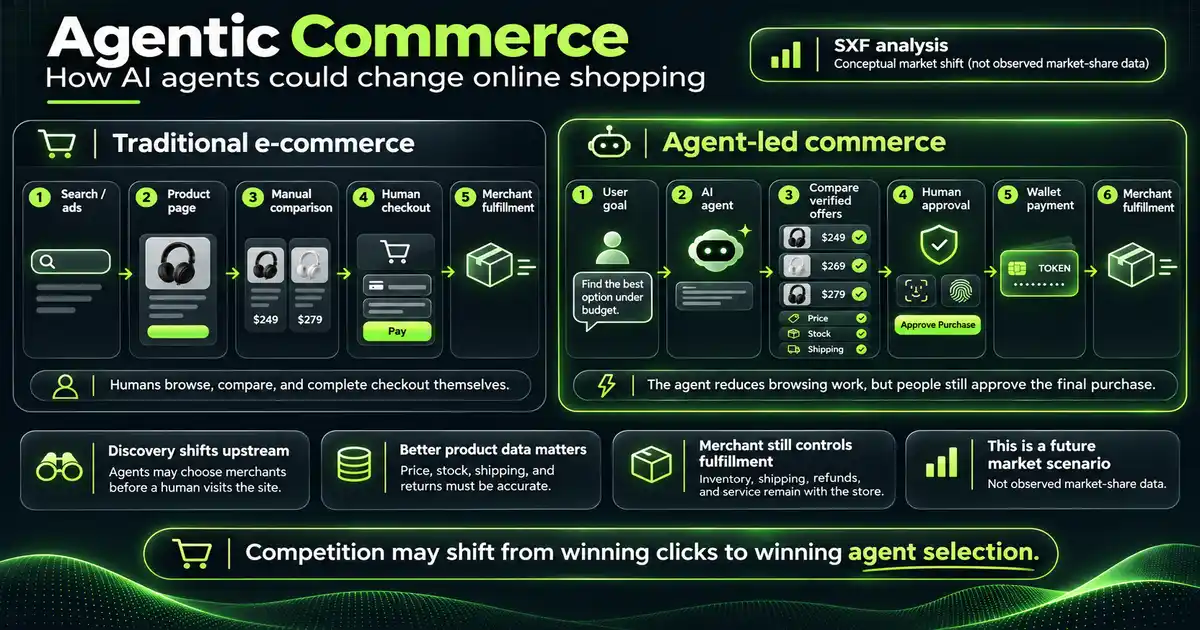
SXF's central thesis: the near-term economic impact of agentic payments is not that AI suddenly owns retail. It is that some shopping decisions may move upstream of the merchant's storefront. When an agent mediates search, comparison and checkout, merchants may compete to be selected by software before they compete for a human's attention.
From page visits to purchase-intent fulfillment
Traditional online retail uses search results, ads, product pages and repeat customer visits to convert attention into orders. Agent-mediated shopping can shorten that path: the user specifies needs and constraints, the agent evaluates options, and the merchant supplies a purchasable offer. Under this scenario, product data quality, verifiable availability, delivery reliability, returns policy and checkout compatibility become more important inputs to selection.
That is a plausible market mechanism, not a measured post-launch effect. The first Wallet rollout is too limited to infer global changes in paid-search spending, merchant profits or consumer shopping behavior.
Price comparison could get sharper—but not always cheaper
Agents can lower the time cost of comparing merchants. In relatively standardized categories—commodity accessories, replacement parts, common household consumables—greater price transparency may intensify price competition. For products differentiated by authenticity, service, customization or delivery certainty, an agent could prioritize reliability rather than headline price. Which force dominates depends on the product category and ranking incentives.
Retailers may lose visits without losing orders
A successful agent may place an order after a brief machine-mediated interaction. That can reduce the merchant's human-visible pageviews while preserving or increasing conversion from high-intent traffic. Analytics dashboards that use sessions as a proxy for demand could misread this change. Measure contribution margin and fulfilled orders, not merely clicks.
Brand advantage may shift from creative attention to credible evidence
Brand recognition is unlikely to disappear. Instead, the way it reaches the decision layer could change: clear specifications, trustworthy reviews, customer service records, guarantees and product authenticity may matter more when an agent must justify a recommendation. However, agents may still reflect paid placement, biased feeds, incomplete evidence or opaque optimization. “Best product” cannot be treated as a neutral algorithmic fact.
Platforms, merchants and payment networks retain different forms of power
OpenAI may shape the discovery and agent experience, while merchants retain price-setting, inventory, fulfillment and direct customer sales. Payment networks and issuers remain responsible for established payment rails. If agent interfaces concentrate buyer attention, the intermediary could gain bargaining influence—even when it does not own the inventory or become merchant of record. The resulting balance of power is an open strategic question.
Five economic changes to monitor
- Customer acquisition: referral and agent discovery may compete with paid search and marketplace traffic.
- Conversion friction: tokenized, user-approved checkouts may reduce data-entry steps, subject to real-world merchant acceptance.
- Market concentration: whichever services mediate agent shopping could acquire influence over which sellers are surfaced.
- Price and margin: standardized goods may face harder comparison while differentiated services may preserve premiums.
- Governance: transparent delegation, disclosures, disputes and auditing could become commercially important rather than merely technical obligations.
For adjacent analysis of commercial delegation and bargaining power, see SXF's research into AI agents negotiating payment terms and AI negotiation agents.
07A / SXF ORIGINAL ECONOMIC ANALYSIS
Could ChatGPT Wallet change Google Shopping and Amazon? Four control points
Direct answer: ChatGPT Wallet does not mean Google Shopping or Amazon will disappear. Its strategic significance is that the consumer's shopping intent can be received, compared and routed by an AI assistant before the merchant ever gets a human visit. Competing platforms are deploying their own commerce agents, so the question is not simply “AI versus online stores.” It is who controls discovery, offer selection, permission to transact and the customer relationship.
Google Shopping and Gemini: Universal Cart is already live
Google announced the U.S. launch of Universal Cart on October 15, 2026 across Search and the Gemini app. Google describes a cart combining products from multiple merchants, price/stock alerts, card-benefit suggestions, Google Pay checkouts at participating sellers and transfers to merchant checkout. The Universal Commerce Protocol (UCP) supports structured catalog and cart capabilities. According to Google, merchants remain sellers of record. That is substantially more than the Google Pay payment button—but it is not identical to OpenAI's dots-based Wallet. Google Universal Cart announcement · Google's UCP updates.
Amazon: Alexa for Shopping, Shop Direct and Buy for Me
Amazon's assistant is branded Alexa for Shopping in 2026; earlier coverage calls it Rufus. Amazon says its agent can compare offers, monitor prices, prepare carts and, in supported cases, automate shopping; its Shop Direct / Buy for Me initiative can show off-Amazon offers and purchase from participating external sites. Amazon expanded its text-based shopping experience on November 13, 2026. Do not confuse those separate Amazon capabilities with proof that ChatGPT Wallet supports unattended buying at every Amazon listing. Amazon's November update · Amazon Shop Direct details.
| Ecosystem | Verified 2026 capability | Strategic advantage | Open question |
|---|---|---|---|
| OpenAI · ChatGPT Wallet | Dots help find and buy; each initial-launch Wallet purchase is reviewed and approved. | A conversational agent can become an upstream source of high-intent referrals. | Can agent checkouts earn merchant trust and scale beyond eligible U.S. Pro users? |
| Google Shopping · Gemini | U.S. Universal Cart, Shopping Graph, Google Pay and UCP-based commerce. | Search behavior, retailer product data and established shopping surfaces. | How will agent selection interact with Google Shopping ads and direct store traffic? |
| Amazon · Alexa for Shopping | Shopping assistant, automation tools and Buy for Me / Shop Direct experiences. | Customer history, catalog, delivery network and marketplace relationship. | Can merchants gain agent discovery without losing pricing and customer independence? |
| Independent online stores | Direct product catalogs, checkouts and fulfillment; optional agent-ready interfaces. | Control over price, product authenticity, service and direct buyer relationship. | Will platform ranking and processing fees erode incremental profit? |
SXF framework: who owns the four control points?
Google Search, Amazon, a ChatGPT dot or a merchant's own audience can be the starting channel.
Price, shipping, fit, reviews and ranking incentives determine which merchant enters the shortlist.
Payment consent and credential security determine whether purchase intent becomes a legitimate order attempt.
The seller still has inventory, shipping, returns, support, fraud and refund obligations.
Three plausible futures—and what evidence would distinguish them
| Scenario | Economic mechanism | Observable validation |
|---|---|---|
| Multi-agent distribution | Many assistants compete to bring orders to independent merchants. | Cross-agent referrals, qualified conversion, net contribution per completed order. |
| Concentrated agent gatekeepers | A few intermediaries capture most high-intent prompts and set distribution conditions. | Merchant referral concentration, fees, sponsorship disclosures and buyer retention. |
| Hybrid retail | Users keep browsing stores and marketplaces while agents handle routine or narrow purchases. | Category-level cohorts comparing direct, search, marketplace and agent-mediated orders. |
Potential effect on Google Shopping ads: if an agent chooses a product before the consumer visits a search result, click-based attribution may explain less of the purchasing path. Potential effect on Amazon advertising: seller visibility may depend increasingly on how Amazon's own shopping agent surfaces offers, alongside conventional sponsored placement. Neither effect has been quantified in Wallet's launch materials; no credible revenue-loss percentage can yet be attached to them.
What merchants should measure: incremental profit after payment and support costs, agent-referred conversion, average realized selling price, customer repeat purchasing, false declines, refund rates and intermediary concentration. Pageviews alone are insufficient: a store could lose browsing sessions and gain profitable fulfilled orders. Compare with SXF's contribution-margin sensitivity example and product data readiness.
Machine-readable prices, inventory and verifiable return terms may become economically important to selection by shopping agents. That is a hypothesis to test, not a Google ranking rule, a guaranteed AI citation or evidence that consumers will stop using marketplaces.
08 / ORIGINAL SXF FRAMEWORK
A merchant economics model for agent-led orders
To avoid vague claims that agentic commerce is automatically good or bad for retailers, SXF proposes a simple contribution-margin comparison. Treat the numbers as illustrative sensitivity assumptions, not OpenAI adoption statistics, industry averages or measured Wallet performance.
Revenue − cost of goods − fulfillment − payment fees − acquisition cost − fraud/returns cost = contribution
| Per $100 order (hypothetical) | Human-driven order | Agent-driven order |
|---|---|---|
| Revenue | $100.00 | $100.00 |
| Cost of goods | −$55.00 | −$55.00 |
| Fulfillment | −$10.00 | −$10.00 |
| Payment processing | −$3.00 | −$3.00 |
| Acquisition cost | −$12.00 | −$5.00 |
| Fraud, support and returns | −$4.00 | −$6.00 |
| Contribution margin | $16.00 | $21.00 |
In this hypothetical case, an agent-led order generates $5 more contribution because acquisition costs fall by $7 while risk/support costs rise by $2. But reverse only one assumption—if an agent intermediary effectively adds $8 in acquisition or platform fees—the advantage disappears. There is no reliable public launch-era evidence yet establishing the actual incremental acquisition cost, Wallet conversion rate or fraud cost.
The break-even question for retailers
For a merchant evaluating this channel, the key inequality is acquisition savings + conversion gains > integration, risk and operational costs. Compare incremental costs against what would have happened without agent traffic; do not give the new channel credit for purchases that existing paid or direct traffic would already have produced.
A sensible pilot distinguishes three cohorts: human checkout, agent-assisted browsing with human checkout, and completed agent-led payments. Only then can teams isolate the difference between the value of product discovery and the value of the Wallet payment mechanism.
Adoption and conversion, failed-payment rates, fraud/returns, customer-acquisition efficiency, merchant support burdens and evidence of market concentration. Until independently measured, these remain scenarios—not results.
09 / SEO, PRODUCT DATA & BRAND STRATEGY
How agentic shopping could reshape search, SEO and brand visibility
Today, search engine optimization helps a seller be found by people and crawlers. Agentic commerce adds a second question: can a purchasing agent identify, compare and trust the product well enough to recommend or buy it? The two problems overlap but are not identical.
What merchants should publish clearly
- Canonical products: stable URLs, descriptive names, unique SKUs and transparent variant mapping.
- Price and stock: current availability, final checkout consistency, currency and delivery restrictions.
- Machine-readable fields: appropriate product structured data and feeds where supported, without claiming metadata alone ensures inclusion in any AI system.
- Service proof: return windows, warranty conditions, authenticity, support contact and real shipping estimates.
- Brand identity: consistent merchant names, official contact details and verifiable ownership to reduce impersonation risk.
For SXF readers: having a product feed is not proof that OpenAI's agent will recommend your products. Likewise, deploying Schema.org Product markup does not guarantee ranking, purchase eligibility or a featured snippet. These are discoverability and data-quality investments, not guaranteed placements.
Why “agent optimization” can become a bad SEO fad
Publishing thousands of repetitive AI-generated landing pages may make information harder to verify. More durable differentiation comes from original test data, real product comparisons, independently verifiable claims, honest limitations and consistently updated commercial terms. This matters for conventional search engines and for systems trying to cite reliable answers.
Readers studying the broader technical shift can start with what agentic AI means; agent security and permissions determine whether machine-readable commerce can become reliably executable.
10 / CONTEXT, NOT FALSE EQUIVALENCE
ChatGPT Wallet vs digital wallets and other agentic payment systems
It helps to separate the payment credential from the decision-making agent. Traditional digital wallets may use tokenized card payments without an autonomous shopping agent. Agentic payment products add delegated task execution, seller selection and new authorization questions to already mature payment infrastructure.
| Approach | Who initiates the shopping flow? | What it does (conceptually) |
|---|---|---|
| Traditional card checkout | Human shopper | User enters or supplies payment details directly through merchant checkout. |
| Digital wallet checkout | Human shopper | A wallet can streamline authorization and substitute payment credentials. |
| ChatGPT Wallet (initial launch) | AI agent prepares; human approves | A dot navigates shopping, then user approves each purchase; a network token enables payment. |
| Future delegated agent buying | Agent within a user's preapproved policy | OpenAI's direction: category, budget and time limits; not generally launched as of Nov. 15, 2026. |
These are workflow categories, not a feature-by-feature guarantee about Apple Pay, Google Pay, or another vendor's support in every market. Multiple protocols and payment arrangements may coexist, with different approaches to identity, authorization, discovery and transaction evidence.
Technical architecture will matter: a shopping agent needs to distinguish “I can browse the store,” “I can edit a cart,” “I can submit a payment” and “the bank approved the transaction.” Treating those as a single capability would be a design error.
10A / DIRECT SEARCH COMPARISON
ChatGPT Wallet vs Apple Pay vs Google Pay: what is the real difference?
Short answer: Apple Pay and Google Pay primarily let a shopper pay securely in supported checkouts; ChatGPT Wallet lets a shopping agent reach a checkout and request human approval. The decisive distinction is agent-led shopping orchestration, not the invention of payment tokenization. Apple Pay and Google Pay already use protected card credentials in supported payment flows. Apple's payment security documentation · Google Pay API documentation · Google Wallet virtual cards.
| Feature | ChatGPT Wallet | Apple Pay | Google Pay / Google Wallet |
|---|---|---|---|
| Typical initiator | A dot prepares the purchase; human confirms the proposed payment. | Human at a supported contactless, web or in-app checkout. | Human at a supported checkout; payment data selected via Google Pay / virtual-card flow. |
| Built-in AI shopping task? | Yes, through a dot; Wallet is one step in that task. | Apple Pay itself is a payment method, not a general shopping agent. | Google Pay API is not a shopping agent; Google's separate Shopping/Gemini products offer AI features. |
| Consent | Review merchant, items, total and card; security check for each launch-flow purchase. | Device/user authentication according to Apple Pay flow. | User selects payment method in a supported checkout; device verification varies by context. |
| Card protections | Network/provider-issued substitute credential keeps original card details away from merchant and agent. | Device account number and transaction-specific protections; merchant does not receive full underlying number. | Google Pay payment tokens; eligible Google Wallet virtual cards replace the underlying number. |
| Seller relationship | Retailer is merchant of record for order, returns and refunds. | Retailer remains seller; Apple Pay facilitates payment. | Retailer remains seller; Google Pay facilitates payment. |
| Availability | Early U.S. Pro 18+ dots rollout with eligible U.S. cards. | Depends on country, device, issuer and merchant support. | Depends on country, card, device, browser and merchant integration. |
| Core limitation | Agent navigation, user approval and merchant/issuer acceptance are separate failure points. | Does not itself select and order across merchants. | Payment API alone does not authorize Gemini or Search to purchase on a user's behalf. |
Important Google distinction: Google Pay is a payment service/API, while Universal Cart is Google's 2026 cross-retailer shopping experience using Search and Gemini. Comparing ChatGPT Wallet only with a Google Pay button ignores Google's broader agentic commerce strategy. See the Google Shopping and Amazon analysis.
Is ChatGPT Wallet safer than Apple Pay or Google Pay?
There is no verified, comparable fraud dataset proving one of these products is categorically safer. They protect different stages. A payment token can reduce exposure of the physical card credentials, but cannot by itself verify the product's authenticity, prevent an account takeover or stop a person from approving a deceptive offer. Evaluation needs equivalent user cohorts, merchant types, dispute definitions and measured outcomes.
Does ChatGPT Wallet integrate with Apple Pay or Google Pay?
The initial OpenAI announcement does not establish universal integration with either service. The published flow uses substitute card credentials within merchant checkout. Do not assume that Apple Pay or Google Pay must be installed, nor that a retailer supporting those payment buttons automatically accepts every agent-initiated Wallet purchase.
11 / OPEN QUESTIONS
The risks that will determine whether agentic payments scale
1. The last-inch authorization problem
Did the user approve the real merchant, final price, delivery address and subscription terms? Fast checkout matters only if it preserves deliberate consent. Design review screens and audit receipts to make that test possible.
2. Storefront access and the bot paradox
Retailers spent years deploying tools to block automated traffic. Trusted purchasing agents now need differentiated access. A seller that simply disables bot protection risks abuse; one that blocks all agents loses potentially legitimate demand. Verified requests and scoped controls are the middle ground.
3. Fraud detection and false declines
An unusual device, navigation path or velocity may look suspicious even with an authorized token. The challenge is proving legitimacy without weakening screening. OpenAI specifically warns that risk systems may cause declines or cancellations.
4. The principal-agent incentive problem
An agent could optimize for low price, high commission, platform preference, fastest shipping or some combination. Which objective is selected—and whether the consumer can inspect it—may become a central competition and consumer-protection issue. This is an economic risk scenario, not a reported abuse in ChatGPT Wallet.
5. Accountability after a transaction
When an order is wrong, customers need a straightforward path through refund, dispute and delivery support. OpenAI says merchants retain responsibility for pricing, fulfillment, returns and service. Payment tokens do not make post-sale obligations disappear.
6. Uneven global and merchant coverage
A narrow U.S. Pro rollout gives early technical feedback but not a representative signal of global consumer demand. Businesses should plan for experimentation, not assume all customers will shift to agents in 2027.
Agentic commerce scales only if buyers trust consent, sellers accept verified traffic, issuers can distinguish real payments from fraud, and the overall experience improves on manual checkout. Failure in any one layer can suppress adoption.
11A / PRACTICAL CONSUMER PROTECTION
ChatGPT Wallet fraud, refunds, chargebacks and disputed payments
Who should you contact? For order changes, returns, cancellation, shipping and refunds, contact the merchant. For declined, pending, disputed or unrecognized card charges, contact the card issuer promptly. For Wallet errors, account compromise or an order different from the displayed approval, contact OpenAI Support. OpenAI's Wallet terms make the merchant the seller of record, not OpenAI; chargeback rights remain subject to issuer/network rules and applicable law. OpenAI's official troubleshooting guidance.
| Scenario | What to do first | What to retain |
|---|---|---|
| Payment approved, but no merchant confirmation | Check the merchant's order system or receipt before repeating checkout; ask seller to verify. | Order attempt time, amount, merchant and redacted approval. |
| Pending charge after failed agent checkout | Check order status with merchant; ask issuer about authorization hold and timing. | Pending transaction record and seller response. |
| Wrong product, late delivery or defective item | Request support or refund from the merchant; ask issuer about eligible dispute protections if unresolved. | Order receipt, item description, communications, tracking. |
| Final item/price differs from user's approval | Contact OpenAI Support about Wallet mismatch; merchant about the order; issuer if disputed charge. | Redacted approved details versus final receipt. |
| Unrecognized purchase or suspected card fraud | Promptly notify issuer through verified official channels; secure accounts and notify OpenAI if compromised. | Charge details, case references and timestamps. |
| Recurring charge after checkout | Review recurring terms and ask merchant to manage/cancel; contact issuer for disputed charges. | Terms accepted, subscription notice, cancellation proof. |
| Legitimate agent transaction declined | Consult issuer and merchant risk/payment provider; don't interpret a token as guaranteed acceptance. | Decline time, error message, merchant identity. |
Scenario 1: the bank shows a pending payment, but the agent says checkout failed
This is not proof that a merchant order exists or that the customer has permanently paid. A pending issuer authorization can precede merchant confirmation or settlement. OpenAI explicitly advises checking for merchant confirmation before retrying. An immediate second attempt can create duplicate orders; use the receipt or contact the seller and issuer first.
Scenario 2: a page tries to redirect the agent to a fraudulent seller
This is a hypothetical prompt-injection threat, not a documented ChatGPT Wallet breach. The agent may encounter malicious instructions inside a product page. Site content is not payment authority: the person should inspect merchant identity, line items and amount before approval. Under OpenAI's terms, materially changed purchase details before submission require renewed approval. Related controls: SXF prompt-injection guide and AI agent authorization.
Scenario 3: the user approved a recurring service, then sees another charge
Per-purchase security review at setup is not a universal guarantee that merchants can never bill again. OpenAI explains that, when a user agrees to recurring or continuous payment terms, a merchant may retain the supplied payment credential and charge according to that agreement. Review the recurring terms, cancel with the merchant where appropriate and contact the issuer about unauthorized charges. Do not confuse a one-time Wallet purchase with a documented subscription consent.
Where does a chargeback fit?
A refund is normally handled by the merchant; a chargeback/dispute follows the issuer and payment-network process. An order problem does not automatically qualify for a chargeback, and eligibility, deadlines and evidence depend on card terms and applicable law. OpenAI can provide Wallet records or reasonable assistance but does not generally decide or fund merchant chargebacks. OpenAI Wallet terms, section 7.
Track user approval, merchant order ID, PSP authorization state, refund request and issuer dispute separately. Keep masked card digits and redacted receipts—never store complete card numbers, card security codes, passwords or verification codes in support tickets. A trusted merchant needs a readable transaction trail, not just a successful bot message.
12 / WHAT TO WATCH
ChatGPT Wallet roadmap: the evidence SXF will monitor
Evergreen coverage should update when a materially verifiable change occurs—not merely when the product attracts another headline. This is SXF's tracking framework for future revisions.
| Signal to monitor | Why it matters | Where evidence should come from |
|---|---|---|
| New countries, plans and supported cards | Market breadth | Official OpenAI and issuer eligibility pages |
| Merchant and processor compatibility | Whether transactions complete at scale | Provider documentation and measured merchant tests |
| New authorization model | Whether preapproved autonomous spending becomes real | Product release notes and verifiable feature descriptions |
| Decline and dispute performance | Risk-adjusted conversion | Audited or clearly sampled merchant/operator data |
| Merchant plugins / WebMCP support | How reliable non-browser workflows become | Official tool and protocol documentation |
| Competition or interoperability | Market concentration and merchant bargaining | Primary announcements and transparent technical specs |
| Consumer outcomes | Whether agent buying saves time or money | Controlled studies with clear comparison groups |
Current evidence cutoff: this page was initially published and fact-checked November 15, 2026, based on OpenAI's November 13 launch announcement. A future “last verified” update should be made only after checking the primary source again. Never interpret unverified rumors as product features.
SXF also covers the current event in the November 15 SXF Brief. That news report answers what happened; this guide answers how it works, how to prepare and what it could change.
13 / DIRECT ANSWERS
ChatGPT Wallet FAQ: 21 direct answers
Answers below reflect the November 15, 2026 verified information cutoff. Short answers are presented in visible text as well as in page structured data; rich-result appearance is determined by search engines, not by adding markup.
What is ChatGPT Wallet?
ChatGPT Wallet is OpenAI's agentic payment wallet. An eligible user's dot can reach a merchant checkout and request approval. The user reviews the items, total and card, authenticates each purchase, and the payment network supplies a token rather than sharing the underlying card credentials with the agent or merchant.
How does ChatGPT Wallet work?
The user saves an eligible card, asks their dot to shop, reviews the final order, and approves each purchase with a security check. A network-issued payment token is then used with the merchant's existing checkout flow. Merchant authorization, fraud checks and order fulfillment still apply.
Is ChatGPT Wallet available now?
OpenAI began a limited US rollout on November 13, 2026. Initial eligibility is ChatGPT Pro, age 18 or older, US residency and an eligible US-issued card, with purchases initiated through dots. Access is not universal.
Is ChatGPT Wallet available outside the US?
No broader rollout was announced as of November 15, 2026. OpenAI says it plans to learn from the initial US release and expand over time; it has not announced a date for other countries.
Does ChatGPT Wallet work with Visa, Mastercard and American Express?
OpenAI announced partnerships with American Express, Mastercard and Visa. Availability depends on the particular eligible US-issued card and the early rollout. Network partnership does not mean every card or merchant is supported.
Does ChatGPT Wallet charge extra fees?
OpenAI's November 13 launch announcement does not specify a separate Wallet fee schedule. Users should check the relevant ChatGPT subscription, merchant checkout, card agreement and any later product terms rather than assume there are no fees.
Can AI agents buy things without permission?
Not with ChatGPT Wallet's launch flow. Each purchase requires review and a security approval. OpenAI describes preapproved autonomous purchasing within specified limits as a future direction, not a current feature.
Are my card details shared with the AI agent?
OpenAI says the agent and merchant do not receive the user's actual card details. After user approval, a payment network issues substitute payment credentials. This reduces exposure of the original card data but does not eliminate fraud, account takeover or mistaken orders.
Do online stores need a ChatGPT plugin to accept Wallet purchases?
No. OpenAI says agent browser access does not require a plugin or product feed and Wallet tokens can work with existing checkout flows. Merchants may still need to adjust bot access, product data and fraud rules, and optional plugins can improve agent interactions.
How do merchants prepare for ChatGPT Wallet?
Keep product prices and stock accurate; allow verified agent traffic where appropriate; review payment and fraud declines with providers; validate order details and price changes; maintain refund and customer-service processes; and test end-to-end agent purchase flows.
Does ChatGPT Wallet replace Apple Pay, Google Pay or credit cards?
The launch does not replace card networks or merchants' payment relationships. It adds an agent-initiated approval and token-payment flow. Comparisons with conventional digital wallets are useful conceptually, but product coverage and capabilities differ.
What is the difference between ChatGPT Wallet and agentic commerce?
Agentic commerce is the broad category of AI agents discovering, comparing, negotiating and purchasing goods or services. ChatGPT Wallet is one specific payment mechanism within that emerging ecosystem.
Can a merchant reject an AI-agent order?
Yes. A merchant's checkout, payment and risk controls still determine whether the transaction succeeds. OpenAI notes that legitimate agent purchases may be declined or cancelled if site access or fraud screening is not configured appropriately.
Will AI agents replace online stores?
Not necessarily. Agentic commerce may reduce manual browsing and change traffic acquisition, but merchants still control inventory, price, fulfillment, returns and service. The scale and timing of any transformation remain uncertain.
Is ChatGPT Wallet better than Apple Pay?
They solve different tasks: ChatGPT Wallet connects AI agent shopping with per-purchase user-approved payment, whereas Apple Pay is a payment method. Both protect underlying card details in supported flows. No reliable head-to-head fraud evidence establishes that either is categorically safer.
What is the difference between ChatGPT Wallet and Google Pay?
Google Pay supports checkout and tokenized payment data at participating merchants. ChatGPT Wallet adds an agent that prepares a purchase and requires the user to approve the final transaction. Google's separate Universal Cart on Search and Gemini is a shopping experience, not the same as the Google Pay API.
Can I get a refund for a ChatGPT Wallet purchase?
Contact the merchant for a return, cancellation or ordinary refund. Contact the card issuer for disputed or unrecognized charges; contact OpenAI Support for Wallet errors or a transaction that differs from what you approved. Merchant terms and issuer protections govern outcomes.
What if my ChatGPT Wallet payment is pending but no order appears?
Check the merchant's receipt and order status before repeating the payment. Ask the merchant whether the order exists and the card issuer about the pending authorization. A Wallet approval or conversation error alone does not confirm the order.
Will ChatGPT Wallet replace Google Shopping?
There is no evidence that it will. Google's Universal Cart and Shopping Graph remain active, and the platforms may compete for shopping-intent discovery and offer selection. SXF treats changes to shopping ads and merchant traffic as hypotheses requiring measured evidence.
Will Amazon allow AI agents to buy products?
Amazon already has its own Alexa for Shopping and Buy for Me / Shop Direct features. That does not establish universal compatibility with OpenAI's ChatGPT Wallet or its particular checkout permissions.
Can a merchant make recurring charges after Wallet approval?
OpenAI's help documentation says a merchant may retain the payment credential and charge again under recurring-payment terms the user agreed to. Review those terms, contact the merchant to cancel, and dispute unrecognized charges with the issuer.
14 / EVIDENCE & EDITORIAL METHOD
Primary sources, research limits and SXF editorial methodology
Source of record: OpenAI's November 13, 2026 product announcement. The launch section, purchase sequence, availability, partnerships, merchant guidance and announced future direction above are derived from that announcement. References to future commercial effects are explicitly labeled SXF analysis, not established results or OpenAI projections.
- OpenAI — ChatGPT Wallet Terms (effective Nov. 12, 2026). Contractual purchase approval, issuer authority, seller-of-record obligations, refunds and disputes.
- OpenAI Help Center — Making Purchases With ChatGPT Wallet. Approval vs merchant confirmation, pending charges, recurring plans, fraud and support routing.
- Apple Platform Security — Paying With Cards Using Apple Pay. Authentication and card-data protection in Apple Pay.
- Google Developers — Google Pay Web API Overview and Google Wallet Help — Keep Your Payment Info Safe. Tokenized checkout and virtual-card scope.
- Google — Universal Cart Launch, October 15, 2026 and Google — Universal Commerce Protocol Updates. Google Shopping and Gemini's commerce initiatives.
- Amazon — Alexa for Shopping by Text (updated Nov. 13, 2026) and Amazon — Shop Direct and Buy for Me. Amazon agent-led discovery and buying.
- OpenAI — Introducing ChatGPT Wallet (Nov. 13, 2026). Primary source for access requirements, card network partners, user approval, tokenization and merchant guidance.
- OpenAI — Commerce Partner Playbook / developer resources. Technical starting point cited by OpenAI for agent access, product discovery, checkout and risk-provider coordination. Refer to current documentation for implementation details.
- SXF — AI Agent Authorization. Background on delegation, limits, proof and action receipts.
- SXF — Can AI Agents Negotiate Better Payment Terms?. Related analysis of agent-mediated commercial decisions.
- SXF — AI Agent Security. Security context for tools, prompt injection and human approval.
What this guide has not established
No independently verified public data in the launch announcement quantify Wallet transaction volume, realized savings, conversion uplift, merchant fraud rates, default fees or global acceptance. The $100 contribution-margin example is a transparent hypothetical exercise. It must not be cited as an empirical result.