SIGNAL / RESEARCH

OpenAI Commits $2 Million to AI Child Safety Research: What It Means

SOURCEOpenAI
PUBLISHEDNovember 12, 2026
LAYERResearch
SIGNAL SCORE53/100
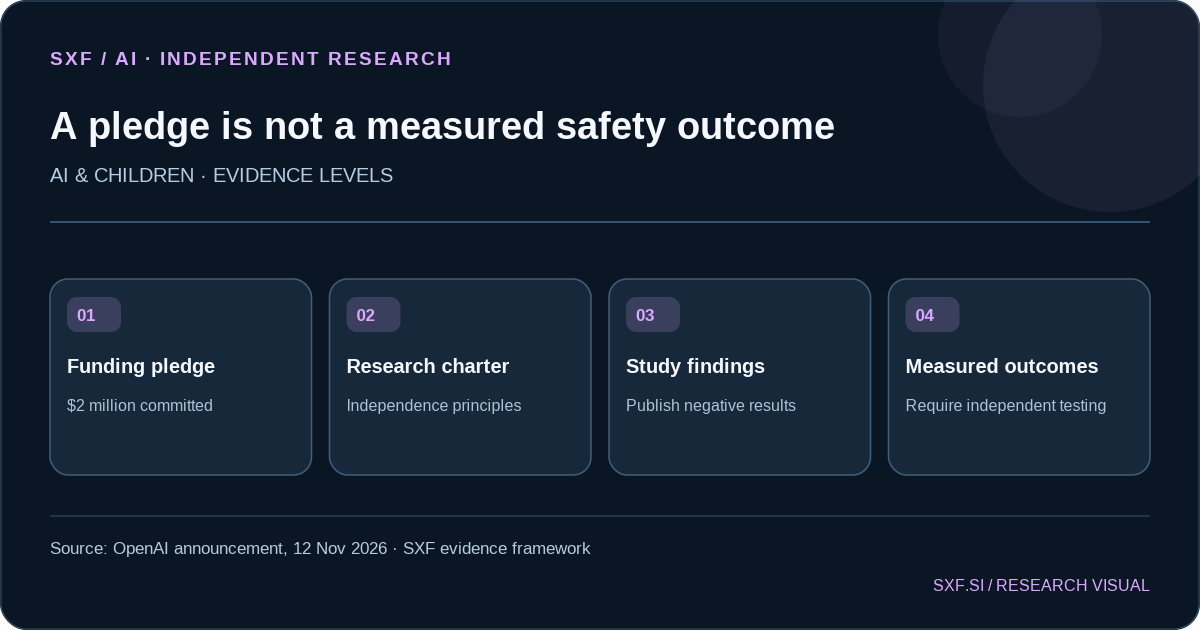
SXF original research-evidence ladder from funding pledge and charter to technical safeguards and independent child safety outcomes.
SXF editorial evidence ladder explaining the difference between funding commitments and measured child safety outcomes.

SXF VERIFIED BRIEF

On November 12, 2026, OpenAI said it signed an international children's AI safety charter and committed $2 million to shared research measuring AI risks and opportunities for children. This is a separate initiative from its $5 million teen-development research grants announced on September 8.

WHY IT MATTERS

Public concern about young people's AI use needs reproducible evidence, transparent publication and safeguards rather than relying solely on product announcements or industry promises.

WHAT TO VERIFY

This is a funding commitment, not proof that a specific chatbot is already safer. The release outlines research independence and publishing negative results, but does not provide complete outcome data or an audited impact evaluation.

RESEARCH FUNDING / CONTEXT

OpenAI's AI Child Safety Research Funding: $2M vs $5M

OpenAI announced two separate research funding initiatives in 2026. September focused on independent grants for studies of teenagers; November committed support to a scientific network developing shared child-safety measurements.

ComparisonSeptember 8, 2026 — $5MNovember 12, 2026 — $2M
FundingUp to $5 million in research grants; individual awards up to $1 million$2 million pledged to support a scientific research network
Population and focusTeenagers ages 13–17; generative AI's effects on social and emotional developmentChildren more broadly; measuring AI risks and opportunities
Research modelIndependent researchers apply for project grants administered by OpenAI Group PBCResearch network under the Coalition for Children's Rights and Protection in the Age of AI
Publication approachPublic release is strongly encouraged, but publication is not a funding conditionOpenAI says findings will be published, including negative or inconclusive results
Evidence so farGrant announcement and intended research; no safety outcome follows from funding aloneResearch-network commitment and charter; not proof of measured safety improvement

The $5 million and $2 million are separate announced commitments, not one $7 million programme or evidence that $7 million has already been disbursed.

Original announcements: September 8 grant announcement · November 12 child-safety pledge

SXF RESEARCH EXPLAINER

What the technical evidence means.

Source-grounded analysis

TECHNICAL ANALYSIS / 01

What did OpenAI promise at the Paris Peace Forum?

OpenAI says it signed a charter at the Paris Peace Forum and committed $2 million to research supporting the Coalition for Children's Rights and Protection in the Age of AI. The programme is framed around shared measurement tools for risks and opportunities rather than a direct grant for a new child-facing product.

That distinction matters: financing better measurement could help researchers compare systems and policies, but the announcement is not itself a peer-reviewed finding that children are safer. The size of the pledge also does not establish the adequacy or efficiency of the eventual studies.

Check primary-source evidence ↗

TECHNICAL ANALYSIS / 02

What would trustworthy AI child safety research measure?

The announced programme calls for tools that enable risk and benefit measurement. A useful research design would specify age groups, tasks, recruitment safeguards, exposure intensity and outcomes beforehand; it would record failures and benefits as well as cases where there is no measurable effect. Those design elements are SXF's proposed criteria, not completed elements asserted by OpenAI.

Outcome reporting should distinguish harmful content exposure, inappropriate relational behaviour, privacy disclosure, educational assistance and access to creative tools. Aggregate headline scores can conceal age-specific effects or platform differences. Independent replication and accessible methodologies matter more than a single positive headline.

Check primary-source evidence ↗

TECHNICAL ANALYSIS / 03

Are the findings independent if an AI company contributes funding?

OpenAI says the charter contains protections for research independence, that researchers retain control of conclusions, and that negative or inconclusive findings will be published. These are important announced principles, but publication and governance should be checked in practice as the network produces results.

SXF would look for named investigators, declared funding, conflict-of-interest disclosures, preregistered study methods where appropriate, access to non-sensitive aggregate results and visible corrections. This checklist does not imply that the coalition has failed these tests; it specifies what a reader needs to verify rather than accepting independence as a self-certifying label.

Check primary-source evidence ↗

TECHNICAL ANALYSIS / 04

SXF analysis: how to tell funding, standards and safety outcomes apart

A funding announcement supports research capacity; a charter states principles; a product protection changes technical behaviour; and an independent evaluation measures whether those changes actually work. These are four separate kinds of evidence. Conflating them can overstate progress or dismiss legitimate efforts before any results are available.

For families, educators and policymakers the immediate practical approach is to check age suitability, privacy settings, parental controls, content-reporting options and how incidents are reviewed. The research may eventually improve such safeguards, but those future impacts should only be claimed after published evidence and independent checks.

Check primary-source evidence ↗

EVIDENCE LEVELS / CHILD SAFETY

Four kinds of evidence that should not be confused

A commitment, policy and observed outcome answer different questions. The final column identifies what would count as stronger public evidence.

StageWhat it establishesWhat to request next
Funding pledgeResources committed to researchNamed projects and budgets
CharterPrinciples for independence and protectionPublished governance and disclosures
Product safeguardsA technical control has been addedAuditable implementation and risk tests
Independent outcomesObserved effects under a study designMethods, replication and limitations

This is SXF's analytical framework; OpenAI has announced the first two stages, not demonstrated all the outcomes. Check the original evidence ↗

READER QUESTIONS

OpenAI child safety research questions

Did OpenAI announce a $2 million child safety grant?

OpenAI says it committed $2 million to a research network associated with the Coalition for Children's Rights and Protection in the Age of AI.

Will the research publish negative findings?

OpenAI states that researchers retain control over their conclusions and that negative or inconclusive findings will be published; the promise needs follow-up verification.

Does the announcement prove ChatGPT is safer for children?

No. A pledge and research charter are not an independent product-effectiveness study or a measured outcome.

PRIMARY-SOURCE FACTS

What the evidence establishes.

Reviewed 2026-11-15
Announcement

OpenAI published the commitment on November 12, 2026. Primary evidence ↗

Amount

OpenAI pledged $2 million toward child AI safety research. Primary evidence ↗

Forum

The company says it signed the Charter of Engagement for Safer AI for Children at the Paris Peace Forum. Primary evidence ↗

Programme

The research network operates under the Coalition for Children's Rights and Protection in the Age of AI. Primary evidence ↗

Research objective

The funding is intended for shared scientific tools to measure AI risks and opportunities for children. Primary evidence ↗

Independence commitment

OpenAI says research teams retain control over conclusions. Primary evidence ↗

Negative findings

The announcement says published results will include negative or inconclusive outcomes. Primary evidence ↗

Policy proposals

OpenAI advocates default age-appropriate safeguards, parental tools, recurring risk assessments and accountability. Primary evidence ↗

Jurisdiction

OpenAI says it plans to engage European policymakers as the EU Kids Act develops. Primary evidence ↗

Separate September commitment

OpenAI announced up to $5 million in independent research grants for the effects of generative AI on people ages 13–17 on September 8, 2026. Primary evidence ↗

LIMITATIONS

The pledge is a company announcement, not audited evidence of an achieved safety improvement. The released summary does not quantify expected research impact, publish new clinical or developmental findings, or demonstrate the actual independence of every eventual study. The term 'safety' spans different risks and age groups; no single metric can establish it across contexts. The separate September $5 million teen-research grants and November $2 million child-safety network commitment must not be combined into a single grant programme or treated as disbursed funds.

PRACTICAL TAKEAWAYS

What readers can check next.

Verification checklist

  1. Distinguish a funding pledge from completed scientific findings.
  2. Check the published governance and independence procedures.
  3. Look for age-specific methods and declared conflicts of interest.
  4. Check whether negative and inconclusive results appear.
  5. Evaluate real product safeguards separately from charter commitments.

Read the related SXF guides

TOPICSOpenAIAI Safety
MODELSNo named model detected