SIGNAL / OPEN SOURCE

llama.cpp v1.0.0: what changed and how to prepare an upgrade

SOURCEggml-org / Hugging Face
PUBLISHEDNovember 13, 2026
LAYEROpen Source
SIGNAL SCORE40/100
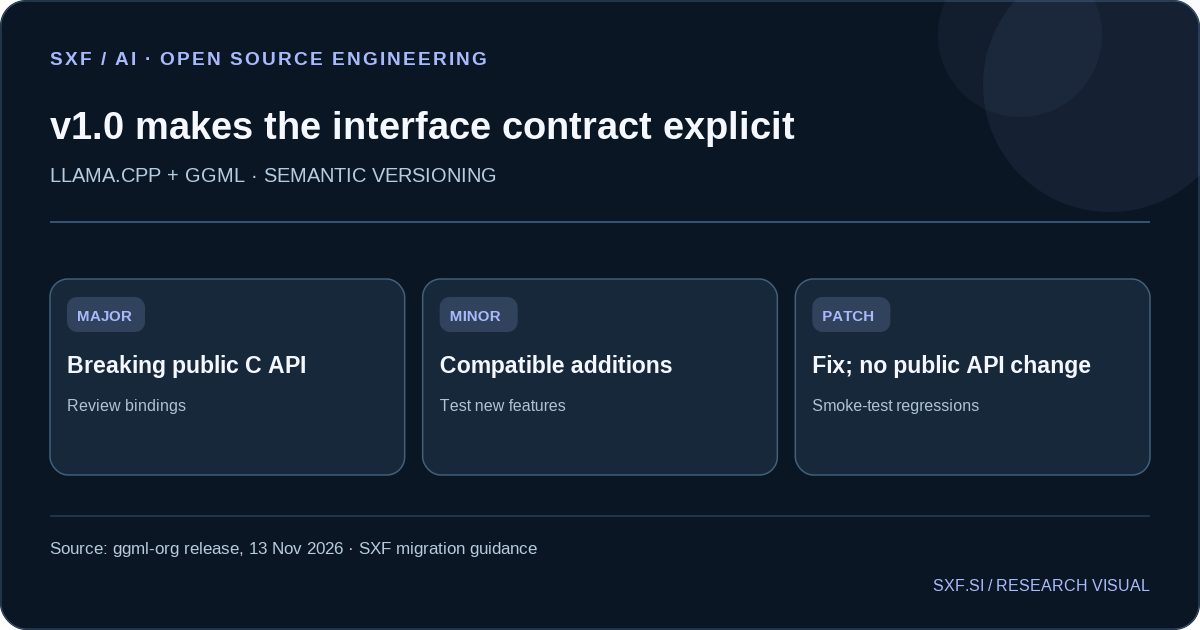
SXF original diagram distinguishing llama.cpp major, minor and patch releases and test responsibilities.
SXF explanatory versioning chart based on ggml-org's published v1.0.0 semantic-version rules.

SXF VERIFIED BRIEF

llama.cpp and ggml libraries received a v1.0.0 release with a public versioning policy specifying major, minor and patch changes for C APIs.

WHY IT MATTERS

An explicit compatibility promise allows projects embedding local models to plan dependency updates and build distribution pipelines without treating every upstream commit as a safe drop-in replacement.

WHAT TO VERIFY

A library 1.0 tag does not establish a stable model-output format, a fixed set of supported accelerators, or a measured performance boost. Compatibility still depends on build flags, linked backends and application behaviour.

SXF RESEARCH EXPLAINER

What the technical evidence means.

Source-grounded analysis

TECHNICAL ANALYSIS / 01

What exactly is stable in llama.cpp 1.0?

The key change is a versioned contract for C entry points exposed by libllama and libggml. A major increment communicates public incompatibility, a minor increment signals compatible features and model or backend support, and a patch increment covers fixes that do not modify the public API. This makes release selection more predictable for applications that compile or link against the libraries.

The promise has a defined scope: headers in the public include directory. It does not automatically guarantee byte-for-byte identical inference results across machines, stable private C++ internals, or identical behaviour after quantization and device-driver changes. An adopter should distinguish the published library interface from the broader runtime stack.

Check primary-source evidence ↗

TECHNICAL ANALYSIS / 02

Does llama.cpp 1.0 improve inference speed or model quality?

The announcement is about maintenance discipline, package delivery and backend coverage. It does not provide a controlled benchmark showing a universal speed improvement in tokens per second, lower first-token latency or better answer accuracy. Any such performance claims need tests on named models, quantization formats, devices and comparable prompts.

SXF recommends two measured baselines before upgrading: prompt-processing throughput and generation throughput, paired with output consistency or task-accuracy tests. Hold model weights, prompt formatting, GPU drivers and context length constant wherever practical. A software milestone can reduce integration risk without necessarily improving the underlying model.

Check primary-source evidence ↗

TECHNICAL ANALYSIS / 03

How should library users migrate to v1.0.0?

First pin both library dependencies, record the current public API functions and compile with warnings treated as failures in a staging environment. Run a small corpus of local inference tasks through each configured CPU or GPU backend, checking crashes, tokenization, batching behaviour, memory budgets and API return values before shipping a package update.

Next, document a rollback procedure and keep a short compatibility matrix for operating systems, architectures and model families. The SXF open-source collection provides additional implementation context; the goal is reproducible release engineering, not a claim that all 150-plus reported architecture variants have been independently verified by our newsroom.

Check primary-source evidence ↗

TECHNICAL ANALYSIS / 04

SXF analysis: the difference between source stability and operational stability

Semantic versioning is a useful signal for build-time compatibility, but production stability must also cover model conversion tools, packaging, accelerator selection and the shape of application outputs. A public API that still compiles can nonetheless behave differently when the hardware backend or model weights change.

Compare before-and-after versions along three axes: link/load success, representative task correctness and operational cost under the same workload. A good upgrade report records build identifiers, CPU or GPU model, memory, quantization, prompts and reasons for any rejected outputs. It avoids attributing performance changes to a 1.0 label rather than measured evidence.

Check primary-source evidence ↗

VERSIONING CONTRACT / RELEASE ENGINEERING

What MAJOR, MINOR and PATCH mean for library adopters

The project's stated semantic version contract tells maintainers how to interpret public-interface changes, not how to predict runtime performance.

Version changeProject contractWhat an integrator should test
MAJORBreaking public C API changesRebuild bindings and verify interface migrations
MINORCompatible functionality or new backend/model supportTest new features plus existing workflows
PATCHBug fix without public API changeSmoke-test affected code and model outputs

The last column is SXF's recommended engineering process, not a benchmark or project warranty. Check the original evidence ↗

READER QUESTIONS

llama.cpp v1.0.0 questions

Is llama.cpp v1.0.0 a new large language model?

No. llama.cpp is an inference library for running model architectures; the release concerns its software and versioning contract.

Does version 1.0 mean every future release is backward compatible?

No. The maintainers promise to signal breaking changes with major version increments, not to avoid breaking changes indefinitely.

Is v1.0 guaranteed to run faster?

The launch article does not establish a universal measured speed gain. Benchmark your actual model and hardware before drawing that conclusion.

PRIMARY-SOURCE FACTS

What the evidence establishes.

Reviewed 2026-11-15
Date

The release article is dated November 13, 2026. Primary evidence ↗

Core libraries

The project announces llama.cpp library v1.0.0 and ggml library v1.0.0. Primary evidence ↗

Public API

The policy applies to interfaces exposed in project public headers under include directories. Primary evidence ↗

Major rule

Breaking changes to the public C API require a major version bump. Primary evidence ↗

Minor rule

Backward-compatible features, backend and model support or API additions trigger minor increments. Primary evidence ↗

Patch rule

Bug fixes without API changes trigger patch increments. Primary evidence ↗

Build platforms

The project describes distribution work across Linux, macOS, Windows, mobile operating systems and common package ecosystems. Primary evidence ↗

Hardware abstraction

ggml uses dedicated compute backends that can be built as libraries and loaded optionally at runtime. Primary evidence ↗

Architecture coverage

The maintainers claim support for more than 150 architecture variants; this is a project figure, not a measurement made by SXF. Primary evidence ↗

Release provenance

llama.cpp publishes the v1.0.0 tag in the maintainers' official release repository. Primary evidence ↗

LIMITATIONS

Version 1.0.0 describes a library and public API contract, not a guarantee that every program, model format or accelerator remains backward compatible. A numerical release milestone does not independently demonstrate faster inference or lower RAM use. Project-reported architecture counts may change; consumers should verify specific model and backend combinations.

PRACTICAL TAKEAWAYS

What readers can check next.

Verification checklist

  1. Pin the libllama and libggml versions in your dependency manifest.
  2. Verify public header/API compatibility in an automated build.
  3. Run each actually deployed backend and model combination.
  4. Compare inference latency and correctness against a recorded baseline.
  5. Keep rollback assets and documented reproducible build settings.

Read the related SXF guides

TOPICSOpen Source AI
MODELSNo named model detected