SXF RESEARCH EXPLAINER
What the technical evidence means.
TECHNICAL ANALYSIS / 01
Who can enable Gemini 4 Hydrogen inside GitHub Copilot?
GitHub lists Copilot Pro, Pro+, Max, Business and Enterprise as eligible plans, and describes availability across VS Code, Visual Studio, popular IDEs, CLI, the coding agent, GitHub web and mobile, and the Copilot SDK. Start by checking the model picker in the actual client you use; a feature being generally announced does not mean it appears simultaneously in every account.
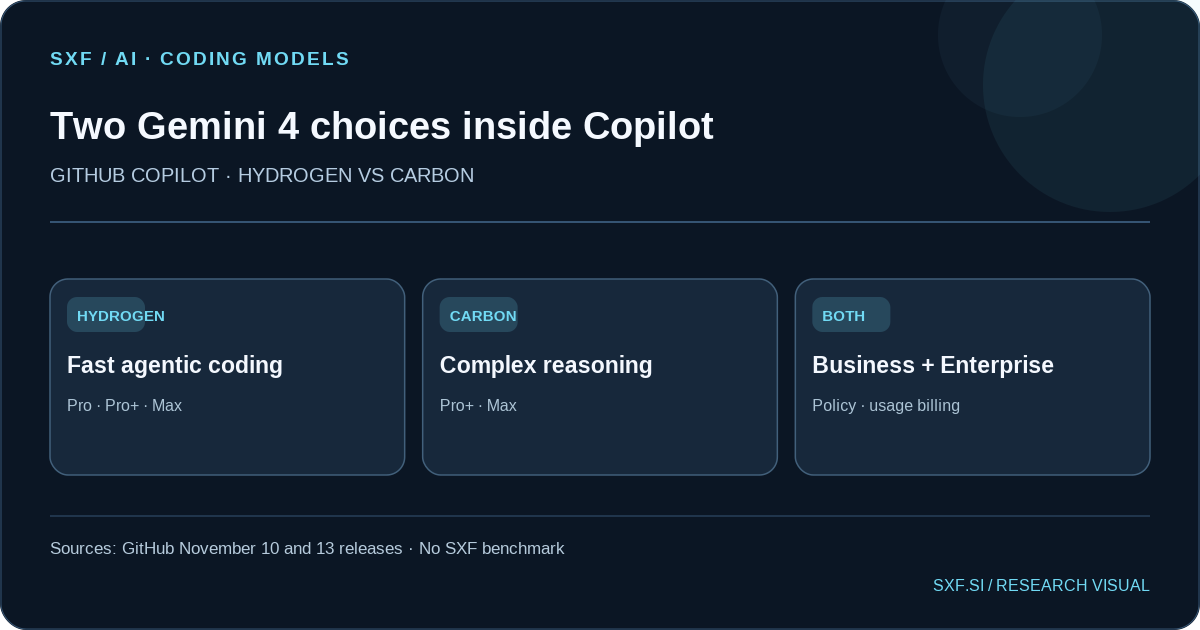
On Business and Enterprise plans, a model policy can disable or permit a named model. If Hydrogen is missing, check your subscription, client release, rollout state and organization settings before troubleshooting local code. The Carbon article covers a different Gemini 4 option with narrower individual plan eligibility.
Check primary-source evidence ↗
SETUP / ACCESS CHECKLIST
How to enable Gemini 4 Hydrogen in VS Code and GitHub Copilot
GitHub's November 13 release lists Copilot Pro, Pro+, Max, Business and Enterprise; clients include VS Code, Visual Studio, JetBrains, Xcode, Eclipse, the CLI, coding agent, GitHub.com, mobile app and SDK. Availability is gradual and depends on the client and administrator settings.
- Confirm your plan: Copilot Pro or higher is named in the launch note. Free and Student access is governed by auto model selection and must not be confused with direct model-picker access.
- In VS Code: open Copilot Chat, choose the current-model dropdown at the bottom of the chat view, and select
Gemini 4 Hydrogen if available. Update VS Code and the Copilot extension if needed.
- For Business or Enterprise: ask an organization owner to review
Organization Settings → Copilot → Models. An enterprise-enforced restriction cannot be overridden by the organization.
- For other clients: check that product's model picker and published support list; different surfaces can roll out at different times.
Why Gemini 4 Hydrogen may not appear
| Symptom | Likely check |
|---|
| Model missing from dropdown | Confirm plan, rollout stage, client updates and that you are signed into the intended account |
|---|
| Business/Enterprise seat cannot select it | Check organization/enterprise Copilot model policy and default availability |
|---|
| It works in Chat but not completions | Copilot Chat model selection and inline suggestion model selection are different controls |
|---|
| Billing is unexpected | Inspect the live Copilot usage ledger, included AI credits and spending policies |
|---|
References: GitHub: change the model in Copilot Chat · GitHub: manage organization models. These steps are documentation-based; SXF did not test your account.
TECHNICAL ANALYSIS / 02
Gemini 4 Hydrogen vs Gemini 4 Carbon: which should a developer test?
Hydrogen is described as Google's Flash-oriented model for quick agentic coding and instruction following. Carbon is described as the more demanding coding and reasoning option, with a focus on security-oriented work. This is the vendors' product positioning, not measured proof that Hydrogen is cheaper for every accepted pull request or that Carbon always writes safer code.
SXF recommends a paired evaluation: attempt the same documented bug fix, repository question, multistep refactor and security review with both models where the plan permits. Record first useful answer, test-pass rate, manual edits, tool calls and final usage charges. The lower cost per accepted and reviewed change, not the model name, should guide routing.
Check primary-source evidence ↗
OFFICIAL PRICING / VERIFIED 2026-11-15
Gemini 4 Hydrogen vs Gemini 4 Carbon: GitHub Copilot token prices
GitHub publishes provider-list, usage-based prices per one million tokens for Copilot—not the standalone Gemini API. The snapshot below was checked against GitHub's billing reference on November 15, 2026. Carbon's promotional rates have a published cutoff; review the live pricing page before budgeting.
| Model / period | Input / 1M | Cached input / 1M | Output / 1M |
|---|
| Gemini 4 Hydrogen — Nov 15, 2026 | $1.50 | $0.075 | $7.50 |
|---|
| Gemini 4 Carbon — promotional, before Dec 1, 2026 | $2.00 | $0.10 | $10.00 |
|---|
| Gemini 4 Carbon — announced rates from Dec 1, 2026 | $4.00 | $0.20 | $20.00 |
|---|
Example: estimated token cost for the same coding workload
For 500,000 uncached input tokens and 100,000 output tokens with no separate cached input: Hydrogen is $1.50; Carbon's November promotional rate is $2.00; Carbon's published rate from December 1 would be $4.00. Formula: (input tokens ÷ 1,000,000 × input rate) + (output tokens ÷ 1,000,000 × output rate).
This is an illustrative price calculation, not a measured SXF benchmark or a user's invoice. Copilot AI credit allowances, billing rules, cache behavior, additional agent/tool calls and budgets change effective account spend. A lower per-token rate also does not prove a lower cost per correct merged pull request.
Source: GitHub Copilot models and pricing · SXF: Carbon's separate launch and supported plans.
TECHNICAL ANALYSIS / 03
What does usage-based billing mean in Copilot?
The announcement says Hydrogen uses provider list pricing under usage-based billing. That is not a per-request quote and is not interchangeable with a standalone Gemini API token rate. Copilot subscriptions, enterprise controls and user-specific spend policies determine how the charge appears in the billing system.
Before a team-wide rollout, verify current account pricing and limits, then run a small fixed workload while recording usage and accepted results. Compare model costs on identical tasks and set administrative spending or usage limits where supported, especially if agents can invoke tools repeatedly.
Check primary-source evidence ↗
MIGRATION / DECEMBER 14, 2026
Replacing Gemini 3.8 Flash with Hydrogen in Copilot before December 14
GitHub lists December 14, 2026 as the retirement date for Gemini 3.8 Flash across Copilot experiences and names Gemini 4 Hydrogen as the suggested alternative. That makes this a time-bound Copilot migration task, not a declaration that all Gemini API users must migrate.
- Inventory: locate team documentation, reusable prompts and workflow configuration that explicitly select Gemini 3.8 Flash.
- Check model policy: confirm the enterprise and organization allow Hydrogen before changing team defaults.
- Run a paired evaluation: test the same bug fix, repository question, refactor and tool-using agent task on both models where available.
- Review accepted results: record tests passed, edits required, reviewer time, tool calls, latency and token cost—not only first-answer speed.
- Update and monitor: switch approved workflows, document fallbacks and revisit costs after the December policy and pricing changes.
SXF research note: this is a reproducible evaluation design, not a claim that SXF measured Hydrogen's performance. Use a fixed repository revision, identical prompts and meaningful human review before calling one model superior. See the Gemini 4 model family overview for broader model context, not Copilot-specific plan rules.
Source: GitHub's December 14 retirement announcement.
TECHNICAL ANALYSIS / 04
SXF analysis: why Hydrogen is also a migration decision
GitHub separately announced that Gemini 3.8 Flash will be deprecated across Copilot experiences on December 14, 2026, with Hydrogen as the suggested alternative. Developers who pin a model in prompts or coding workflows therefore have a concrete migration deadline, independent from any general curiosity about a new model launch.
Create an inventory of workflows using the retiring identifier, test their prompts and agent commands with Hydrogen, update team documentation, and reserve time for review before the retirement date. This launch should not be confused with Gemini 4 Hydrogen in Google Search, whose consumer answers and referral implications follow a different product and billing path.
Check primary-source evidence ↗