Bottom line: The important signal is not that AMD has beaten Nvidia in a published benchmark. It is that a frontier coding model may help an AI lab remove part of the engineering friction of supporting multiple GPU architectures. For buyers, that could improve negotiating power and hardware flexibility. For Nvidia, it bears on one component of CUDA's software lock-in, not on the company's entire hardware or software advantage.
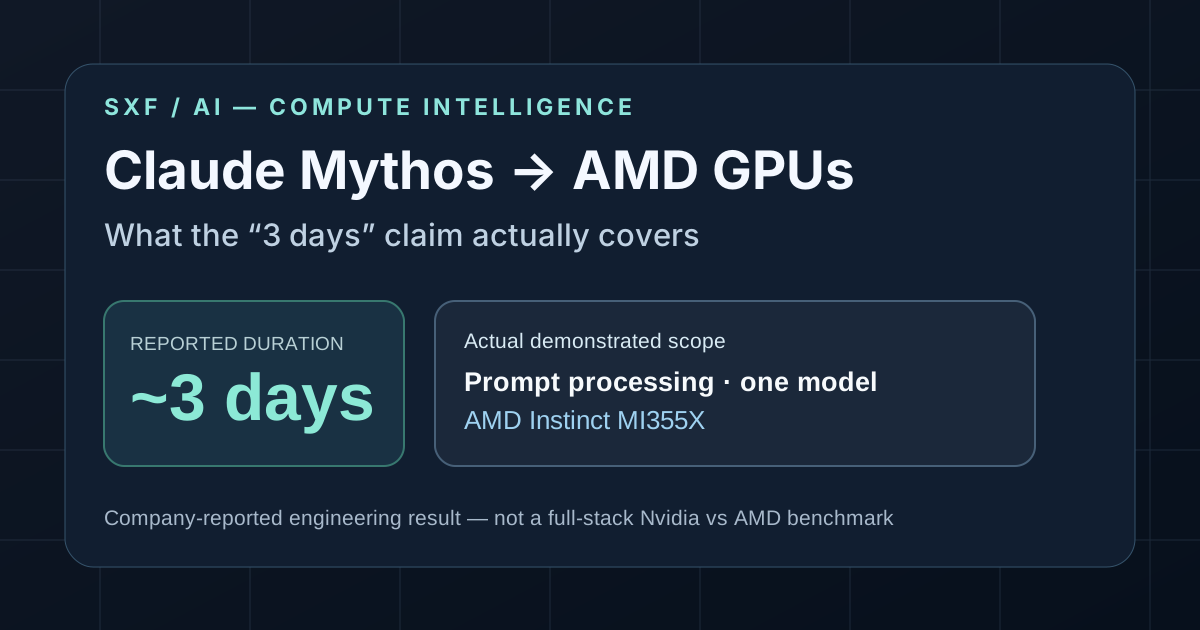
“Claude running on AMD in three days” is a shorthand. The roadshow footnote narrows it to prompt processing for one model on AMD MI355X. It does not establish that Anthropic moved all inference, training, serving, distributed communication and operations to AMD in that timeframe. View Anthropic's roadshow.
What did Claude Mythos actually achieve on AMD MI355X?
During the compute section of Anthropic's November 2026 IPO roadshow, co-founder and Chief Compute Officer Tom Brown described using Mythos to help the company bring up Claude on AMD GPUs. Brown said the model wrote or ported nearly all the relevant GPU kernels, with very little human intervention, in about three days. The presentation contrasted that with the months of engineering historically associated with onboarding a new accelerator platform.
The qualifying footnote matters more than the headline. Anthropic describes the three-day result as bringing up prompt processing for a single Anthropic model on AMD Instinct MI355X GPUs to a useful performance level. In inference, prompt processing (also called prefill) computes over input tokens before the model generates its answer token by token. That subsequent decode phase has different bottlenecks and is not shown by the footnote to have been migrated in three days.
The slide compares roughly three days with a traditional six-to-twelve-month bring-up estimate from Anthropic's experience. These are not identical measured scopes: the narrower prompt-processing exercise and the historical full-platform experience should not be presented as a validated 60-to-120-fold engineering speedup. The durations are Anthropic's own disclosure and have not been reproduced independently.
For the model-level background—including Mythos access, safeguards and benchmarks—see SXF's Claude Fable 5.2 versus Mythos 5.2 analysis. Anthropic's November 10 SEC registration amendment independently corroborates the company's multi-chip approach and faster onboarding thesis, without supplying a public three-day benchmark methodology.
Why AI-written GPU kernels matter more than a basic code translation
A GPU kernel is a low-level routine responsible for specific parallel calculations on an accelerator. In large-model inference, performance-critical work can involve matrix operations, attention, memory movement, data formats and device-specific scheduling. Merely compiling existing software for another chip does not guarantee useful throughput or acceptable latency. Teams typically need to profile bottlenecks, adapt kernels, validate numerical behavior and tune the system to an architecture's memory and compute characteristics.
Nvidia CUDA is both a programming model and a mature ecosystem of compilers, libraries, profiling tools and developer practices. AMD ROCm offers a separate open-source GPU computing stack, including HIP, libraries and tooling. Automated code generation may help developers implement or port kernels between target architectures, but it cannot by itself prove equality of the surrounding execution, communication and operational stacks. Nvidia's CUDA guide and AMD's ROCm documentation describe the respective ecosystems.
Anthropic has not published the generated kernel source, a reproducible benchmark harness, the testing budget, a kernel-level timing table or an independent audit for this example. Therefore, “almost 100% of the kernels” should be read as Brown's account of the work, not as a measured percentage of all code in Claude's inference stack.
Does the three-day port threaten Nvidia's CUDA moat?
Potentially at the software-porting margin, not automatically at the platform level. A switching cost is valuable to an incumbent when customers have spent years tuning workloads for one toolchain. If coding models can carry out more of that retargeting work, accelerator alternatives become easier to evaluate. This could give large buyers more credible options—and reduce the premium attached to the hardest-to-rewrite parts of a stack.
But Nvidia's advantage is wider than the cost of manually rewriting kernels. Customers also weigh GPU availability and supply, memory capacity and bandwidth, interconnects, collective communication, compiler maturity, debugging, security updates, scheduling, fleet reliability, supported frameworks and predictable performance at scale. A successful prefill prototype does not measure these factors.
| Question | What the evidence supports | Not established |
|---|---|---|
| Can AI assist low-level porting? | Anthropic reports extensive model-assisted kernel work for one workload. | Universally correct, fully autonomous porting across GPU families. |
| Can Claude run on AMD MI355X? | Anthropic reports useful prompt-processing bring-up on that GPU. | Complete full-model serving or training migrated in three days. |
| Is AMD faster or cheaper than Nvidia? | No comparative cost-performance result supplied for this exercise. | A like-for-like throughput, latency, energy or TCO winner. |
| Is CUDA lock-in ending? | One software migration barrier might be reduced. | Disappearance of CUDA libraries, tooling, network effects or Nvidia demand. |
The strongest interpretation is a testable change in the cost of portability. The weakest interpretation is an instant hardware winner or the end of CUDA. Neither the roadshow nor the registration statement claims that Nvidia hardware has been abandoned.
Anthropic's four-chip strategy: Nvidia, AMD, Google TPU and AWS Trainium
Anthropic's SEC S-1/A filing says it trains and serves Claude across four major accelerator families: AWS Trainium, Google TPUs, Nvidia GPUs and AMD GPUs. It describes a proprietary orchestration layer that routes workloads based on price and performance, and states that years of prior investment enable the company to onboard chip platforms faster.
That last point is essential context. The Mythos-assisted result did not start from an empty infrastructure environment: Anthropic already had multi-chip systems, scheduling, measurement processes and relationships with suppliers. Its results cannot automatically be generalized to a team without those capabilities. The company also discusses access to upcoming AMD Instinct MI450-series systems through separate commercial arrangements. The roadshow's particular three-day test names MI355X; the two chip references should not be confused.
On AMD's official specification page, an MI355X accelerator is listed with 288 GB HBM3E and up to 8 TB/s peak memory bandwidth. These are hardware specifications, not observed Claude performance in the cited Anthropic exercise. AMD MI355X specifications.
Read SXF's Anthropic IPO roadshow report for the financial filing timeline and the status of Anthropic's proposed stock offering. The GPU story is a technical claim within that broader investor presentation, not an independently certified hardware benchmark.
Five tests before claiming the CUDA switching barrier has collapsed
- Separate prefill from decode. Benchmark initial prompt processing and token-by-token output generation under realistic input/output length distributions.
- Verify numerical and task quality. Compare outputs, tolerances, long-context behavior and edge cases; a running kernel is not necessarily a correct kernel.
- Measure service-level economics. Report time to first token, steady-state throughput, p95/p99 latency, batch size, memory utilization, energy and total cost per completed request.
- Scale across devices and clusters. Include collective communication, parallelism, scheduling, failure recovery and sustained loads—not just one successful bring-up path.
- Publish reproducibility details. State model configuration, hardware, drivers, ROCm/CUDA versions, compiler settings, workload definitions, human engineering hours and a repeatable test suite.
A fair comparison would apply the same service-level target to both Nvidia and AMD, include software development and operations costs, and measure enough workloads to show whether the gains generalize. Until those results exist, conclusions about market-share displacement are speculative.
Evidence ledger: confirmed documents versus interpretation
Anthropic's investor roadshow is the primary source for Tom Brown's three-day story and the specific MI355X prompt-processing qualification. Original presentation.
The S-1/A describes four accelerator families, existing orchestration, new-chip onboarding improvements and supplier arrangements. It does not itself validate the three-day duration as an independent test. Official filing.
AMD MI355X hardware, ROCm and CUDA establish vendor-published specifications and architectures, not winner-take-all economics.
Reduced porting work could increase buyer flexibility; it does not establish reduced Nvidia market share, lower AMD total cost or collapsed CUDA ecosystem effects. Those outcomes require external measurements.
Frequently asked questions
Did Claude Mythos move all of Claude to AMD in three days?
No. Anthropic's footnote limits the timeframe to prompt processing for one Anthropic model on MI355X at a useful performance level. That is not evidence of a three-day full production migration.
Does the Mythos result make Nvidia CUDA obsolete?
No. AI-generated kernels may lower development friction, but the full CUDA moat includes software libraries, tools, distribution, operations and the hardware ecosystem. The demonstration measures none of those end to end.
What is prompt processing (prefill)?
It is the phase where the model processes the user's input tokens and sets up the initial attention state, before autoregressive decoding produces output tokens.
Was the AMD MI355X used, or the newer MI450 series?
The three-day roadshow footnote specifies AMD Instinct MI355X. Anthropic's filing also discusses AMD MI450-series access as part of its wider commercial strategy, a distinct reference.
Have independent researchers confirmed the three-day claim?
Not with a public reproducible benchmark or comprehensive technical audit as of November 13, 2026. The quoted timelines come from Anthropic's presentation and historical comparison.
Sources and editorial limitations
SXF reviewed the primary materials below on November 13, 2026. Statements attributed to Anthropic are company disclosures; hardware figures are AMD-published specifications. This article does not present independent lab tests, market forecasts, GPU purchase recommendations or investment advice.
- Anthropic — investor IPO roadshow, “Approach to compute” segment (Nov 2026).
- Anthropic — SEC Form S-1/A, Amendment No. 2 (filed Nov 10, 2026; multi-chip infrastructure discussion).
- Anthropic — proposed IPO roadshow announcement (Nov 10, 2026).
- AMD — Instinct MI355X official specifications.
- AMD — ROCm official documentation.
- Nvidia — CUDA Programming Guide.