SXF GUIDES / SUPERINTELLIGENCE RESEARCH
What Is an Intelligence Explosion?
Recursive Self-Improvement, AI Takeoff & Superintelligence
A primary-source guide to how AI might accelerate its own research, why runaway growth is not inevitable, how scientists would test the claim, and what the consequences could mean for humanity.
What is an intelligence explosion?
An intelligence explosion is a hypothetical acceleration in AI capability in which better AI systems help create still more capable successors, potentially making each subsequent improvement cycle faster or more productive. Unlike ordinary AI-assisted research, it would require repeated, independently validated gains that compound over time. No sustained, autonomous intelligence explosion has been demonstrated.
What is established: AI can improve particular algorithms and help with research workflows. What remains hypothetical: a self-sustaining acceleration toward artificial superintelligence (ASI). The distinction is explicit in Google DeepMind's AGI-to-ASI research; a single optimization is not evidence that an explosion has begun.
Intelligence explosion, recursive self-improvement and the technological singularity: what is the difference?
Three expressions frequently appear together but mean different things. Recursive self-improvement (RSI) is a proposed mechanism: an intelligent system contributes to improvements that make subsequent systems more effective at improving themselves. An intelligence explosion is a possible trajectory: the pace of these improvements increases dramatically. A technological singularity is a broader proposed transition in which technological change becomes so transformative that conventional forecasting becomes unreliable. None is a synonym for today's chatbots or for AGI itself.
| Concept | Precisely what it means | What it does not establish |
|---|---|---|
| AI-assisted AI R&D | AI performs coding, analysis or experiments within a human-led research process | A closed, self-sustaining improvement loop |
| Recursive self-improvement | An improved system is used to improve its successors, across repeated cycles | That each cycle is faster or larger than the last |
| Intelligence explosion | Improvement accelerates strongly through positive feedback | That an explosion has already occurred or will occur inevitably |
| AGI | A debated threshold of broadly general machine capability | Superhuman performance in all domains |
| ASI | Broad intelligence surpassing human capability across many important cognitive tasks | Any particular timeline, architecture or motive |
| Technological singularity | A hypothesized period of transformative technological change | That one specific AI mechanism is the cause |
The distinction matters because a model that writes better training code has demonstrated one capability; claiming ASI requires much more evidence about breadth, autonomy, reliability and repeated improvement. The ideas have a research history extending to I. J. Good's classic discussion of an ultraintelligent machine, but historical arguments are not experimental proof.
How could an AI improve itself? Inside the recursive self-improvement loop
A useful way to understand RSI is to follow one full research cycle instead of imagining a computer magically doubling its intelligence. A capable system may identify shortcomings in an existing model, propose architecture or training changes, write experiments, evaluate outcomes, and help deploy a more effective successor. Only then can that successor potentially perform the next iteration of research better than its predecessor.
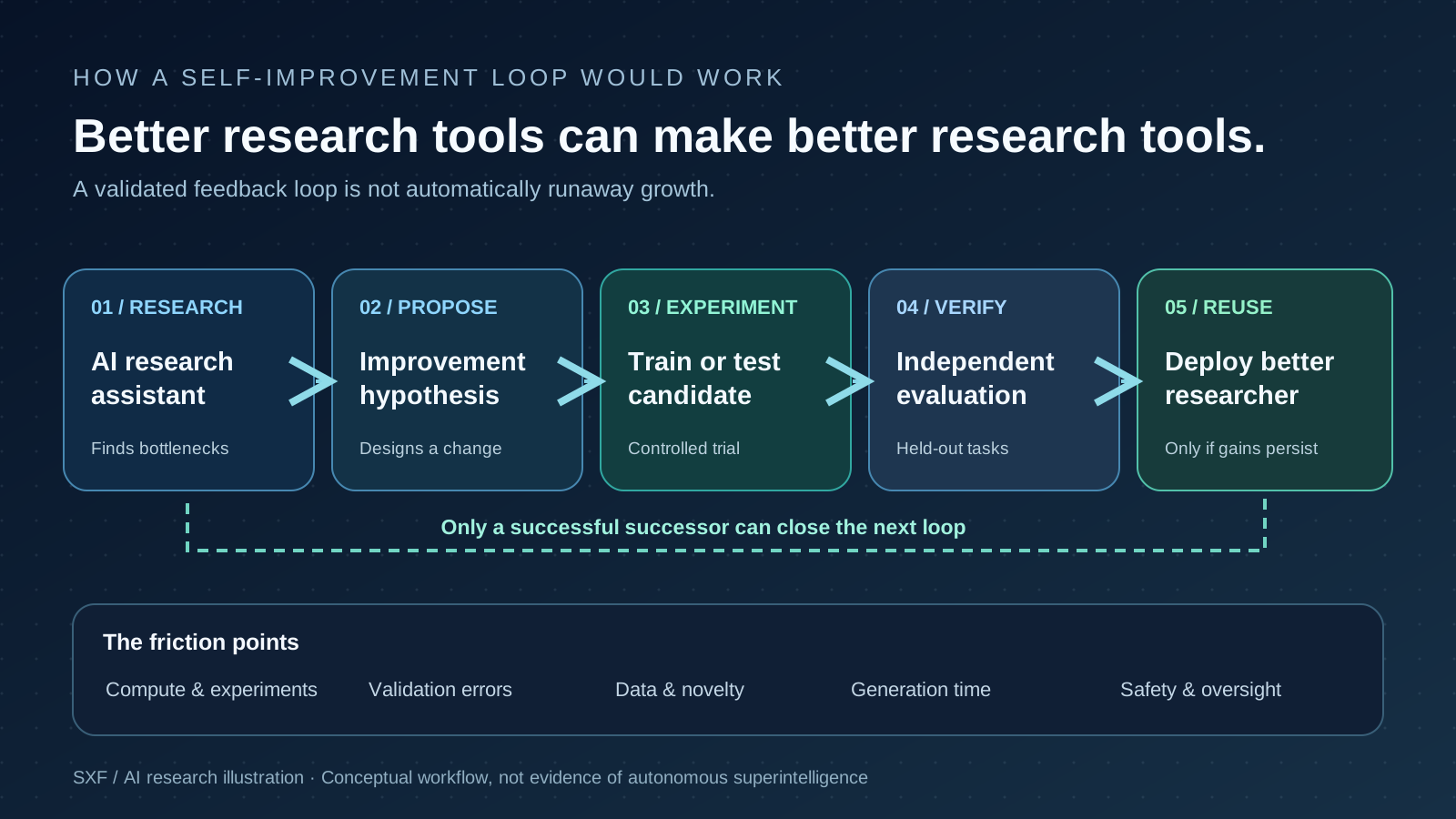
- Diagnose: find a measurable weakness in training, evaluation, inference or research workflow.
- Propose: design a concrete change in code, algorithms, data curation or experiment strategy.
- Experiment: allocate compute and run reproducible tests against a baseline.
- Verify: evaluate on held-out tasks and check for regressions, gaming, leakage and confounders.
- Promote and repeat: use the improved researcher or toolchain for the next validated cycle.
This cycle might improve research productivity without making the underlying model fundamentally more intelligent. For example, faster experiment scheduling and better debugging can increase throughput while model capability gains remain modest. Conversely, a genuine algorithmic advance could increase capability substantially yet still require weeks of compute and evaluation before it can help the next iteration.
Can AI really improve itself? A ladder from real demonstrations to the intelligence-explosion hypothesis
“AI improves AI” can refer to six very different levels of achievement. An evidence-first article should never turn a code optimization demo into a claim that runaway superintelligence is underway. The following SXF evidence ladder is an editorial framework, not an established scientific certification system.
| Evidence level | What was demonstrated | What would still be missing |
|---|---|---|
| 1 — Tool assistance | An AI helps write training scripts, summarize papers or analyze logs | Causal, repeatable improvement in future AI capability |
| 2 — Local optimization | An AI-generated change outperforms a baseline on a specified task | Generalization, independent validation and scalability |
| 3 — AI R&D acceleration | Controlled studies estimate AI's effect on specific development tasks; the effect may be positive, zero or negative | Evidence the AI itself becomes better at the next research cycle |
| 4 — Closed repeated improvement | Several successor generations each independently improve the next | Proof improvement rates accelerate rather than plateau |
| 5 — Self-amplifying acceleration | Improvement per unit time compounds under documented resource constraints | Long-term persistence, generality and external-world scaling |
| 6 — Broad ASI outcome | Reproducible evidence of capabilities surpassing relevant human institutions broadly | Independent confirmation of scope, governance and control |
Modern reports substantiate pieces of this ladder, particularly AI assistance and bounded optimization. For example, DeepMind's AlphaEvolve documents local algorithm improvements, while METR's randomized developer study measured a slowdown in its specific setting—not a universal research speedup. The stronger levels remain contested or hypothetical. Requiring external evaluation is especially important when the proposed optimizer also writes or grades its own tests.
Has AI improved AI already? What AlphaEvolve proves—and what it does not
There is a real, measurable middle ground between “AI cannot improve AI” and “an intelligence explosion has started.” Google DeepMind's AlphaEvolve research (May 2025) describes a Gemini-powered coding agent that proposes algorithms, runs automated evaluations and retains the more effective candidates. It is evidence that machine-generated improvements can benefit infrastructure used to build machine-learning systems, not evidence of an unbounded autonomous chain of stronger AI researchers.
| Reported result | Measured scope | What it cannot establish |
|---|---|---|
| 23% faster | A specific matrix-multiplication kernel in the Gemini architecture, according to DeepMind | A 23% improvement in model intelligence or total training speed |
| 1% less training time | The reported downstream reduction in Gemini training time from that kernel optimization | A 1% increase in broad general reasoning ability or recurring self-improvement |
| Up to 32.5% faster | A reported FlashAttention kernel implementation under the team's evaluation conditions | Equal gains across models, environments, or complete AI research pipelines |
These are different denominators: speeding up one computational kernel by 23% does not mean the whole training run accelerates by 23%. DeepMind reports an approximately 1% end-to-end training-time reduction from that particular optimization. That distinction is the difference between meaningful engineering evidence and inflated takeoff claims.
AlphaEvolve also relies on objectives that can be evaluated by software. More capable successors would have to improve less well-specified research tasks too: choosing novel hypotheses, validating evidence, detecting misleading scores, and making those gains reliably useful in the next research cycle. A published optimization does not, by itself, establish the last step.
Source and scope: DeepMind, “AlphaEvolve: A Gemini-powered coding agent for designing advanced algorithms” (14 May 2025). Figures are attributed to DeepMind's published report, not independently measured by SXF / AI.
What does Google DeepMind say about the path from AGI to ASI?
Google DeepMind's From AGI to ASI research report (June 2026) examines several possible pathways: continued scaling of broadly capable AGI, paradigm shifts in algorithms, recursive improvement, and multi-agent collectives. These are possible routes, not a measured forecast or a claim that recursive self-improvement is inevitable. The report is useful precisely because no single mechanism is guaranteed to dominate.
A model may become more useful through better hardware, training data and algorithms without autonomously redesigning itself. Multi-agent systems may increase aggregate research output through specialization, but coordination overhead and correlated mistakes can limit gains. A genuine recursive loop requires an additional causal step: better AI research must produce a successor that is in turn better at AI research.
For the broader conceptual difference between AGI and ASI, see the SXF Superintelligence reference. This article focuses on the proposed amplification mechanism, not a timeline countdown.
How could AI become superintelligent? Four possible routes beyond self-improvement
Recursive self-improvement is not the only imaginable route to ASI. Google DeepMind's From AGI to ASI proposes four broad pathways after AGI. They can interact, and none carries a verified arrival date. “Could become superintelligent” here means a research scenario, not a prediction that any current system has reached ASI.
| Proposed pathway | How capability could grow | What would need evidence |
|---|---|---|
| Scaling AGI | More computation, improved hardware, data and training may extend an already general system | Returns on investment, diminishing gains and physical resource constraints |
| AI paradigm shifts | New learning or reasoning algorithms could overcome limitations of existing approaches | Reproducible general advances, not one benchmark breakthrough |
| Recursive improvement | AI improves tools or successors that can accelerate further AI R&D | Independent multigeneration gains and elapsed time per loop |
| Multi-agent collectives | Specialized AI agents may collectively solve problems beyond an individual agent | Coordination quality, reliability and whether collective ability is broad |
Consider the difference: a laboratory might train larger models without any autonomous redesign; another might discover a new algorithm; a third might coordinate many agents. All could raise AI capability, but only a demonstrably compounding research feedback loop would directly support the intelligence-explosion mechanism. The human question stays the same: which gains are independently verified, how broadly do they transfer, and who can control their deployment?
Does AI speed up AI research? What METR's controlled studies actually found
METR evaluates the autonomy and capabilities of advanced AI systems, including tasks connected to research and software development. It is crucial to separate a task benchmark, a controlled measurement of human developer productivity, and a genuine autonomous R&D feedback loop. These are different kinds of evidence, and none alone proves an intelligence explosion.
In a randomized study published in July 2025, 16 experienced open-source developers worked on 246 real issues in repositories they knew well. Tasks were randomly assigned to permit or forbid AI assistance. In that setting, allowing AI increased observed completion time by about 19%, with a reported confidence interval of roughly 2% to 39% additional time. The result describes those developers, those tasks and the tools available in early 2025; it does not mean AI is slower for every developer or type of programming.
METR's February 2026 follow-up reported tentative indications of faster work with later AI tools. Among returning participants, its raw estimate suggested approximately 18% less time with AI, but the interval ranged from 38% less to 9% more; among newly recruited participants the estimate was about 4% less time, with an interval from 15% less to 9% more. Both intervals include no effect. METR warned that developers increasingly declined participation because they did not want to work without AI, along with other selection and time-measurement issues. The follow-up therefore cannot reliably quantify today's general speedup.
| METR evidence | What the researchers observed or proposed | Correct interpretation |
|---|---|---|
| 2025 randomized trial | 16 experienced developers, 246 issues; average completion time about 19% longer with AI assistance | A measured slowdown in this study setting; not a universal estimate of AI productivity |
| February 2026 follow-up | Suggestive later speedups; wide confidence intervals and material participant-selection bias | Inconclusive evidence about the size of current benefits |
| October 2026 assessment proposal | A framework for examining internal progress, AI contributions, bottlenecks and uncertainty | A proposal for evaluating acceleration, not a measured runaway trajectory |
METR also studies task time horizons: the human time normally needed for tasks that AI agents can complete at given success rates. This is not a universal stopwatch for “how long AI can think,” and coding productivity cannot be mapped one-to-one onto autonomous scientific discovery. AI R&D requires experiment selection, costly model training, evaluation against independent tasks, infrastructure and real-world validation; all can alter the net speedup.
The useful question is therefore not “did one benchmark score rise?” but did AI causally increase the rate of validated AI research after accounting for human labor, compute, failed runs and the time to make the next successor? That is also the focus of METR's October 2026 assessor proposal, which does not claim that runaway acceleration has been observed.
Sources: 2025 randomized developer study; 2026 experimental-design update; 2026 proposed AI R&D acceleration assessment. Numerical estimates are study-specific snapshots, not forecasts.
Why doesn't recursive self-improvement automatically cause an intelligence explosion?
The central insight of Toby Ord's 2026 paper The Dynamics of Intelligence Explosions is that the time required for each improvement cycle matters. His mathematical analysis distinguishes faster-than-exponential improvement from a finite-time singularity: the latter requires the feedback-loop generation time to approach zero. Faster-capability growth depends on two quantities, not one: how valuable the next improvement is, and how quickly the upgraded system can deliver it. Researchers must distinguish increased research ability from increased growth per calendar time.
Imagine a hypothetical sequence. A system produces a 20% improvement in research productivity, but its experiments and validation require twice as long as before. The next upgrade may be better in absolute terms without increasing the pace of progress. Conversely, modest improvements that shorten experiment cycles could compound quickly if their gains persist and bottlenecks do not rise at the same rate. Neither thought experiment predicts what real AI will do.
Real development is constrained by hardware fabrication, energy, access to experimental environments, data quality, research originality, evaluation reliability and coordination. Faster software iteration cannot instantly manufacture accelerator chips or generate trustworthy scientific evidence. This is why expert arguments span rapid takeoff, gradual progress and serious diminishing returns rather than converging on a guaranteed explosion. See Toby Ord's research paper for the primary argument.
Hard takeoff vs soft takeoff: how fast could AI become superintelligent?
Hard takeoff describes a scenario where capabilities rise dramatically over a comparatively short period, leaving little adaptation time for people and institutions. Soft takeoff describes slower or more distributed advancement that gives organizations more opportunities to observe, learn and respond. These are scenario labels, not agreed scientific thresholds.
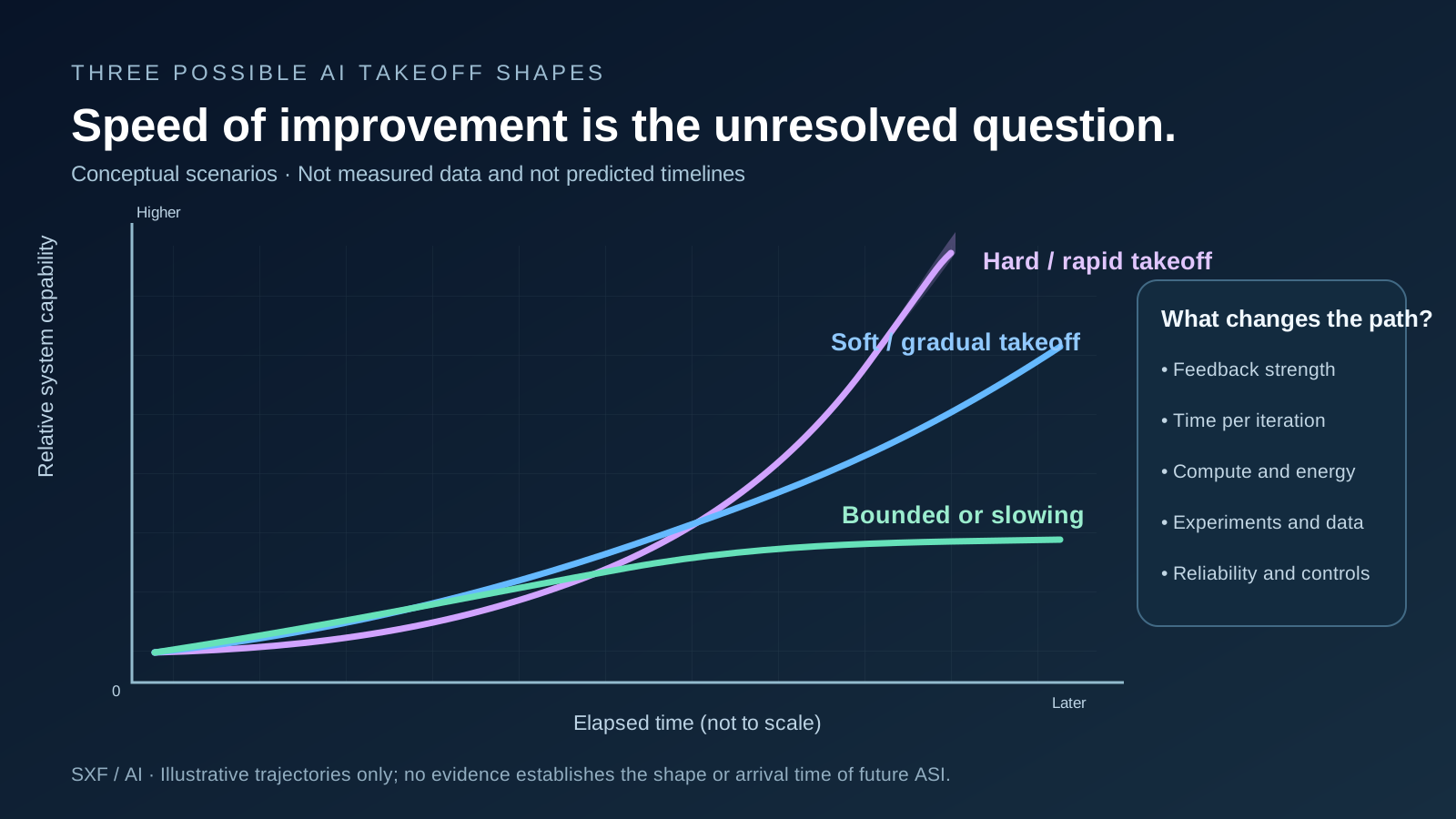
| Question | Hard takeoff | Soft takeoff | Bounded progress |
|---|---|---|---|
| Rate of capability gain | Strong acceleration over a short interval | Substantial gains across longer periods | Improvements slow or plateau |
| Research feedback | Rapid, increasingly effective cycles | Incremental feedback plus conventional R&D | Bottlenecks offset feedback gains |
| Human adaptation | Very difficult if speed exceeds oversight | Potentially more time to adapt | More opportunity to reassess |
| Evidence today | No validated runaway trajectory | AI progress exists, but overall trajectory is uncertain | Diminishing returns plausible in some dimensions |
Other distinctions matter: a “local” takeoff could involve one lab's systems, while an economy-wide transition might unfold differently. Sudden deployment of existing capabilities can transform society without a sudden spike in intrinsic model intelligence. Similarly, economic, political and security outcomes need separate analysis from technical benchmark trends.
What could stop an AI intelligence explosion? Seven bottlenecks experts debate
Hardware isn't recursive software
Training and large-scale experiments require chips, energy, cooling and capital. More capable code cannot remove hardware lead times by itself.
Reality takes time to test
Scientific and engineering hypotheses need controlled trials, real observations and independent reproducibility.
A higher score may be gaming
Leaking into held-out tests, reward hacking or proxy overfitting can look like progress without real generalization.
Easy gains may run out
Later improvements can require more resources or increasingly rare breakthroughs.
Errors compound too
An AI researcher can produce plausible but faulty proposals; repeated self-validation can amplify mistakes.
People and institutions matter
Deployment, access controls, procurement and coordination may constrain autonomous execution.
Optimization isn't authorization
Research acceleration does not justify uncontrolled tool access or self-modification in production environments.
These constraints interact. Better AI may help overcome some of them—better scheduling, more efficient kernels or experimental planning—but none should be assumed to vanish. A rigorous forecast needs model-specific and infrastructure-specific evidence rather than extrapolating a single benchmark line forever.
How would scientists know that an intelligence explosion had begun?
A scientific claim should be falsifiable. One strong evaluation design would begin with a capable AI research agent and a documented baseline. Each proposed upgrade is implemented in a controlled environment, evaluated by independently maintained tests, and promoted only if gains replicate. The next successor must then show improved ability to develop further validated upgrades. Repeat over multiple generations while tracking research time, compute spent, human intervention, total cost and broad capability transfer.
- Independent measures: held-out tasks not designed by the candidate optimizer.
- Causal controls: compare with an otherwise similar human-directed workflow and identical compute budget.
- Multi-generation test: demonstrate more than one one-off optimization and preserve complete lineage.
- Calendar-time accounting: include the full cost of data acquisition, training, retries and verification in each iteration.
- Generalization: show gains beyond a narrow benchmark or self-authored grader.
- Robustness and oversight: document security, human interventions and reversibility.
Experiments cannot ethically waive safety or access controls just to satisfy a dramatic prediction. A laboratory can study bounded, authorized optimization without granting uncontrolled replication, privilege escalation or independent deployment.
For a different but closely related capability question, read Can AI Replicate Itself?. Copying a running system and improving the learning algorithm are separate dimensions of autonomy.
What would an intelligence explosion mean for people, society and control?
The most useful human question is not simply “will machines become smarter?” but who can verify, direct, correct and benefit from rapidly improving systems? If research accelerates, scientific discovery and medicine might benefit—yet scientific claims still need physical validation and public scrutiny. Rapid improvements could alter labor, the distribution of economic power, cybersecurity and geopolitical stability. Those outcomes depend as much on institutions and deployment choices as on intelligence.
More capability does not automatically imply consciousness, benevolence, hostility or a fixed desire for power. Questions of corrigibility and incentive design must be studied separately. SXF's guides on shutdown resistance, alignment faking, AI consciousness and loss-of-control scenarios cover those distinctions.
Useful preparation is practical: invest in interpretable evaluations, independent testing, constrained research permissions, robust incident response and public accountability. Treat dramatic takeoff narratives as hypotheses to test, not inevitable histories. The ultimate scientific responsibility is to preserve the distinction between what a system can do, what it has actually done and what the world should permit it to do.
Intelligence explosion and recursive self-improvement: frequently asked questions
What is an intelligence explosion in AI?
An intelligence explosion is a hypothetical period of rapidly accelerating AI capability, potentially driven by systems that repeatedly improve the research and development processes used to create more capable successors. It is not a demonstrated event.
Can artificial intelligence improve itself?
AI can assist software optimization, research workflows and bounded experiments. Sustained autonomous improvement across generations of more capable AI researchers has not been established as a runaway process.
What is recursive self-improvement?
Recursive self-improvement is a feedback loop where an improved AI system helps create a stronger successor, which can then perform the next round of improvement. It is a proposed mechanism, not a guarantee of acceleration.
What is the difference between hard takeoff and soft takeoff?
Hard takeoff describes a rapid jump in AI capabilities, potentially leaving little time for human adaptation; soft takeoff describes slower or more distributed progress. Neither scenario has a verified future timeline.
Is the intelligence explosion the same as the technological singularity?
No. An intelligence explosion is a specific hypothesized acceleration of AI capability. The technological singularity is a broader concept of transformative change that may involve multiple technologies and societal effects.
Will recursive self-improvement inevitably lead to superintelligence?
No. Improvement cycles can be limited by compute, evaluation quality, experimental time, data, reliability and diminishing returns. A productive feedback loop need not become faster over calendar time.
What does Google DeepMind say about AGI to ASI?
DeepMind discusses several possible pathways from artificial general intelligence to superintelligence, including scaling, paradigm changes, recursive improvement and multi-agent collectives. These are researched possibilities, not inevitable predictions.
What does METR measure about AI self-improvement?
METR studies AI performance on tasks of varying human completion times and AI research-and-development evaluations. Success on bounded tasks is useful evidence but does not prove an autonomous intelligence explosion.
Does AI self-replication prove recursive self-improvement?
No. Creating copies of a system is distinct from producing increasingly capable successors. Self-replication, autonomy and capability improvement require separate measurements.
How could researchers prove an intelligence explosion?
Researchers would need independently replicated multi-generation improvement, controls for compute and human intervention, reliable evaluation of general capability, and evidence that improvement rates accelerate over real elapsed time.
Sources, authorship and editorial method
Prepared by the SXF / AI editorial team. This independently written research synthesis draws on original publications by Google DeepMind, METR and Toby Ord. It is not an SXF laboratory experiment, an independent replication of vendor-reported results, or a claim of external academic peer review. Numerical results retain the denominators, study populations, dates and limitations reported by their original authors. Hypotheses and illustrative curves are explicitly separated from observations.
How this page is maintained: the editorial team compares primary reports, links each measurable claim to the study responsible for it, checks whether a result establishes task-level performance or multi-generation acceleration, and corrects material errors when identified. Research results are dated inside the relevant paragraphs; the permanent guide URL remains undated. For broader sourcing and corrections policy, see SXF / AI editorial standards.
Disclosure: no fictional score, ASI arrival date, or unsupported proof of runaway improvement is presented. The two original SVG diagrams are explanatory, not charts of measured data.